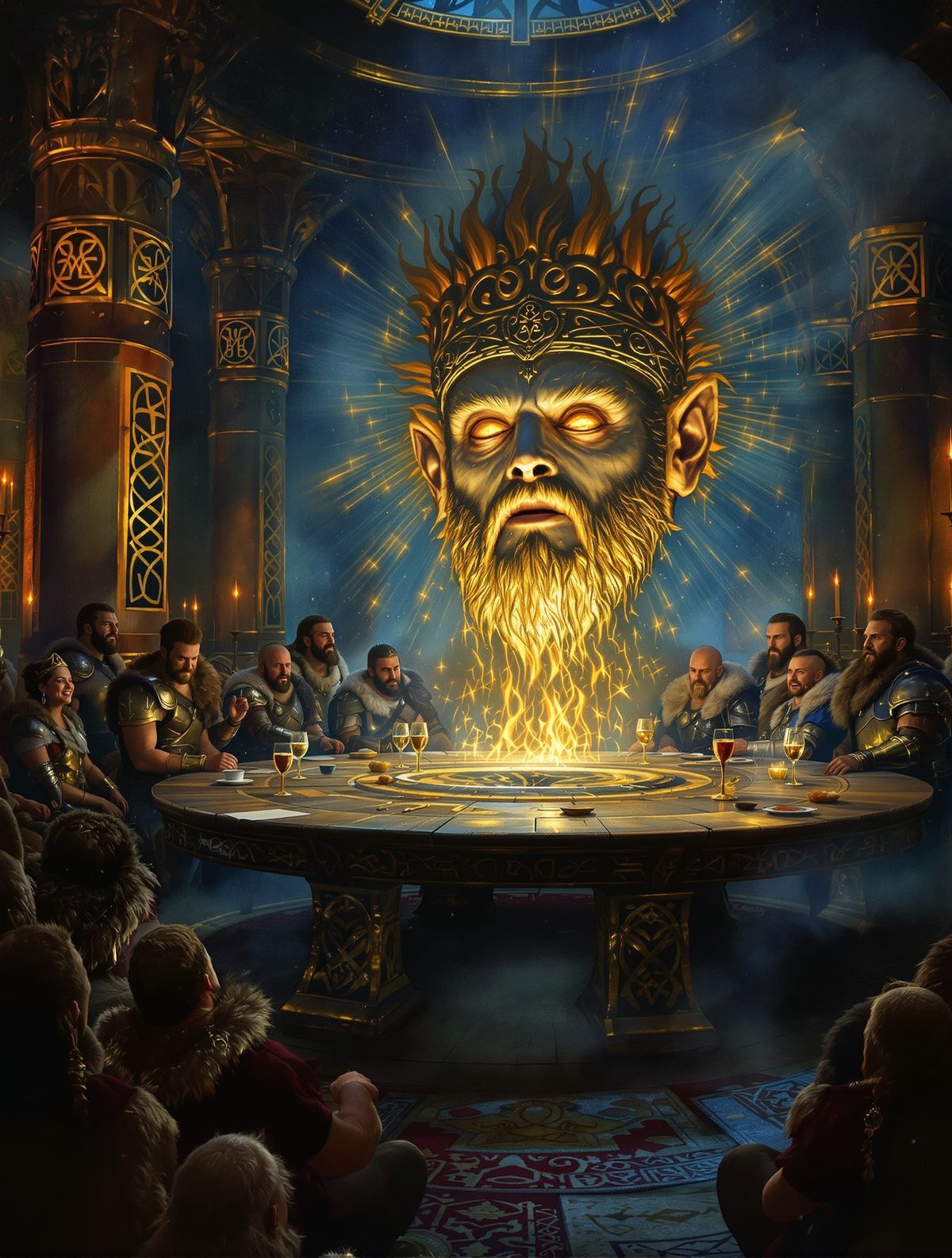
Picture this: you're sitting at a magnificent feast, the table groaning under the weight of golden platters and jeweled goblets. Laughter echoes through the hall as your companions share tales of old battles and forgotten loves. At the head of the table sits your beloved king, regaling you with stories that seem to stretch into eternity itself. There's just one small detail that might unsettle modern dinner guests—your king's head has been severed from his body for the better part of a century.
Welcome to the most extraordinary dinner party in Celtic mythology, where death was merely a minor inconvenience and conversation flowed as freely as the wine. This is the legend of Bran the Blessed, the giant king whose severed head became the ultimate party host, entertaining his loyal warriors for eighty-seven years in a feast that defied every law of nature—and good taste.
The Giant King Who Walked Across the Irish Sea
Bendigeidfran, known to his friends as Bran the Blessed, wasn't your average medieval monarch. Standing so tall that no house could contain him and no ship could carry him, this giant king of Britain ruled from his court in Wales with wisdom that matched his impossible stature. When ancient scribes recorded his legend in the Mabinogion—that treasure trove of Welsh mythology compiled in the 12th and 13th centuries—they described a ruler so massive he could wade across the Irish Sea as if it were a shallow stream.
But Bran's size was nothing compared to the magnitude of the disaster that would define his legacy. It all began, as these stories often do, with family drama of epic proportions. When his sister Branwen married Matholwch, the King of Ireland, it should have been a union that brought peace between two lands. Instead, it sparked a war that would drench Ireland in blood and transform a living king into the most talkative corpse in Celtic history.
The trouble started when Bran's hot-headed half-brother Efnysien, in a fit of rage over not being consulted about the marriage, mutilated Matholwch's horses. Though Bran tried to make amends with generous gifts—including a magical cauldron that could resurrect the dead—the Irish king's wounded pride festered like an untreated wound. Back in Ireland, Matholwch took his humiliation out on Branwen, banishing her to the kitchens where she was beaten daily by the palace butcher.
When Ravens Carried Royal Mail
Here's where the story takes a turn that would make even the most creative intelligence agency jealous. Branwen, resourceful as she was desperate, trained a starling to carry a message across the Irish Sea to her giant brother. Imagine the bird's surprise at delivering its tiny scroll to a king whose finger was probably larger than most men's arms.
Bran's fury upon learning of his sister's treatment was as enormous as his frame. He assembled the largest army Britain had ever seen and began his march to Ireland. Since no ship could bear his weight, Bran simply walked through the sea, his head towering above the waves like a mobile mountain. His fleet followed in his wake, protected by his massive form from the worst of the ocean's fury.
The Irish, spotting what appeared to be a moving forest on the horizon, initially mistook Bran's approaching fleet for a floating woodland. When they realized the "forest" was actually the massed spears of a British army led by a giant who used the sea as a footpath, panic swept through Matholwch's court faster than wildfire through dry grass.
The Cauldron of Resurrection and Ireland's Bloodiest Day
The ensuing battle would earn its place as the bloodiest conflict in Celtic mythology, thanks in no small part to the very gift Bran had given to secure peace. The magical cauldron—Pair Dadeni in Welsh—could restore life to any warrior placed within it, though the resurrected fighters returned mute, their voices claimed as payment for their second chance at life.
Picture the horror of that battlefield: British warriors would cut down their Irish foes, only to watch them rise again from the cauldron, silent and implacable as death itself. The tide of battle swayed back and forth like a deadly dance, with the dead refusing to stay buried. It was Efnysien, the very man whose actions had sparked this catastrophe, who finally turned the tide. In an act of desperate redemption, he hid among the Irish dead and allowed himself to be thrown into the cauldron, then stretched himself until both his heart and the magical vessel burst.
Victory came at a price that would haunt the survivors forever. Of Bran's mighty army, only seven warriors remained alive. The giant king himself lay dying, mortally wounded by a poisoned spear that had found its mark despite his tremendous size. As his life ebbed away on Irish soil, Bran gave his faithful companions the most bizarre final command in military history.
The Talking Head's Eternal Feast
"Cut off my head," the dying king instructed his seven surviving warriors, "and carry it with you to London. Bury it on the White Hill with its face toward France, and it will protect Britain from invasion." But here's the kicker—the journey would take exactly eighty-seven years, during which time his severed head would remain as lively and talkative as ever.
What followed was perhaps the most surreal road trip in mythological history. The seven warriors—Pryderi, Manawyddan, Glifieu, Taliesin, Ynawag, Grudyen, and Heilyn—along with the rescued Branwen, began their epic journey home with their king's head carefully wrapped and carried like the world's most precious cargo.
Their first stop was Harlech, where they remained for seven years in a state of suspended bliss. The head of Bran held court as if nothing had changed, regaling his companions with tales, songs, and wisdom while they feasted in a hall where time seemed to move differently. Branwen, however, could not bear the joy that felt so hollow after witnessing the destruction of two kingdoms for her sake. She died of a broken heart, and her grave became the first of many monuments to the war's terrible cost.
The Island Where Time Forgot to Pass
After burying Branwen, the seven warriors and their talkative cargo moved on to Gwales, a mystical island off the coast of Pembrokeshire. Here, in a hall with three doors, they would spend eighty years in what the Welsh called the "Assembly of the Noble Head." Two doors they could open freely, but the third—the one facing Cornwall—must remain forever sealed.
For eight decades, this was paradise found. Bran's head, still possessing all the charisma and wisdom that had made him a beloved king, held court each day as if he were merely taking a brief rest between royal duties. The warriors never aged, never sickened, never even felt the passage of time. They existed in a bubble of eternal contentment, sustained by their king's presence and protected from the sorrows of the world beyond their magical hall.
The conversations that must have taken place in that hall over eighty years! Imagine the stories shared, the songs sung, the philosophical discussions that unfolded while outside the sealed chamber, generations lived and died. Bran's head became the ultimate raconteur, a fountainhead of entertainment that never ran dry. His companions wanted for nothing in this timeless sanctuary where grief and aging held no power.
When Paradise Ends with a Door
All perfect things must end, and this eternal feast met its doom through simple human curiosity. Heilyn, after eight decades of wondering what lay beyond that forbidden door, finally could resist no longer. "Shame on my beard," he declared, "if I don't open that door and see if what they say about it is true."
The moment the door swung open, reality crashed back into their protected world like a tsunami of memory and loss. Suddenly, they remembered every horror they had witnessed, every friend they had lost, every drop of blood spilled in that terrible war. The weight of eighty years pressed down upon them in an instant, and even Bran's head fell silent, its magical animation finally broken by the return of mortal awareness.
The surviving warriors gathered up their now-silent king and completed their journey to London, where they buried the head on the White Hill—the site where the Tower of London would later stand. Legend claims that as long as Bran's head remained in its resting place, Britain would never fall to foreign invasion. Some say King Arthur later dug up the head, declaring that Britain should depend on his strength alone, not on ancient magic.
The Head That Speaks Across Time
Why does this bizarre tale of a talking head and an eighty-seven-year dinner party continue to captivate us more than eight centuries after it was first written down? Perhaps because it speaks to our deepest fears and desires about death, memory, and the relationships that define our lives.
In our age of digital immortality, where our social media posts outlive us and AI might someday simulate our voices long after we're gone, Bran's living head feels less like fantasy and more like prophecy. We too seek ways to cheat death, to extend meaningful connection beyond the grave, to preserve the essence of who we are in forms that can continue to comfort those we leave behind.
The story also explores the seductive danger of refusing to face grief. Those eighty years of perfect happiness came at the cost of engagement with the real world. Sometimes, the tale suggests, we must open the door that leads back to sorrow if we want to truly live—or in this case, to truly die and find peace.
Most profoundly, Bran's tale reminds us that the most powerful magic isn't the resurrection cauldron or the timeless feast—it's the simple act of gathering around a table to share stories with those we love. In the end, that's all his warriors really needed: their king's voice, spinning tales that made them forget their troubles and remember who they were. That's magic we can all conjure, no severed heads required.