Picture this: You're a revered sage with the power to curse gods into oblivion, and you've just been handed the ultimate theological question—which of the three supreme deities truly deserves humanity's devotion? Your testing method? Walk up to each god and deliver the most outrageous insult imaginable. For the great sage Bhrigu, this wasn't just a thought experiment—it was a divine mission that would culminate in one of the most shocking moments in Hindu mythology: a mortal man kicking a sleeping god square in the chest.
What happened next would forever change how millions understood the nature of true divinity, humility, and the surprising power of restraint over retaliation.
The Cosmic Question That Started It All
The story begins in the ancient text known as the Padma Purana, one of eighteen major Puranic texts that form the backbone of Hindu religious literature. According to these sacred writings, a great assembly of sages had gathered at the banks of the holy river Saraswati—a congregation so significant that it would make any modern religious summit pale in comparison. These weren't ordinary holy men; they were rishis and maharishis, beings who had achieved such spiritual heights that they could literally reshape reality with their thoughts.
The burning question that had brought them together was both simple and impossibly complex: among Brahma the Creator, Vishnu the Preserver, and Shiva the Destroyer—the trinity known as the Trimurti—which god was most worthy of receiving the highest form of devotion called Sattvika worship?
It was Sage Bhrigu who volunteered to find the answer. Now, Bhrigu wasn't just any sage—he was one of the legendary Saptarishis (seven sages), a mind-born son of Brahma himself, and possessed such spiritual power that even gods trembled before his potential wrath. His plan was elegantly simple and utterly audacious: he would test each deity's reaction to the ultimate insult and see who demonstrated the most divine qualities in response.
The Creator's Rage: Testing Brahma
Bhrigu's first stop was Satyaloka, the highest realm of existence where Brahma, the four-faced creator of the universe, resided in cosmic meditation. The very air of this realm vibrated with the primordial sound of creation—the eternal Om that had birthed reality itself.
When Bhrigu arrived at Brahma's court, he committed an act so shocking that it still reverberates through Hindu consciousness today: he deliberately refused to show any reverence to the Creator. No prostrations, no folded hands, no respectful words—nothing but cold, calculated disrespect. In a culture where showing proper respect to elders and superiors wasn't just courtesy but cosmic law, this was equivalent to spitting in the face of existence itself.
Brahma's reaction was swift and terrible. The Creator's divine composure shattered like glass, his four faces flushing with rage that made the stars themselves tremble. How dare this mortal, even if he was a great sage, show such audacity? Brahma's anger was so intense that cosmic fires began to manifest around him, threatening to reduce Bhrigu to ash.
But here's what makes this story fascinating: Bhrigu wasn't intimidated. He had found his answer about Brahma. A truly supreme deity, he reasoned, wouldn't be so easily provoked by mortal behavior. The Creator had failed the first test.
The Destroyer's Fury: Confronting Shiva
Undeterred, Bhrigu next journeyed to Kailasa, the mystical mountain peak where Lord Shiva dwelt with his consort Parvati. If you've ever seen artistic depictions of Kailasa, you know it's portrayed as a realm of impossible beauty—crystalline peaks touching the heavens, celestial beings dancing in eternal bliss, and the very embodiment of transcendence made manifest.
Shiva, the great ascetic who had spent eons in meditation, was engaged in cosmic dance when Bhrigu arrived. But instead of waiting respectfully for an audience—as protocol demanded when approaching the Lord of Destruction—Bhrigu committed an even greater breach of etiquette. He interrupted Shiva mid-meditation and again showed deliberate disrespect.
The result was cataclysmic. Shiva's third eye—the eye of destruction that could reduce entire universes to ash—began to open. The temperature around Kailasa spiked to levels that could melt mountains. Shiva reached for his trident, the weapon that could pierce through the very fabric of reality. The Lord of Destruction was about to live up to his name.
Only the intervention of Parvati, Shiva's wise consort, prevented cosmic annihilation. She calmed her husband and reminded him that destroying a sage—even an impudent one—would have consequences that could unravel the cosmic order. Shiva reluctantly controlled his rage, but the damage was done in Bhrigu's mind. The Destroyer, like the Creator, had failed the test of supreme divine temperament.
The Ultimate Test: Kicking God
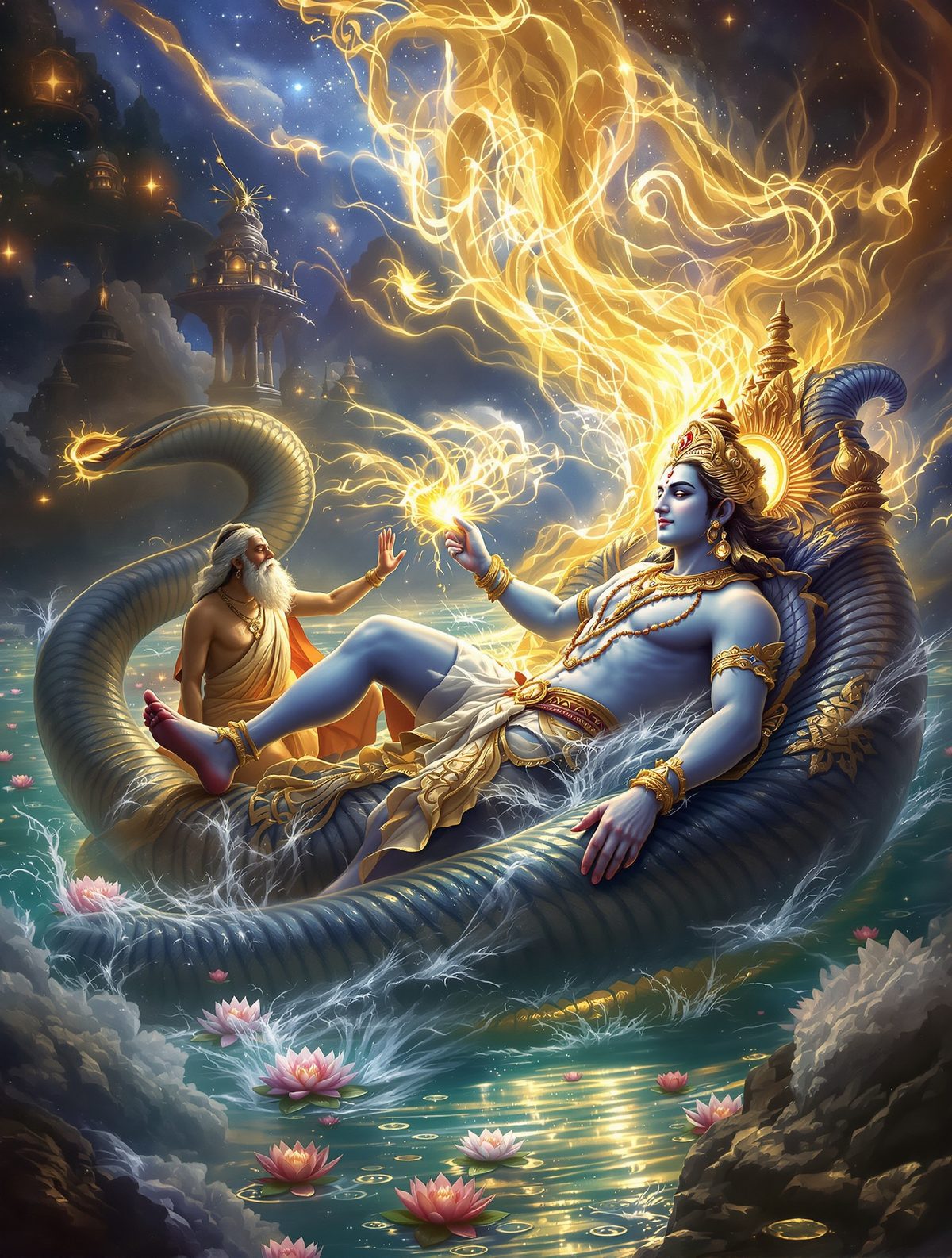
Bhrigu's final destination was Vaikuntha, the eternal realm where Vishnu, the Preserver of the universe, resided with his consort Lakshmi. What Bhrigu found there was a scene of perfect tranquility—Vishnu was resting peacefully, his head in Lakshmi's lap, in a state that mystics call yoga nidra—yogic sleep, where consciousness remains aware even while the body rests.
Now here's where the story takes its most shocking turn. Instead of simply showing disrespect through words or gestures, Bhrigu decided to deliver the ultimate insult to divinity itself. He walked up to the sleeping Vishnu and kicked him directly in the chest—right where the divine mark called the Srivatsa adorned the god's heart.
Imagine the audacity of this moment: a mortal being delivering a physical assault to the god who maintains the balance of the entire universe. In any other mythological tradition, this would be the moment where divine retribution would reduce the offender to less than dust.
But Vishnu's reaction was something that nobody—not even Bhrigu himself—could have predicted.
The Response That Changed Everything
Vishnu awoke not with anger, but with gentle concern. Instead of unleashing divine wrath, he sat up and said something extraordinary: "Oh, great sage, your foot must be hurting from kicking my hard chest." Then, in a gesture that redefined the very concept of divinity, Vishnu began massaging Bhrigu's foot.
But the story doesn't end there. Vishnu went further, saying, "Your feet are soft, and my chest is like a rock. I'm worried that your foot might be injured. Please forgive me for causing you discomfort." He then pressed Bhrigu's feet to his chest and declared, "From now on, let the touch of your feet become a permanent mark on my chest, adorning me forever."
This is why, according to tradition, Vishnu's chest bears the mark called Srivatsa—it's said to be the eternal imprint of Bhrigu's foot, worn by the god not as a reminder of insult, but as a badge of divine humility.
Lakshmi, however, had a different reaction. Witnessing a sage kick her husband filled her with such indignation that she prepared to curse Bhrigu. But Vishnu calmed her too, explaining that the sage was testing divine nature, and his test had revealed the highest truth about divinity—that true power lies in compassion, not in the ability to destroy.
The Wisdom That Echoes Through Time
Bhrigu returned to the assembly of sages with his answer: Vishnu alone possessed the divine quality of Sattvam—perfect balance, compassion, and freedom from ego. While Brahma had shown pride and Shiva had demonstrated anger, Vishnu had responded to insult with kindness, to attack with healing, and to disrespect with love.
But here's the deeper lesson that makes this 2,000-year-old story remarkably relevant today: in our age of instant retaliation—whether on social media, in politics, or in personal relationships—the tale of Bhrigu's kick reminds us that the most profound strength often lies in restraint. The story suggests that true leadership, true divinity, and perhaps true humanity itself, is measured not by our capacity to strike back when wronged, but by our ability to respond with understanding and grace.
In a world where showing weakness is often feared more than showing cruelty, the image of the all-powerful Vishnu massaging his attacker's foot offers a revolutionary definition of strength—one that transforms enemies into devotees not through force, but through an almost incomprehensible level of compassion.
The great sage Bhrigu's test revealed a truth that transcends religious boundaries: the gods we choose to worship reflect the kind of people we choose to become. And sometimes, the most divine response to a kick in the chest is to worry about the foot that delivered it.