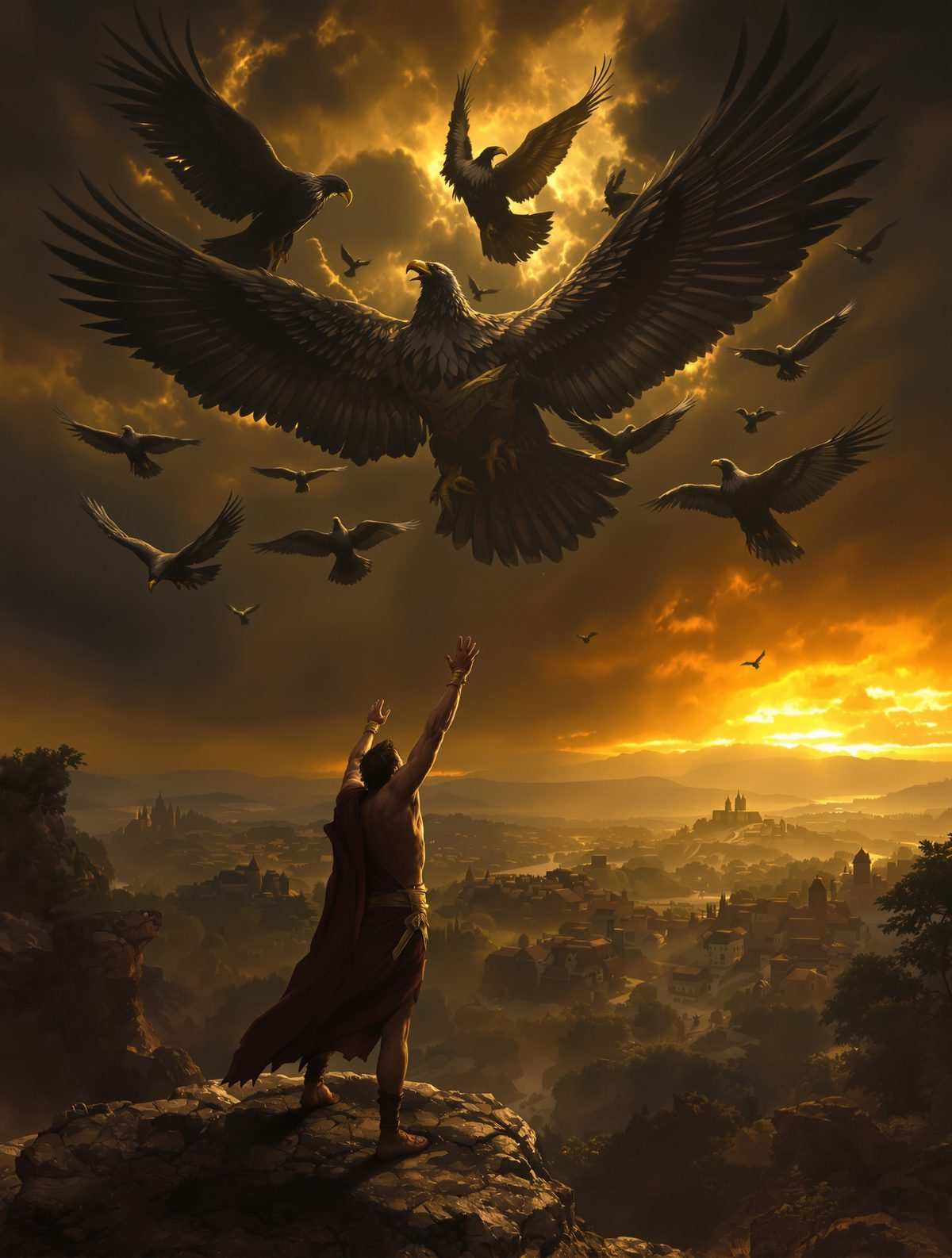
In the pale light of dawn on April 21, 753 BCE, two brothers stood on opposite hills overlooking the Tiber River, their eyes scanning the empty sky. The fate of what would become history's greatest empire hung in the balance, waiting for a sign from the gods themselves. Romulus gripped his augur's staff on the Palatine Hill while his twin brother Remus did the same on the Aventine. They had agreed to let the divine birds of Jupiter decide which of them would rule their new city. What happened next would echo through twenty-seven centuries of human civilization.
But this wasn't just a simple contest between siblings. This was a moment when mythology, politics, and raw human ambition collided with such force that the very ground beneath Rome would be forever stained with the blood of kinship.
The Sacred Art of Reading Heaven's Will
To understand the gravity of what Romulus and Remus were attempting, we must first grasp the profound significance of augury in ancient Italian culture. The practice of interpreting divine will through bird behavior wasn't mere superstition—it was the cornerstone of legitimate rule, imported from the mysterious Etruscan civilization that dominated central Italy.
The Etruscans had developed an intricate science of divination that mapped the heavens into sixteen sacred regions, each governed by different deities. Augures—the priest-diviners who practiced this art—could read everything from the flight patterns of birds to the sound of their calls, the direction they came from, and even their species. Vultures held special significance because they were sacred to Mars, the god of war, and their appearance was considered an omen of great military fortune.
What many don't realize is that augury wasn't just about predicting the future—it was about legitimizing power. No major decision in early Rome, from declaring war to founding cities, could proceed without proper divine approval. The twins weren't just competing for bragging rights; they were seeking the gods' official endorsement for kingship.
The Morning When Gods Chose Favorites
As the sun climbed higher on that fateful morning, Remus was the first to spot movement in the sky. Six dark shapes wheeled above the Aventine Hill—vultures, unmistakably, their massive wings catching the morning thermals. According to Livy's account, written seven centuries later, Remus immediately declared victory and called for his supporters to acknowledge him as the divinely chosen king.
But the gods weren't finished speaking.
Shortly after Remus's sighting, an even more spectacular omen appeared above Romulus on the Palatine Hill. Twelve vultures—exactly double his brother's count—circled in the sacred space above the future founder of Rome. The mathematical precision was unmistakable: if six vultures indicated divine favor, then twelve represented an overwhelming mandate from heaven itself.
Here's where the story takes a fascinating turn that most retellings miss: ancient sources suggest that both brothers may have been engaging in a bit of divine fraud. Ennius, one of Rome's earliest historians, hints that the vulture sightings might have been embellished or even fabricated entirely. Some scholars believe the twins' supporters may have released captive birds at strategic moments, turning divine will into political theater.
When Brothers Become Enemies
The competing omens created a crisis that ancient arbitration couldn't resolve. Remus argued that priority mattered—he had seen his sign first, making him the gods' initial choice. Romulus countered that quantity trumped timing—twelve vultures represented a far stronger divine endorsement than six.
What followed reveals the brutal pragmatism that would later characterize Roman politics. Rather than seek mediation from elders or priests, Romulus simply declared himself king and began marking the boundaries of his new city with a plow. This wasn't just ceremony; under ancient Italian law, the pomerium (the sacred boundary) was inviolable once established. Crossing it without permission was punishable by death.
Remus, perhaps driven by wounded pride or genuine belief in his divine claim, committed the ultimate act of defiance. Ancient sources differ on exactly what happened next—Ovid claims Remus leaped over the furrow in mockery, while Livy suggests he was killed during a broader conflict between the brothers' supporters. But the result was the same: Remus lay dead, and Romulus stood as sole ruler of a city that would bear his name.
The Blood-Stained Foundation
The murder of Remus presents one of ancient history's most troubling paradoxes. How could the foundation of Rome—a civilization that would eventually celebrate law, order, and brotherhood—begin with such an act of fratricide? The answer reveals something profound about how Romans understood power and divine will.
In the Roman worldview, the gods' favor wasn't just suggested by omens—it was confirmed by results. Romulus's ultimate victory, despite the moral horror of killing his brother, proved that the twelve vultures had indeed been the true sign. The gods had spoken not just through birds, but through blood and conquest.
This principle, known as ex eventu (from the outcome), would become central to Roman political philosophy. Success itself was evidence of divine approval, regardless of the methods used to achieve it. It's a concept that would later justify everything from Caesar's conquest of Gaul to Augustus's transformation of the Republic into an Empire.
Archaeological evidence adds another layer to this story. Recent excavations on the Palatine Hill have uncovered what appears to be an actual 8th-century BCE settlement, complete with defensive walls and organized housing. While we can't prove Romulus existed as a historical figure, something significant was definitely happening on that hill around the traditional founding date of Rome.
The Vultures' Long Shadow
The story of the twelve vultures wasn't just ancient propaganda—it established patterns of legitimacy that would persist throughout Roman history. Every subsequent emperor would seek similar divine validation, from Augustus's claim that a comet marked his adoptive father's deification to Constantine's vision of the Christian cross before the Battle of the Milvian Bridge.
But perhaps the most fascinating aspect of this tale is how it reveals the Romans' complex relationship with violence and power. Unlike many ancient cultures that portrayed their founders as peaceful wise men or benevolent law-givers, Romans embraced a origin story that was both divine and deeply troubling. They never tried to whitewash Romulus's crime; instead, they incorporated it into their national identity.
This myth served as both warning and permission: the gods might choose Rome's leaders, but those leaders would need to be strong enough to seize and hold power, even if it meant destroying those closest to them. It's a theme that would echo through Roman history, from the civil wars that ended the Republic to the palace intrigues that plagued the Empire.
When Gods and Politics Collide
Today, as we watch modern politicians claim divine mandates and popular approval, the story of Romulus and his twelve vultures feels remarkably contemporary. How do we distinguish between genuine leadership and manufactured legitimacy? What happens when different groups claim contradictory signs of popular or divine approval?
The Roman answer was characteristically brutal and practical: let results speak for themselves. The brother whose city survived and prospered had clearly read the omens correctly, regardless of how the competition began. It's a philosophy that prioritizes effectiveness over ethics, success over justice—and perhaps explains both Rome's remarkable achievements and its ultimate moral contradictions.
The twelve vultures that circled above the Palatine Hill on that spring morning weren't just choosing a king—they were establishing a template for how power could be claimed, justified, and maintained. In the shadow of those dark wings, we can see the entire arc of Roman civilization: brilliant, brutal, and utterly convinced of its own destiny.