Picture this: a battle-weary hero trudges across the burning sands of North Africa, carrying in his leather pouch the most terrifying weapon ever conceived. Perseus has just slain Medusa, the serpent-haired Gorgon whose gaze could turn any living creature to stone in an instant. He's exhausted, desperate for shelter, and about to encounter a giant so massive that his shoulders literally hold up the heavens themselves. What happens next is a tale of divine justice, ancient hospitality laws, and how one moment of cruelty created an entire mountain range that still bears the titan's name today.
The Wandering Hero's Desperate Hour
The year was approximately 1350 BCE, according to ancient Greek chronologies, when Perseus found himself staggering through the scorching wilderness of what we now call Morocco's Atlas Mountains. But these peaks didn't exist yet—they were about to be born from an act of supernatural vengeance.
Perseus had just completed what many considered an impossible quest. King Polydectes had sent him to retrieve Medusa's head, fully expecting the young hero to die in the attempt. Instead, Perseus had used Athena's bronze shield as a mirror, approaching the sleeping Gorgon backward to avoid her deadly gaze. With Hermes' adamantine sickle, he'd severed her head in one clean stroke, careful to look only at her reflection even as her sisters Stheno and Euryale awakened and pursued him with otherworldly shrieks.
Now, days into his journey home to the Greek islands, Perseus was discovering that carrying Medusa's head presented its own unique challenges. Even wrapped in Athena's special pouch, the severed head retained its petrifying power. He couldn't risk opening it near any living thing—one accidental glimpse would mean instant death by transformation into stone. The psychological burden was immense: Perseus carried in his bag perhaps the most dangerous object in the known world.
When Hospitality Becomes a Matter of Life and Death
In the ancient Mediterranean world, the concept of xenia—sacred hospitality—wasn't just social courtesy; it was a divine commandment. Zeus himself was called Zeus Xenios, the protector of strangers and guests. To refuse hospitality to a traveler, especially one clearly in need, was to invite the wrath of the gods themselves.
This makes Atlas's decision all the more shocking. When Perseus approached the titan's realm—a lush garden paradise at what the Greeks believed was the western edge of the world—he was following protocols that had governed civilized behavior for centuries. The hero identified himself, explained his quest, and humbly requested food, water, and shelter for the night.
But Atlas had reasons for his refusal that went deeper than mere inhospitality. The titan had recently received a prophecy from Themis, the goddess of divine law, warning him that "a son of Zeus would one day steal the golden apples from his garden." Perseus, being the son of Zeus and the mortal princess Danaë, fit this description perfectly. The irony is delicious: by trying to prevent the prophecy through his cruelty, Atlas would actually fulfill it in the most dramatic way possible.
The Titan Who Carried the World
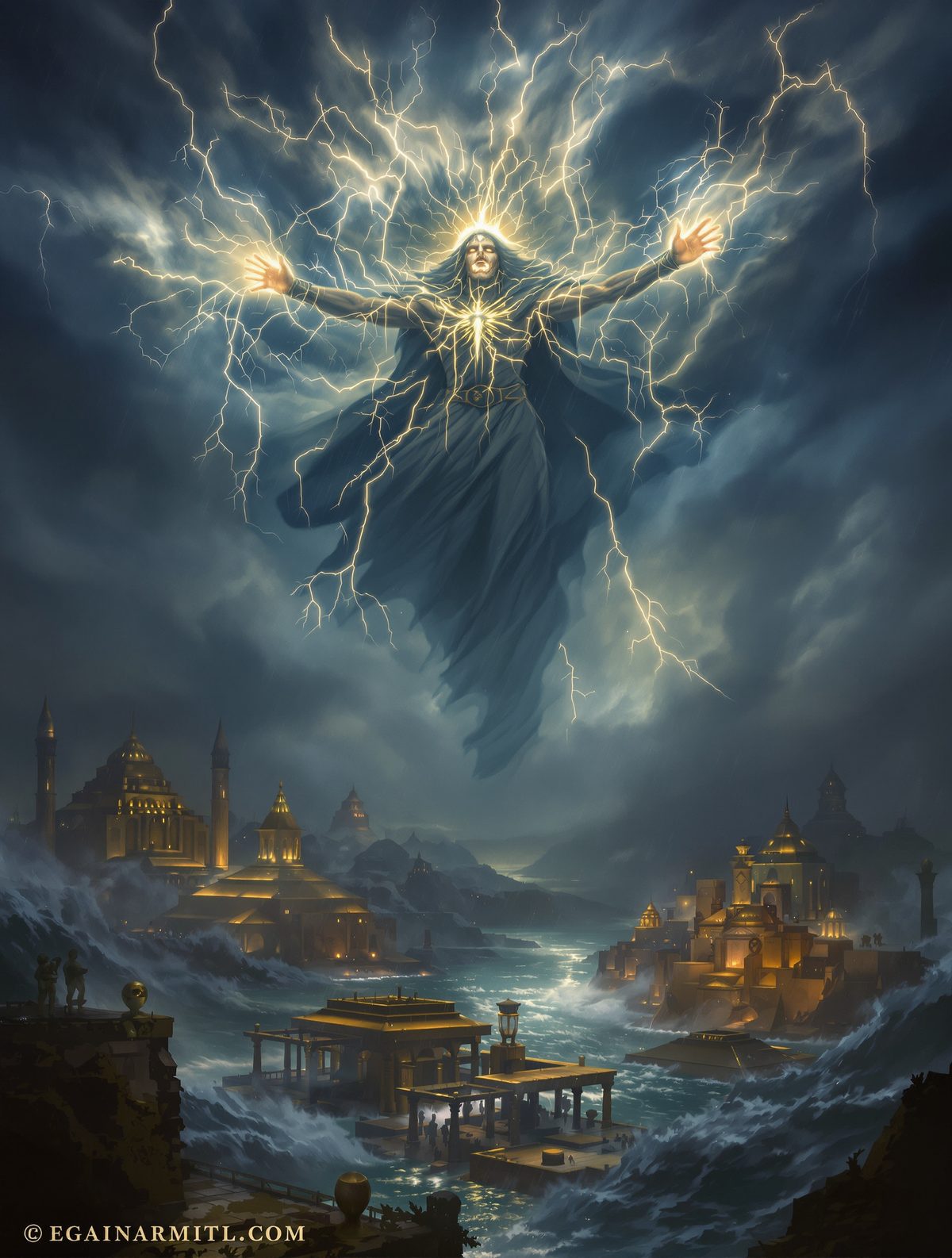
To understand the magnitude of what happened next, we need to grasp just who Atlas was. Standing nearly 500 feet tall according to Hesiod's Theogony, Atlas wasn't just any giant—he was one of the twelve Titans, the generation of gods who ruled before Zeus and the Olympians. After the Titanomachy, the great war between the Titans and the Olympians, Zeus had condemned Atlas to the specific punishment of holding up the heavens for all eternity.
This wasn't merely a metaphor. Ancient Greeks understood Atlas to be literally supporting the celestial sphere on his shoulders, preventing the sky from crashing down upon the earth. His strength was so immense that he could bear this cosmic burden without rest, without relief, for thousands of years. His domain was the far west, where the sun set each day, in a garden filled with golden apple trees tended by his daughters, the Hesperides.
Atlas's garden was described by ancient sources as a paradise beyond imagination. The golden apples weren't just valuable—they were gifts from Gaia, the Earth Mother, given to Hera as a wedding present. These apples granted immortality to anyone who consumed them, making them among the most precious objects in existence. A hundred-headed dragon named Ladon coiled around the tree, never sleeping, never blinking its countless eyes.
The Moment That Created Mountains
When Atlas not only refused Perseus hospitality but actively threatened to hurl him into the sea, the hero had reached his breaking point. Ancient sources describe Perseus as normally patient and diplomatic—he'd talked his way out of numerous scrapes during his adventures. But the combination of exhaustion, the psychological burden of carrying Medusa's head, and the shocking violation of sacred hospitality laws pushed him past his limit.
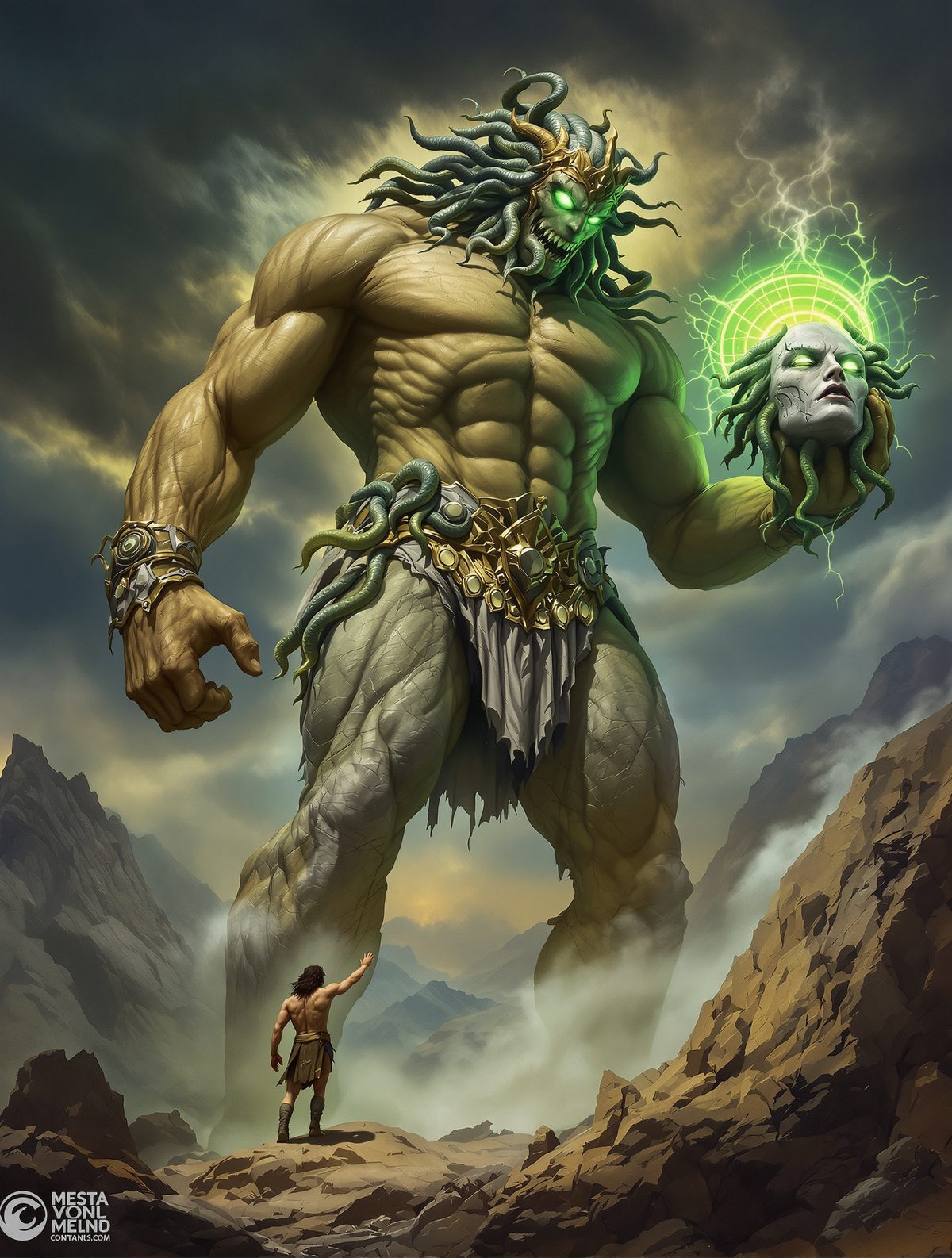
"Since you refuse to show kindness," Perseus declared, "let me offer you a gift instead." The words dripped with ironic politeness, but his actions were swift and terrible. Turning his face away, Perseus reached into Athena's sacred pouch and withdrew the most feared object in creation.
Medusa's head, even in death, retained its supernatural power. Her bronze hands had become brass, her golden wings were now metallic feathers, and her hair writhed with venomous serpents that continued to hiss and strike even though their mistress was dead. But it was the eyes that carried the curse—eyes that had looked upon Athena in her own temple, committing an act so blasphemous that the goddess had transformed beautiful Medusa into a monster.
Atlas, in his arrogance, looked directly at the head. The transformation was instantaneous and irreversible. Starting from his feet, the titan's flesh became granite, his bones became marble, his beard and hair became forests. His massive shoulders, which had supported the dome of heaven itself, became peaks so tall they pierced the clouds. The very heavens he had held up now rested upon his new stone form, and the mountain range that resulted stretched for over 1,500 miles across North Africa.
The Geological Poetry of Divine Justice
Here's where the myth becomes eerily prescient: the Atlas Mountains, as they're known today, actually do stretch across Morocco, Algeria, and Tunisia in almost exactly the configuration ancient sources describe. The highest peak, Toubkal, rises 13,671 feet above sea level—certainly tall enough to seem like it's holding up the sky to ancient observers.
Even more fascinating, recent geological surveys have revealed that the Atlas Mountains were indeed formed through a process that resembles the mythical transformation. The range was created through the collision of the African and Eurasian tectonic plates, a process that literally pushed the earth upward into towering peaks. The mountains are also rich in the kinds of minerals—including significant marble and granite deposits—that ancient sources claimed made up Atlas's transformed body.
But the story doesn't end with Atlas's transformation. Perseus, according to Ovid's Metamorphoses, felt a moment of remorse as he watched the titan become stone. The hero had achieved justice, but at a terrible cost. An immortal being who had endured eons of cosmic responsibility had been condemned to an even more eternal fate. Perseus carefully wrapped Medusa's head and continued his journey, but the weight of what he'd done—creating an entire mountain range in a moment of anger—would follow him for the rest of his adventures.
When Ancient Wisdom Meets Modern Consequences
This ancient tale resonates with startling relevance in our modern world. At its heart, it's a story about the consequences of refusing to help those in need, about how a moment's cruelty can create lasting, irreversible change. Perseus's desperate request for shelter mirrors the pleas of refugees and travelers throughout history who have found themselves at the mercy of those more powerful than themselves.
The myth also explores the terrible responsibility that comes with possessing ultimate power. Perseus carries Medusa's head—a weapon of mass destruction, in modern terms—and must grapple with when and how to use it. His decision to petrify Atlas, while justified by ancient codes of justice, creates permanent consequences that will outlast civilizations.
Perhaps most haunting of all, the story suggests that some transformations, once begun, cannot be undone. Atlas's punishment was meant to be temporary—Perseus could have simply taken what he needed and left the titan to his eternal burden. Instead, a moment of divine wrath created something permanent, beautiful in its own way, but forever changed from what it was before.
Every time we see satellite images of the Atlas Mountains stretching across North Africa, we're looking at the ancient Greeks' explanation for how human choices, divine justice, and natural forces collide to reshape the world in ways that echo through millennia. The legend reminds us that our actions, especially toward those who seek our help, have consequences that reach far beyond what we can imagine—and sometimes, those consequences become the very landscape future generations will inherit.