
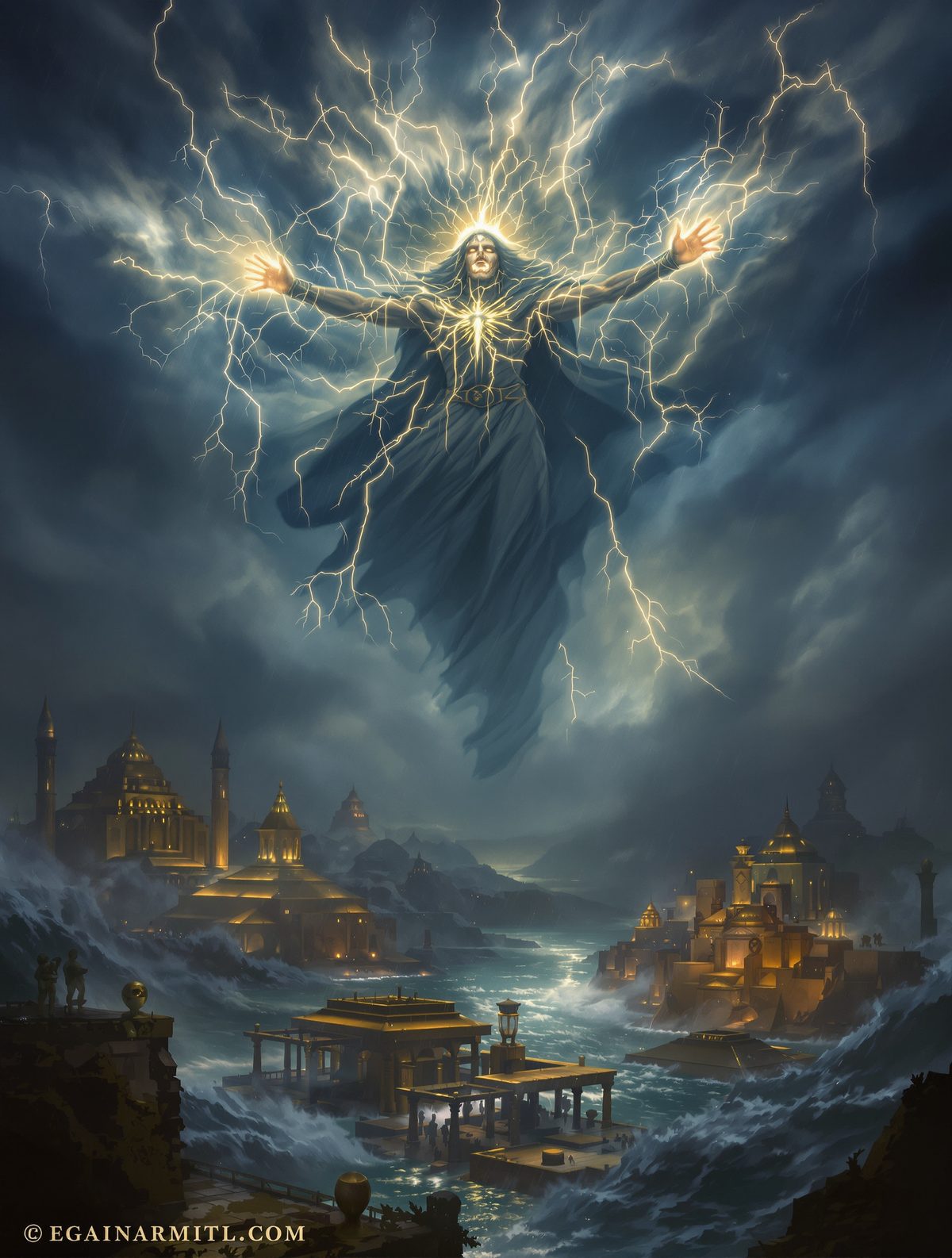
Imagine the sound that finally broke a god's patience. Not the clash of armies or the screams of war, but something far more ordinary and infinitely more maddening: the relentless din of human civilization. The hammering of craftsmen at dawn, merchants haggling in crowded markets, children playing in dusty streets, the creak of cart wheels on stone, the babble of voices that never seemed to cease. For the Mesopotamian god Enlil, lord of wind and storm, this cacophony became unbearable torture—so unbearable that he decided humanity itself had to die.
Around 2100 BCE, Sumerian scribes recorded what may be history's most petty act of divine genocide. Their cuneiform tablets tell us that Enlil, second only to the sky god Anu in the Mesopotamian pantheon, couldn't get a decent night's sleep because humans had grown too numerous and too loud. His solution? Convince his fellow gods to drown every living soul on Earth. The great flood wasn't about sin or moral corruption—it was about noise pollution.
The God Who Ruled the Hurricane's Heart
To understand Enlil's rage, you must first understand his power. In the Sumerian city of Nippur, located in what is now central Iraq, stood the Ekur—literally "Mountain House"—the most sacred temple in all Mesopotamia. Here, Enlil held court as the god who separated heaven from earth, who controlled the winds that brought both life-giving rains and devastating storms.
Unlike the distant sky father Anu, Enlil was immediately present in Mesopotamian life. When the wind howled across the flat plains between the Tigris and Euphrates rivers, that was Enlil's voice. When spring floods deposited fertile silt across the fields, that was his gift. When hurricanes destroyed cities, that was his wrath. The Sumerians called him "Lord Wind," but also "Father Enlil" and "King of the Hurricane."
Archaeological evidence from Nippur reveals the staggering scope of his worship. Enlil's temple complex covered nearly 90,000 square meters and dominated the city for over 3,000 years. Kings from across Mesopotamia—from Sargon of Akkad to Nebuchadnezzar of Babylon—made pilgrimages here to legitimize their rule. To anger Enlil was to court disaster on a civilizational scale.
The Growing Roar of Human Ambition
By 2500 BCE, something unprecedented was happening in Mesopotamia: the world's first urban revolution. Cities like Uruk swelled to populations exceeding 50,000 people—larger than most medieval European capitals would be 3,000 years later. These weren't quiet farming villages; they were buzzing metropolises that never slept.
Picture Uruk at its height: massive walls stretching nearly ten kilometers around the city, enclosing workshops where metalworkers hammered bronze, potters shaped clay on the world's first wheels, and brewers fermented barley into beer in enormous vats. The city's famous ziggurat rose in terraced steps toward the heavens, its construction requiring thousands of workers hauling limestone blocks with ropes, wooden levers, and endless shouted commands.
The Epic of Gilgamesh captures this urban energy, describing Uruk as a place where "the people are aroused" and where the sounds of human activity never cease. Merchants called out prices for grain, silver, and exotic goods from distant lands. Temple prostitutes laughed with customers. Children played games in narrow alleys between mud-brick houses packed together like ancient apartment blocks.
But what sounded like prosperity to human ears grated against divine sensibilities. The Sumerian text known as the Atrahasis Epic describes the problem with startling clarity: "The country became wide, the people became numerous. The country was as noisy as a bellowing bull. The god grew restless at their clamor. Enlil had to listen to their noise."
Divine Council of Destruction
Sleep-deprived and furious, Enlil convened the divine assembly. In Mesopotamian theology, major decisions required consensus among the gods, and Enlil—master politician that he was—knew exactly how to build support for mass extinction.
The scene, preserved in multiple Sumerian and Akkadian texts, reads like a cosmic town hall meeting gone horribly wrong. Enlil argued that humanity had grown beyond all acceptable bounds. They were too numerous, too loud, too presumptuous. The other gods—including Anu, Ninlil, and even the water god Enki—listened as Enlil painted a picture of a world where divine authority meant nothing if mortals could disturb the gods' rest with impunity.
But here's the fascinating detail textbooks often miss: Enlil didn't immediately propose a flood. First, he tried subtler methods of population control. The tablets describe how he sent plague to thin human numbers, then famine, then drought. Each time, however, the clever water god Enki found ways to help humans survive—teaching them medicine, agriculture, and irrigation. The noise problem persisted.
Only when these measured approaches failed did Enlil lose all restraint. The Atrahasis Epic records his chilling words: "Let the flood-weapon go against the people." The divine council, worn down by Enlil's persistence and perhaps sharing his frustration, finally agreed.
The Deluge That Silenced the World
When Enlil opened the heavens, the flood that followed made Hurricane Katrina look like a spring shower. Mesopotamian flood narratives—which predate the Biblical account by nearly a millennium—describe waters that rose for seven days and seven nights, covering even the highest mountains.
But one god couldn't bear to see complete extinction. Enki, bound by oath not to directly warn humanity, found a loophole worthy of a modern lawyer. Speaking to the reed walls of a house rather than to its human occupant—a man named Utnapishtim in some versions, Atrahasis in others—Enki revealed Enlil's plan. "Reed house, reed house! Wall, wall! Listen, reed house! Understand, wall! Build a ship, abandon wealth, seek life!"
The ark that resulted wasn't the quaint boat of children's picture books. The Epic of Gilgamesh provides precise specifications: a cube-shaped vessel measuring 200 feet on each side, with seven decks divided into compartments, sealed with bitumen and pitch. Archaeological evidence suggests such vessels were indeed possible—massive barges used for river transport in ancient Mesopotamia sometimes approached these dimensions.
As the flood waters rose, they accomplished exactly what Enlil intended. The tablets describe a world suddenly, eerily quiet: "The noise of humanity had ceased." Cities that had buzzed with activity for centuries vanished beneath silent waters. The god of wind and storm finally had the peace he craved.
The Price of Divine Silence
But victory brought unexpected consequences. When the waters receded and Utnapishtim's family emerged to repopulate the earth, the gods discovered they had created a new problem: famine. Not human famine—divine famine.
Mesopotamian gods, you see, required human worship to maintain their power. Temples needed daily bread offerings, libations of beer, and the smoke of burning incense. With humanity nearly extinct, the gods began to starve. The tablets describe them gathering "like flies" around Utnapishtim's first sacrifice, desperate for sustenance.
Even more surprisingly, the great flood failed to solve the noise problem permanently. As human civilization rebuilt, the sounds of urban life gradually returned. By 1800 BCE, Babylon was growing into another great metropolis. The hammering, haggling, and human chatter that had so enraged Enlil resumed with renewed vigor.
Perhaps this is why later Mesopotamian texts show a somewhat chastened Enlil. In the Epic of Gilgamesh, he ultimately grants Utnapishtim immortality—a divine admission that humanity's survival had value. The god who once sought to silence human voices forever had learned that a world without them was not the paradise he'd imagined.
When the Gods Couldn't Sleep
Enlil's flood reveals something profound about humanity's relationship with power and noise. In our age of urban density and constant connectivity, when city sounds never cease and digital chatter fills every quiet moment, Enlil's rage feels almost contemporary. How many of us have fantasized about silencing the world's endless din—the traffic, the construction, the neighbor's music, the ping of notifications?
But the Mesopotamian flood myth offers a warning disguised as ancient legend. The powerful—whether gods or governments—who seek to silence human voices often discover that the cure is worse than the disease. A world without human noise is a world without human life, creativity, and progress. The very sounds that irritated Enlil were evidence of civilization's greatest achievement: the ability of thousands of people to live, work, and dream together in unprecedented proximity.
Perhaps the ultimate lesson isn't that gods demand silence, but that the noise of human civilization—chaotic, overwhelming, sometimes maddening—is also the sound of life itself refusing to be quiet. In the end, even Enlil had to learn to live with it.