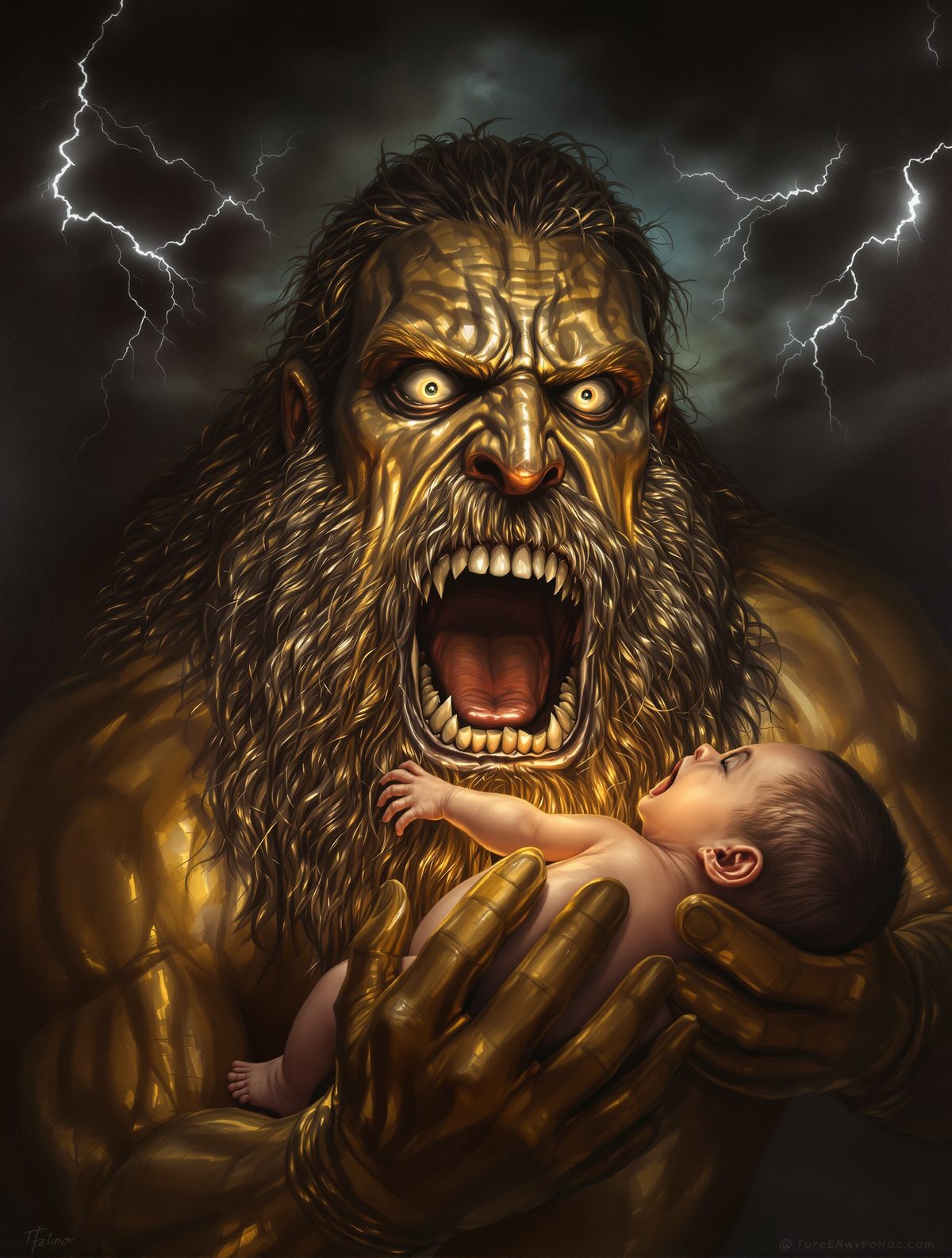
The screams echoed through the marble halls of Mount Othrys as Kronos held his newborn son, still wet with birth blood. His wife Rhea's desperate pleas fell on deaf ears as the Titan king's massive jaws unhinged like some primordial serpent. In one horrific gulp, the child disappeared into the darkness of his father's throat. This wasn't madness—this was calculated terror, born from a prophecy that would drive the most powerful being in the cosmos to commit the ultimate taboo: devouring his own flesh and blood.
Welcome to the darkest chapter of Greek creation mythology, where paranoia and power collided in the most visceral way imaginable.
The Prophecy That Started It All
To understand Kronos's monstrous actions, we must first journey back to the moment that planted the seed of his terror. The prophecy didn't come from some distant oracle or cryptic priestess—it came from his own dying father, Uranus, as Kronos castrated him with an adamantine sickle.
According to Hesiod's Theogony, written around 700 BCE, Uranus's final words were both curse and warning: "As you have overthrown me, so shall one of your own children overthrow you." These weren't the random ravings of a defeated god—in the ancient Greek worldview, the words of a dying divine being carried the weight of cosmic law.
The Greeks called this concept the Moira—fate so absolute that even Zeus himself couldn't alter it. Kronos, now ruler of the universe, found himself trapped in a paradox: the very act of having children, necessary to secure his dynasty, would ultimately destroy him. His solution revealed the calculating cruelty that made the Titans figures of dread rather than worship.
The Feast of Innocents
What followed was a grotesque ritual that repeated itself with mechanical precision. Each time Rhea gave birth—and ancient sources suggest this happened at least six times—Kronos would appear in the birthing chamber, still slick with amniotic fluid and blood, to claim his newborn child.
The Greek poet Apollodorus, writing in the 2nd century BCE, describes the scene with clinical horror: Kronos would grasp each infant immediately after birth and swallow them whole, still alive and screaming. He didn't kill them first—a detail that transforms this from simple infanticide into something far more disturbing. The children, according to myth, remained conscious and growing inside their father's immortal stomach, creating a literally gut-wrenching prison of flesh.
The victims had names that would echo through eternity: Hestia, the future goddess of the hearth; Demeter, who would control the harvest; Hera, destined to rule as queen of the gods; Hades, lord of the underworld; and Poseidon, master of the seas. Each represented fundamental forces of nature and civilization, yet each disappeared into their father's maw before they could even open their eyes.
Rhea's Desperate Gambit
By the time of her sixth pregnancy, Rhea had endured enough. Ancient sources describe her fleeing to the island of Crete—specifically to a cave on Mount Ida (known today as the Idaean Cave, still visited by thousands of tourists annually). Here, she conspired with her mother, Gaia, to perpetrate one of mythology's most famous deceptions.
The plan was audaciously simple. When Zeus was born, Rhea wrapped a stone in swaddling clothes and presented it to Kronos as his newborn son. The Titan king, in his paranoid haste, swallowed the rock whole without even looking. This wasn't mere stupidity—it reveals the mechanical, ritual nature of his infanticide. He had done this so many times that it had become automatic, a horrifying routine that his own compulsion had blinded him to basic observation.
Meanwhile, the real Zeus was spirited away to be raised by the nymphs in secret. The stone Kronos swallowed was later called the Omphalos, and according to Pausanias's travel writings from the 2nd century CE, it was still on display at Delphi over a thousand years later—a tourist attraction even in ancient times.
The Psychology of Divine Paranoia
Modern readers might wonder: why didn't Kronos simply refuse to have children? The answer reveals something profound about how the ancient Greeks understood power and masculinity. For a Titan king to remain celibate or childless would be seen as weakness—an admission that fate had already defeated him.
The myth also reflects real anxieties about succession that plagued ancient rulers. Historical records show that infanticide by paranoid kings was not uncommon—the Roman emperor Herod's massacre of infants, the Byzantine practice of blinding potential heirs, and countless examples of royal children "disappearing" throughout history. Kronos represents the logical extreme of this paranoia.
But there's another layer here that ancient audiences would have immediately recognized. The Greeks believed that hubris—excessive pride that challenged the gods—always led to nemesis, divine retribution. Kronos's attempt to cheat fate through monstrous means guaranteed that his downfall would be equally spectacular.
The Inevitable Reckoning
When Zeus finally came of age, his revenge was poetic in its precision. He didn't simply kill his father—he forced Kronos to disgorge all the devoured children, who emerged fully grown and furious after years of conscious imprisonment. The image of five adult gods spilling forth from their father's mouth, ready for war, became one of the most striking scenes in all of ancient art.
The subsequent war, known as the Titanomachy, lasted ten years and reshaped the cosmos. But the real victory wasn't military—it was moral. Zeus succeeded precisely because he learned to work with fate rather than against it, accepting prophecies and adapting to them rather than fighting them through atrocity.
Interestingly, Zeus himself would later face a similar prophecy about being overthrown by his offspring. His solution? When the goddess Metis became pregnant with Athena, he swallowed her instead of the child—a disturbing echo of his father's crimes that suggests the cycle of violence was harder to break than mythology typically admits.
Lessons from the Abyss
The story of Kronos devouring his children wasn't just ancient entertainment—it was a sophisticated exploration of how fear corrupts power and how attempts to escape fate often guarantee its fulfillment. In our modern world, where leaders still make decisions based on paranoia rather than wisdom, where the powerful still sacrifice the innocent to preserve their positions, this Bronze Age myth feels unnervingly contemporary.
The ancient Greeks understood something we're still learning: that the most monstrous acts often spring not from evil, but from fear. Kronos wasn't a cartoon villain—he was a terrified father who loved power more than his children, and whose terror drove him to become the very monster his fears created. In the end, the prophecy came true not despite his efforts to prevent it, but because of them.
Perhaps that's the real lesson hidden in this ancient tale of divine cannibalism: that our attempts to devour the future to preserve the present don't make us powerful—they make us into Titans, impressive in our might but ultimately doomed by our own appetites.