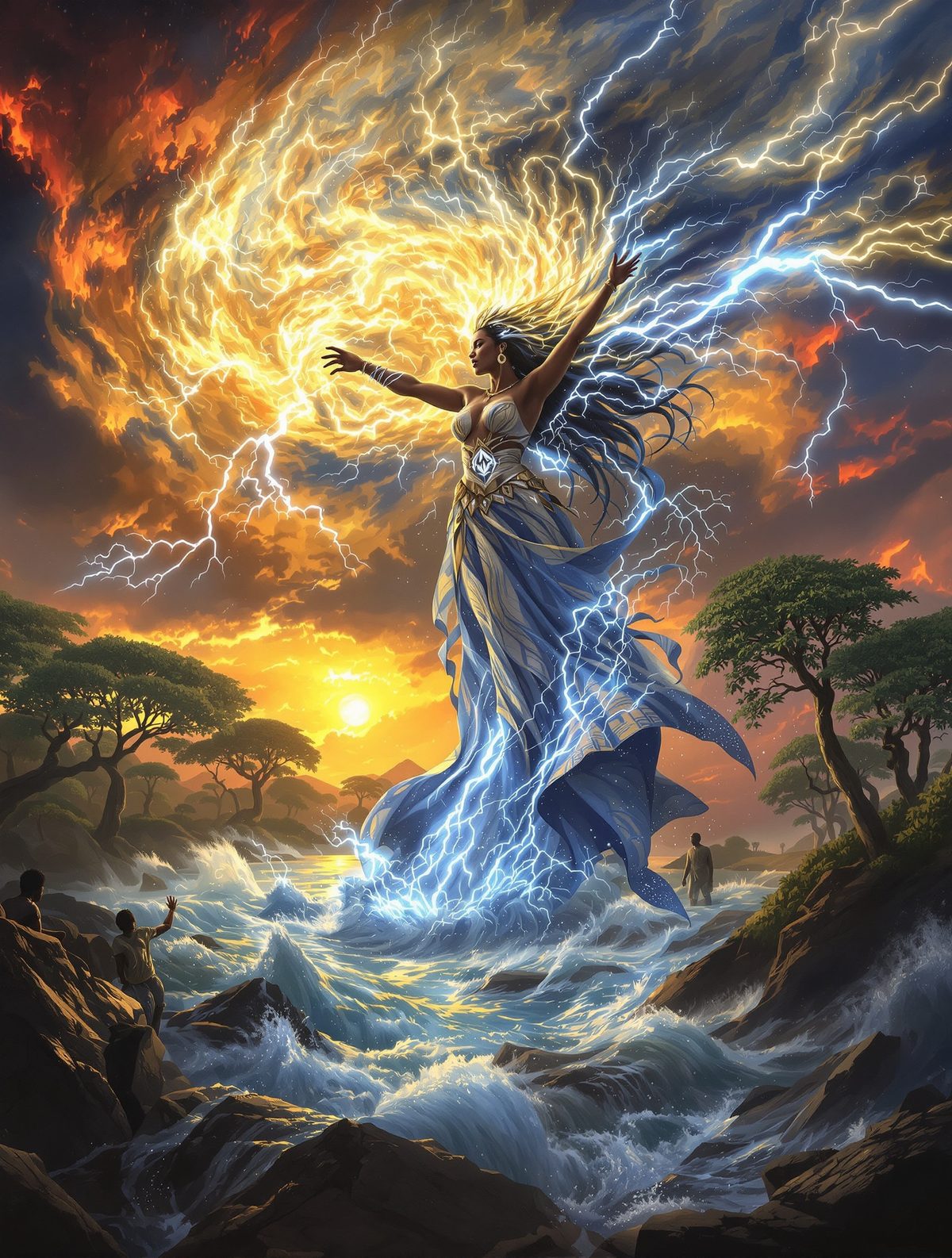
Picture this: the most powerful river in West Africa suddenly abandons its course, its waters rising into the sky in a rage so fierce it births the hurricane itself. This isn't climate science fiction—this is the story of Oya, a goddess whose love affair literally changed the weather patterns of an entire continent. While textbooks reduce African mythology to footnotes, they're missing one of history's most spectacular tales of passion, power, and meteorological revenge.
Long before European colonizers ever set foot on African soil, the Yoruba people of what is now Nigeria, Benin, and Togo had already mapped out a complex universe where gods walked among mortals and natural forces had personalities as volatile as any soap opera character. At the center of this divine drama stood Oya, whose story reveals why hurricanes still bear her name in Yoruba communities across three continents.
The River Queen's Domain
In the beginning, Oya ruled the Niger River with the kind of absolute authority that would make ancient pharaohs jealous. The Niger—Africa's third-longest river at 2,597 miles—wasn't just a waterway; it was the economic lifeline of West Africa. From the river's source in Guinea's highlands to its massive delta in Nigeria, Oya controlled trade routes that moved gold, salt, kola nuts, and slaves across the continent centuries before Europeans arrived.
But here's what the geography textbooks won't tell you: Oya wasn't just managing water levels and fish populations. According to Yoruba cosmology, she commanded an army of ancestral spirits called egungun, souls of the dead who couldn't cross into the afterlife without her permission. Picture the Niger's waters teeming not just with hippos and crocodiles, but with the ghostly forms of thousands of ancestors seeking passage to the other side. Oya was essentially running the world's busiest supernatural border crossing.
The Yoruba people, who numbered in the millions across their city-states, understood that appeasing Oya meant the difference between prosperity and catastrophe. They offered her cowrie shells (the region's primary currency), palm wine, and elaborate festivals where dancers would mimic the river's flowing movements. Archaeological evidence from sites like Ife and Oyo suggests these ceremonies could last for nine days—Oya's sacred number—and involved entire communities.
What made Oya particularly formidable was her dual nature. Unlike other river deities who embodied gentle, nurturing waters, Oya controlled the Niger's violent seasonal floods. When the rains came between June and September, the river could rise 35 feet above its dry-season levels, transforming peaceful trading posts into raging torrents. The Yoruba understood this wasn't random weather—this was Oya's temperament made manifest.
When Thunder Called to Water
Enter Shango, the thunder god whose ego was as massive as his lightning bolts. If Oya was the steady, powerful force of the river, Shango was pure electrical chaos—the deity of fire, thunder, and what we might today call toxic masculinity taken to divine extremes. Historical accounts from Yoruba oral traditions describe him as a former king of the Oyo Empire who became so powerful that he transformed into a god upon his death around the 12th century CE.
Shango wasn't content ruling just the skies; he wanted dominion over everything, including the hearts of his fellow deities. When he first encountered Oya, the meeting was reportedly explosive—literally. Lightning struck the Niger River at a spot near present-day Lokoja, where the Niger and Benue rivers converge, creating a whirlpool that local fishermen still avoid today.
But here's the fascinating part that reveals the psychological sophistication of Yoruba mythology: Oya wasn't immediately smitten. She was intrigued. For eons, she had controlled the steady, predictable flow of river life. Shango represented something she had never experienced—pure, unpredictable power that answered to no natural laws. Where her river carved its path slowly over millennia, his lightning could split the largest iroko tree in an instant.
The courtship between thunder and water became the stuff of legend across West Africa. Shango would create spectacular lightning displays over the Niger, while Oya would send waterspouts dancing across the surface in response. Traders navigating the river during this period reported seeing impossible sights: rain falling upward, fish flying through storm clouds, and the river itself seeming to pulse with electrical energy.
The Abandonment That Shook the Earth
The moment Oya chose love over duty marked one of the most dramatic transformations in African mythology. According to traditions preserved by Yoruba priests called babalawo, Oya's departure from the Niger River didn't happen gradually—it was instantaneous and catastrophic.
Picture the scene: millions of gallons of water suddenly rising into the air, defying every law of physics as they spiraled skyward in a massive waterspout visible for hundreds of miles. The river that had sustained civilizations for millennia suddenly ran at half its normal volume. Fish died in the shallows. Trading boats found themselves stranded on newly exposed sandbars. Entire communities that had thrived on the riverbanks faced immediate drought.
But Oya's transformation was far from complete. As she ascended to join Shango in the realm of sky gods, something unprecedented happened: water and wind merged into something entirely new. The Yoruba describe this as the birth of the hurricane—not just as a weather phenomenon, but as the physical manifestation of a goddess's emotional state.
What's remarkable is how accurately this mythology describes actual meteorological processes. Modern science tells us that hurricanes form when warm ocean water meets atmospheric instability—essentially when water and air begin to dance together in increasingly violent spirals. The Yoruba had identified this same relationship between water and wind thousands of years before the first weather satellite.
The immediate consequences of Oya's departure rippled across West Africa. Trade routes along the Niger had to be completely reorganized. The great trading cities of Timbuktu and Gao, which had relied on predictable river levels, suddenly faced unpredictable floods and droughts. Some historians argue that Oya's mythological abandonment of the river reflects actual climate changes that occurred around the 13th century, when the Medieval Warm Period gave way to cooler, more unstable weather patterns.
The Hurricane Goddess Unleashed
Once Oya joined Shango in the sky realm, she didn't simply become a gentler version of herself. Instead, she evolved into something far more powerful and terrifying than she had ever been as a river goddess. As the deity of hurricanes, tornadoes, and violent change, Oya commanded forces that could level entire cities and reshape coastlines overnight.
The Yoruba developed an intricate understanding of hurricane behavior that rivals modern meteorology. They knew that Oya's storms moved in spiraling patterns (they called them iji, meaning "whirlwind of spirits"), that they drew their power from warm ocean waters, and that they were most likely to occur during specific seasons. Hurricane season in the Atlantic—June through November—corresponds almost exactly with the period when Yoruba ceremonies honored Oya's transformation.
But here's where the story gets really interesting: when enslaved Africans were forcibly brought to the Americas between the 16th and 19th centuries, they carried Oya's story with them. In Cuba, she became Yansa, the goddess who dances with death at the cemetery gates. In Brazil, she's Iansã, the warrior woman who fights alongside her beloved Xangô (Shango). In New Orleans, practitioners of Vodou recognize her as the spirit who commands Hurricane season itself.
The statistical correlation is striking: regions with large populations of African descent often have the richest hurricane folklore and the most sophisticated traditional knowledge about storm behavior. From the Gullah communities of South Carolina to the Maroon settlements of Jamaica, people maintained Oya's teachings about reading wind patterns, interpreting cloud formations, and preparing for the kind of devastating storms that could only be explained as a goddess's rage.
Even today, meteorologists have unofficial names for hurricane behaviors that mirror Yoruba descriptions of Oya's personality. They speak of storms that "intensify rapidly" (Oya's famous temper), that "stall over warm water" (her reluctance to leave Shango's domain), and that produce "unprecedented storm surge" (her river origins asserting themselves).
The Price of Divine Love
The relationship between Oya and Shango wasn't the happily-ever-after that Disney would have you believe. Yoruba mythology is refreshingly honest about the costs of passion, especially when gods are involved. Shango's volatile nature meant their relationship was a constant cycle of explosive fights and passionate reconciliations, each one manifesting as increasingly violent weather patterns across West Africa and beyond.
Traditional stories describe how Oya would summon devastating windstorms whenever Shango's attention wandered to other goddesses (which happened frequently—thunder gods aren't known for their fidelity). Meanwhile, Shango would retaliate with lightning strikes so fierce they could split mountains. Their domestic disputes literally became natural disasters.
The human cost of this divine drama was enormous. Communities across the Yoruba heartland had to develop sophisticated early warning systems for detecting when the god and goddess were fighting. They learned to read atmospheric pressure, wind shifts, and animal behavior to predict when another divine argument might level their villages.
Yet paradoxically, this destructive relationship also brought benefits. The violent storms that resulted from Oya and Shango's conflicts also brought the rains that sustained agriculture. The same winds that could destroy a poorly built house would also fill the sails of trading vessels and disperse crop seeds across vast distances. The Yoruba understood what modern ecology is rediscovering: that periodic destruction is essential for renewal.
Perhaps most significantly, Oya's transformation from river goddess to hurricane deity represented something unprecedented in world mythology—a female deity whose power increased rather than diminished through her relationship with a male god. While other cultures often portrayed goddesses as losing their independence through love, Oya became more formidable, more feared, and more respected after joining Shango.
When Ancient Wisdom Meets Modern Crisis
Today, as climate change makes hurricanes more frequent and devastating, Oya's story offers insights that scientists are only beginning to appreciate. The Yoruba understanding that water and wind systems are interconnected, that weather patterns reflect deeper environmental relationships, and that human communities must learn to live with rather than simply predict natural disasters—these concepts are at the cutting edge of modern climate adaptation strategies.
Consider this: while Western meteorology has only recently begun to study the relationship between African dust storms and Atlantic hurricane formation, Yoruba tradition has always maintained that Oya's storms carry the ancestral spirits of Africa across the ocean to the Americas. Recent satellite imagery shows that Saharan dust clouds do indeed travel across the Atlantic, affecting hurricane development and carrying microorganisms that influence weather patterns—a phenomenon that sounds remarkably like spirits crossing the water.
The story of Oya's transformation also speaks to something profoundly relevant in our current moment: the idea that love can be a force of creative destruction, that sometimes abandoning what we've always known is necessary for growth, and that the most powerful changes often come from the collision between seemingly incompatible forces.
In communities from Lagos to Louisiana, people still invoke Oya's name when hurricanes approach—not as superstition, but as a recognition that some forces in nature are too vast and complex to be fully understood through scientific instruments alone. They carry with them thousands of years of accumulated wisdom about living with uncertainty, respecting the power of natural forces, and finding meaning in the midst of chaos.
Perhaps that's the real lesson of Oya's story: that transformation is never gentle, that love can reshape entire landscapes, and that sometimes the most destructive forces are also the most necessary. In an age of climate crisis and social upheaval, we could do worse than learning from a goddess who understood that true power comes not from controlling the storm, but from becoming it.