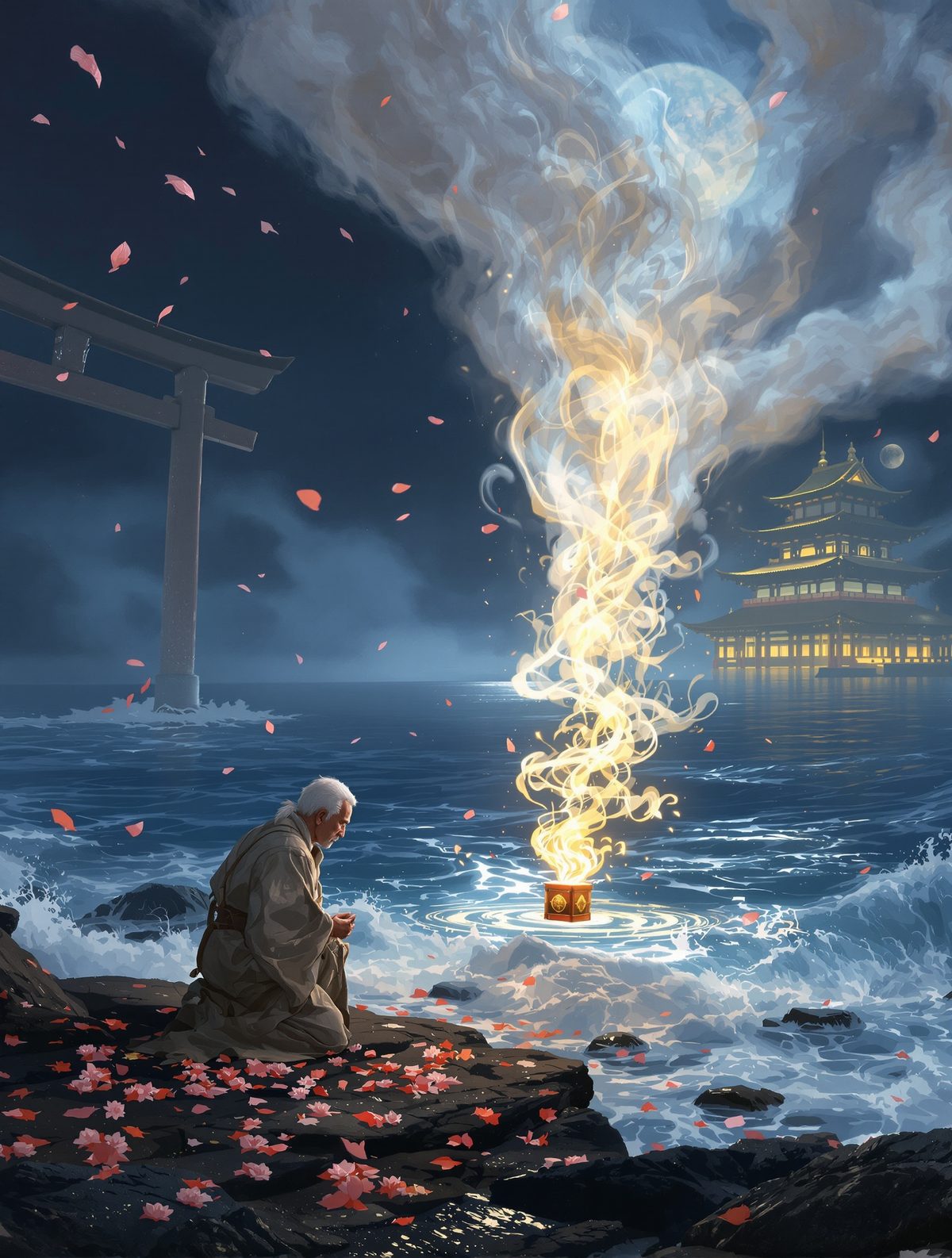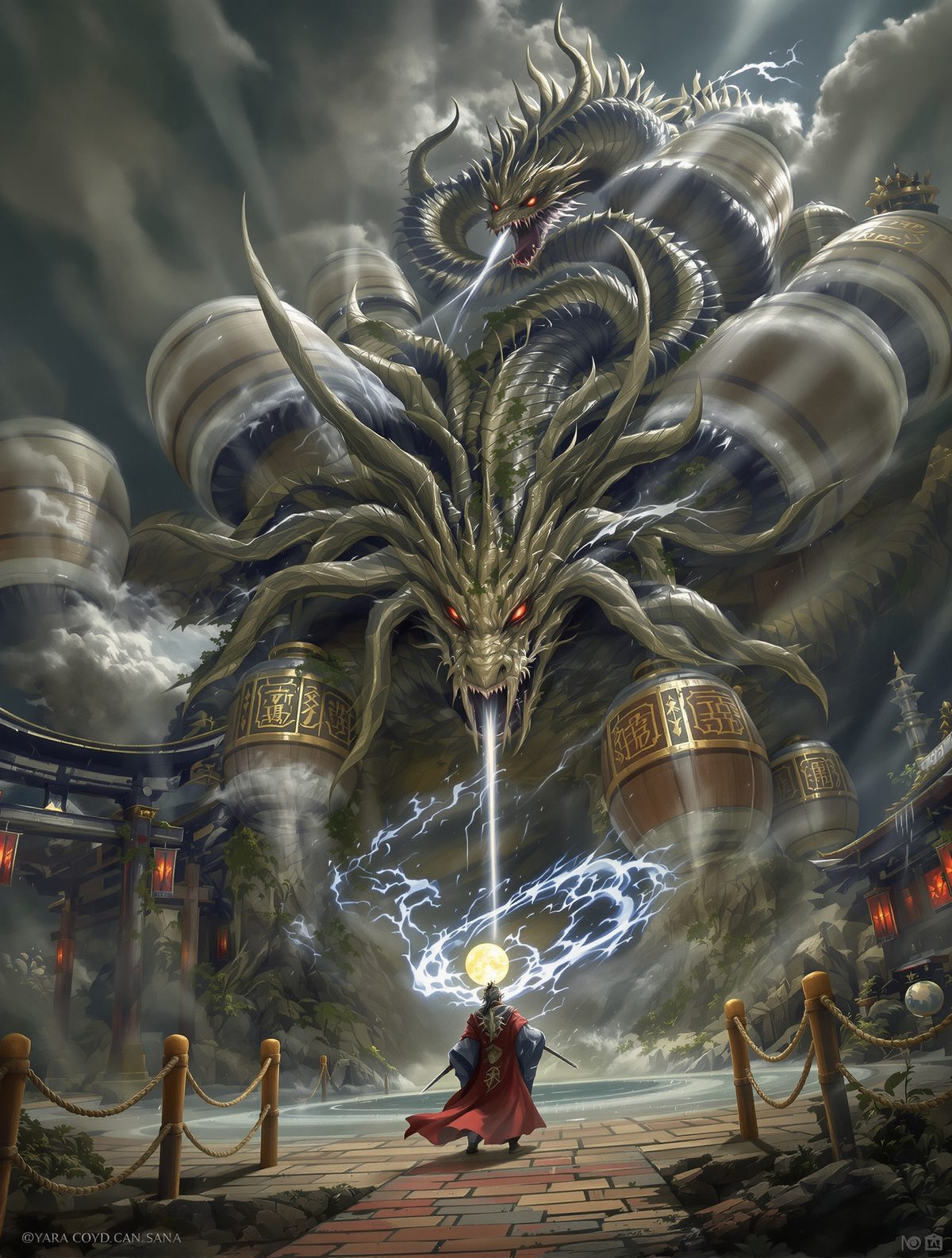
The crimson sake pooled in eight massive barrels, each one carefully positioned beside an ornate wooden gate. In the distance, the earth trembled with approaching footsteps—if you could call them that. What moved through the ancient forests of Izumo Province wasn't quite walking. It was flowing, slithering, bringing with it the stench of death and the promise of another virgin's blood. The eight-headed, eight-tailed dragon Yamata-no-Orochi was coming to claim its prize, and the banished storm god Susanoo was ready with the oldest trick in the book: get your enemy catastrophically drunk, then cut off its heads while it sleeps off the hangover.
This isn't just another monster-slaying tale from Japan's mythological past. It's a story about the power of cunning over brute force, the significance of sake in ancient Japanese culture, and how even gods sometimes have to think outside the box when facing impossible odds.
The Storm God's Disgrace and Desperate Gambit
Susanoo-no-Mikoto, the tempestuous brother of sun goddess Amaterasu, arrived in the mortal realm under less than ideal circumstances. He'd been banished from the heavenly realm of Takamagahara after a spectacular tantrum that involved destroying his sister's sacred weaving hall and—depending on which version you believe—either throwing a flayed horse through the roof or committing acts so unspeakable that Amaterasu herself hid in a cave, plunging the world into darkness.
Now, wandering the mountainous region of Izumo in what would later become Shimane Prefecture, Susanoo encountered an elderly couple, Ashinazuchi and Tenazuchi, weeping beside their beautiful daughter Kushinada-hime. Their story was heartbreaking: they'd once had eight daughters, but for seven consecutive years, the monstrous Yamata-no-Orochi had come to devour one. Tonight, it would claim their last.
The dragon they described defied comprehension. Its body stretched across eight valleys and eight hills. Moss and cypress trees grew on its back like a living landscape. Its eight heads each bore eyes red as winter cherries, and its belly was always bloody. Most terrifying of all, it was intelligent—not just a mindless beast, but a creature that had systematically terrorized this family for nearly a decade.
The Ancient Art of Supernatural Intoxication
Susanoo's solution revealed something fascinating about ancient Japanese culture: sake wasn't just a drink, it was considered a divine substance with genuine spiritual power. The specific type Susanoo demanded wasn't ordinary rice wine—it was yashiori no sake, roughly translated as "eight-fold refined sake" or "sake strong enough for eight people."
The brewing process Susanoo described was elaborate and ritualistic. The sake had to be brewed eight separate times, each fermentation making it progressively stronger and more potent. Some scholars suggest this wasn't just about alcohol content, but about imbuing the drink with spiritual energy through repetitive sacred processes. In ancient Japan, the number eight itself held profound significance—it represented completion, perfection, and infinite expansion.
Archaeological evidence from the Yayoi period (300 BCE - 300 CE) supports the central role of sake in both daily life and religious ceremonies. Clay vessels specifically designed for brewing and storing rice wine have been found throughout Japan, and many show evidence of being used in ritual contexts. The fact that Susanoo chose alcohol as his weapon of choice wasn't random—it was a demonstration of understanding the spiritual as well as practical properties of this sacred beverage.
Engineering a Divine Trap
The construction of Susanoo's trap was as impressive as it was simple. He ordered the creation of eight platforms, each topped with an enormous sake barrel. The barriers around these platforms featured eight gates, perfectly positioned so that each of Yamata-no-Orochi's heads could access its own private drinking station.
This detail reveals something often overlooked in retellings: Susanoo understood his enemy's psychology. The dragon wasn't just a mindless eating machine—it was a creature of habit and pride. By providing eight separate feeding stations, Susanoo appealed to the monster's sense of its own magnificent multiplicity. Each head could drink without competing with the others, making the trap irresistible.
The positioning also showed tactical brilliance. With eight heads focused on eight different locations, the dragon couldn't maintain its usual devastating coordination. It was a classic case of turning an enemy's greatest strength—its multiple heads—into a vulnerability.
The Night the Dragon Drank Deep
When Yamata-no-Orochi arrived, the scene must have been both magnificent and terrifying. Picture this: a creature so massive that its body formed the landscape itself, with eight serpentine necks rising like terrible towers above the forest canopy. Each head was large enough to swallow a human whole, each mouth dripping with the anticipation of virgin blood.
But then the dragon smelled the sake.
What happened next reveals something almost tragic about this ancient monster. Despite its power, despite its terrible intelligence, it couldn't resist the allure of the sacred alcohol. Each head plunged into its designated barrel, drinking deeply of the eight-fold refined sake. The sound must have been incredible—eight massive creatures gulping down gallons of potent rice wine while the earth trembled beneath their bulk.
The intoxication was swift and complete. One by one, the eight heads grew heavy, their terrible red eyes dimmed, and the great body that had terrorized Izumo for eight years finally stilled. Yamata-no-Orochi, the eight-headed terror of ancient Japan, was passed out drunk.
Divine Butchery and Sacred Swords
What followed was less a battle than a methodical execution. Susanoo, sword in hand, systematically severed each of the eight heads, then moved on to the eight tails. But it was in cutting the middle tail that the story takes its most significant turn.
His blade struck something harder than flesh and bone—another sword, embedded within the creature's body. This was no ordinary weapon, but the Kusanagi-no-Tsurugi, the "Grass-Cutting Sword," one of the three sacred treasures of Japan. Some versions suggest the sword had been swallowed by the dragon after it devoured a previous hero; others imply the blade was somehow part of the creature's essential nature.
Susanoo presented this blade to his sister Amaterasu as a peace offering, and it eventually became part of the imperial regalia of Japan. The modern Japanese emperor's coronation still involves the symbolic presentation of three sacred treasures, including a representation of this very sword—making Yamata-no-Orochi's defeat one of the foundational moments of Japanese imperial legitimacy.
Lessons from the Land of Eight Clouds
The story of Susanoo and Yamata-no-Orochi offers more than just thrilling entertainment—it provides insight into how ancient cultures understood the relationship between intelligence and power, between civilization and chaos. Susanoo didn't defeat the dragon through superior strength or divine magic alone. He won through understanding, preparation, and the application of cultural knowledge.
In our modern world, where we face our own seemingly insurmountable challenges, there's something profoundly relevant about a hero who chose strategy over strength, patience over passion. The storm god who once destroyed his sister's hall in a fit of rage had learned to channel his power through wisdom rather than wrath.
Perhaps most significantly, this myth suggests that our greatest enemies—whether they're eight-headed dragons or modern existential threats—often carry within them the seeds of their own destruction. Sometimes the solution isn't to fight harder, but to think more carefully about what our adversaries truly desire, and how we might turn that desire against them.
The eight valleys and eight hills where Yamata-no-Orochi once stretched its impossible length are now peaceful rice fields and quiet villages. But in Shimane Prefecture, local festivals still celebrate the storm god's victory with elaborate sake ceremonies, remembering the night when the right drink, served at the right time, changed the course of mythological history forever.