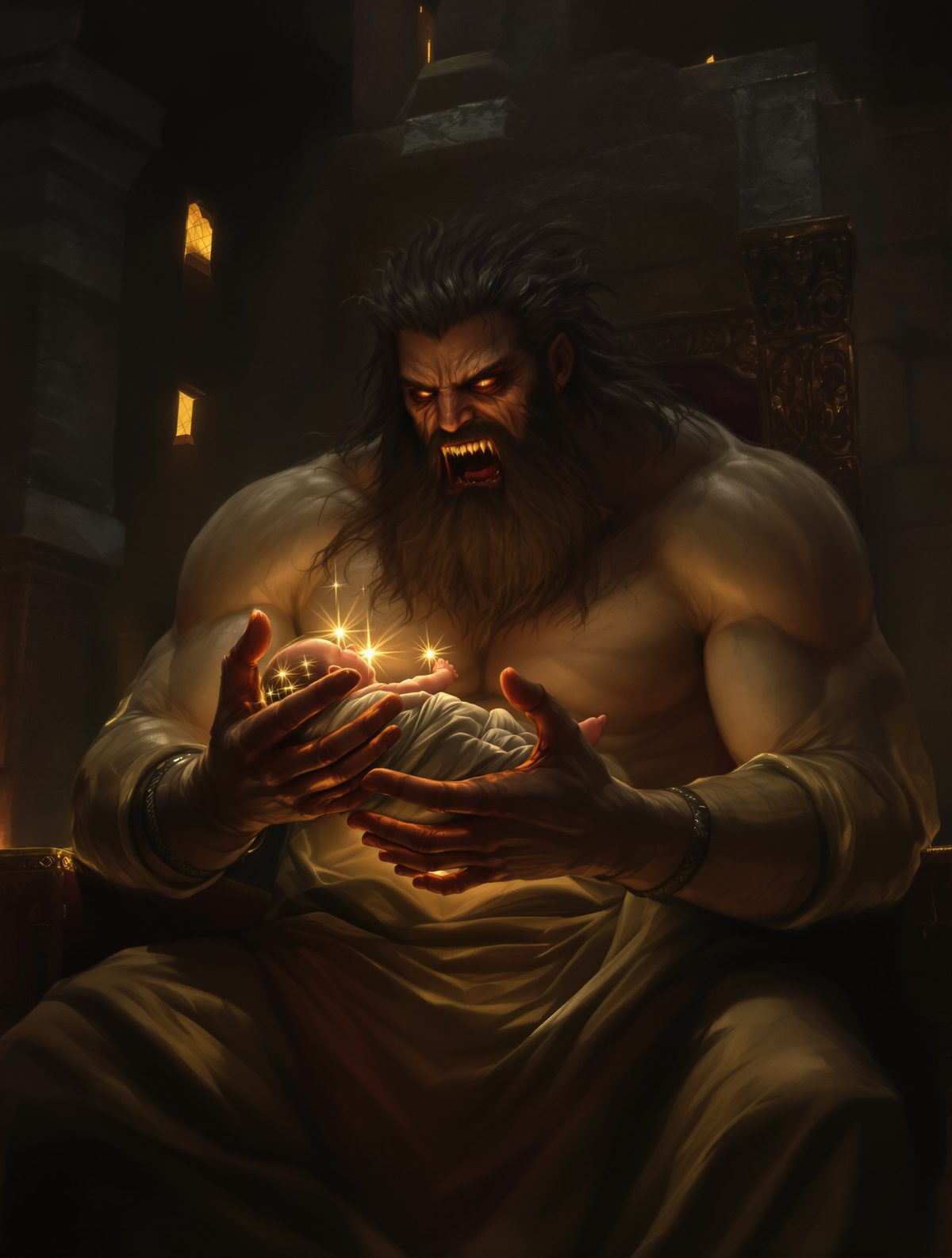
The birthing chamber falls silent except for Rhea's labored breathing. In the flickering torchlight, the Titan queen cradles her newborn daughter—beautiful, perfect, divine. But her eyes are not filled with maternal joy. They're wide with terror. Heavy footsteps echo in the corridor outside. He's coming. Kronos, King of the Titans, Lord of Time itself, approaches to claim his child. Not to bless her, not to name her, but to devour her whole while she still draws breath.
This is no fairy tale. This is the story of the most horrific family in ancient mythology—and the desperate mother who finally said "enough."
The Prophecy That Drove a Father Mad
To understand Kronos's monstrous actions, we must first understand his terror. The youngest of the twelve Titans, Kronos had already committed one act of supreme violence to claim his throne. Using a curved sickle forged by his mother Gaia, he had castrated his own father, Uranus, as the sky god descended to mate with the earth. The severed genitals, cast into the sea, would later give birth to Aphrodite—but that's another story of divine dysfunction.
Having seized power through patricide, Kronos ruled the cosmos during what the Greeks called the Golden Age. Humanity lived without war, without aging, without want. Time itself bent to his will. But absolute power bred absolute paranoia, and when Kronos consulted the oracle about his future, he received the prophecy that would shatter his sanity: "One of your children will overthrow you, just as you overthrew your father."
The Titans were not known for their subtle problem-solving. Where a mortal king might exile his children or keep them imprisoned, Kronos devised a solution of breathtaking brutality. He would consume each child the moment they emerged from Rhea's womb. Not kill them—consume them whole and alive. In his twisted logic, if his children never truly entered the world, they could never fulfill the prophecy.
Five Children, Five Horrors
The first birth should have been a celebration. Hestia, goddess of the hearth, emerged into the world as all divine births do—in a blaze of supernatural light. Ancient sources describe newborn Titans as immediately conscious, their eyes bright with divine intelligence. Hestia would have seen her father's face, might even have reached for him with tiny, perfect hands.
Kronos snatched her from Rhea's arms and swallowed her in a single gulp.
The ancient poet Hesiod, writing in the 8th century BCE, describes the scene with chilling simplicity: "Great Kronos swallowed down his children as each came forth from the womb to his mother's knees, with this intent, that no other of the proud sons of Heaven should hold the kingly office amongst the deathless gods."
Four more times, this nightmare repeated. Demeter, goddess of the harvest. Gulp. Hera, future queen of the gods. Gone. Hades, lord of the underworld. Devoured. Poseidon, master of the seas. Each divine child, each future Olympian, disappeared into their father's gullet while Rhea watched in helpless anguish.
Here's what makes this even more disturbing: the children didn't die. Trapped in Kronos's divine stomach, they continued to grow, to develop their powers, to wait. Imagine the conversations between imprisoned siblings, the plans they made, the rage that festered in that supernatural prison.
A Mother's Desperate Gambit
By the time of her sixth pregnancy, Rhea had endured enough horror for a dozen lifetimes. Ancient sources tell us she fled to Crete when her labor began, hiding in a cave on Mount Ida—a location that remained sacred to Zeus throughout classical antiquity. Archaeological evidence suggests this cave was indeed a center of religious worship for over a millennium.
But Rhea had more than geography on her side. She had allies—the most powerful being Gaia herself, the primordial Earth Mother who had grown disgusted with her son's actions. Together, they devised a plan of stunning simplicity.
When Zeus was born in that Cretan cave, Rhea immediately spirited him away to be raised by the goat Amalthea (whose horn would later become the cornucopia of plenty). In his place, she wrapped a large stone in swaddling clothes and presented it to Kronos as his newborn son.
And the King of Time, in his paranoid hunger, swallowed a rock.
This detail reveals something crucial about Kronos's mental state. This wasn't careful infanticide—it was frenzied, almost automatic consumption. He had become so consumed by his fear that he barely looked at what he was devouring. The prophecy he sought to prevent had already begun to make him the monster it predicted he would become.
The Stone That Saved the World
That substituted stone—called the Omphalos—became one of the most important religious artifacts in ancient Greece. After Zeus eventually forced Kronos to vomit up his siblings (yes, that's exactly how it happened), the Omphalos was placed at Delphi, marking what the Greeks believed was the center of the world. Visitors to the archaeological site can still see the remains of this sacred stone today.
But why did the deception work? Some scholars suggest that Kronos's power over time had begun to fracture under the weight of his actions. In Greek cosmology, temporal powers were linked to cosmic order—and Kronos's violation of the natural bonds between parent and child was literally unraveling his dominion over reality itself.
Meanwhile, on Crete, the infant Zeus grew in secret. The local spirits, called the Curetes, would clash their shields and spears whenever the baby cried, drowning out the sound so Kronos couldn't locate his hidden son. These weren't just mythological details—historical records show that ritual weapon-clashing remained a part of Cretan religious practice well into the Roman period, a direct echo of this ancient story.
The Reckoning of Kings
When Zeus reached adulthood, he returned to fulfill the prophecy in spectacular fashion. Disguised as a cupbearer, he served Kronos a drink mixed with a powerful emetic—essentially, divine ipecac. The effect was immediate and explosive. Kronos vomited up the stone first (which is how it ended up at Delphi), followed by Zeus's five siblings, who emerged fully grown and ready for war.
What followed was the Titanomachy, a ten-year war that literally shook the foundations of creation. Zeus and his siblings, joined by some Titans who opposed Kronos, eventually triumphed. Kronos and his supporters were cast into Tartarus, the deepest pit of the underworld, where they remain imprisoned to this day.
But here's a fascinating detail often overlooked: in some versions of the myth, Kronos was eventually freed and made ruler of the Isles of the Blessed, where the heroic dead dwell in eternal happiness. Even the Greeks, it seems, believed that monsters could be redeemed—that the cycle of violence between generations didn't have to be eternal.
When Mythology Becomes Mirror
This isn't just an ancient story about divine dysfunction—it's a stark examination of how fear destroys families. Kronos's terror of being overthrown created the very conditions that made his overthrow inevitable. His children didn't rebel despite his love; they rebelled because of his violence.
The myth resonates today precisely because we still see parents who, terrified of losing control, destroy their relationships with their children through the very means they use to maintain that control. We see leaders so afraid of losing power that they commit atrocities that guarantee their downfall. We see the eternal human truth that Rhea embodied—sometimes the greatest act of love is active resistance to those who would harm our children, even when that person is family.
In our modern age of divided families and generational trauma, the story of Kronos serves as both warning and promise. The cycles of violence can be broken. Sometimes it takes a mother's courage and a stone wrapped in swaddling clothes. Sometimes it takes growing up hidden in a cave, protected by allies who clash their shields when you cry. But the cycle can be broken.
The question is: when the time comes, will you be Kronos, swallowing stones in your blind hunger for control? Or will you be Rhea, hiding the future in a cave until it's strong enough to save itself?