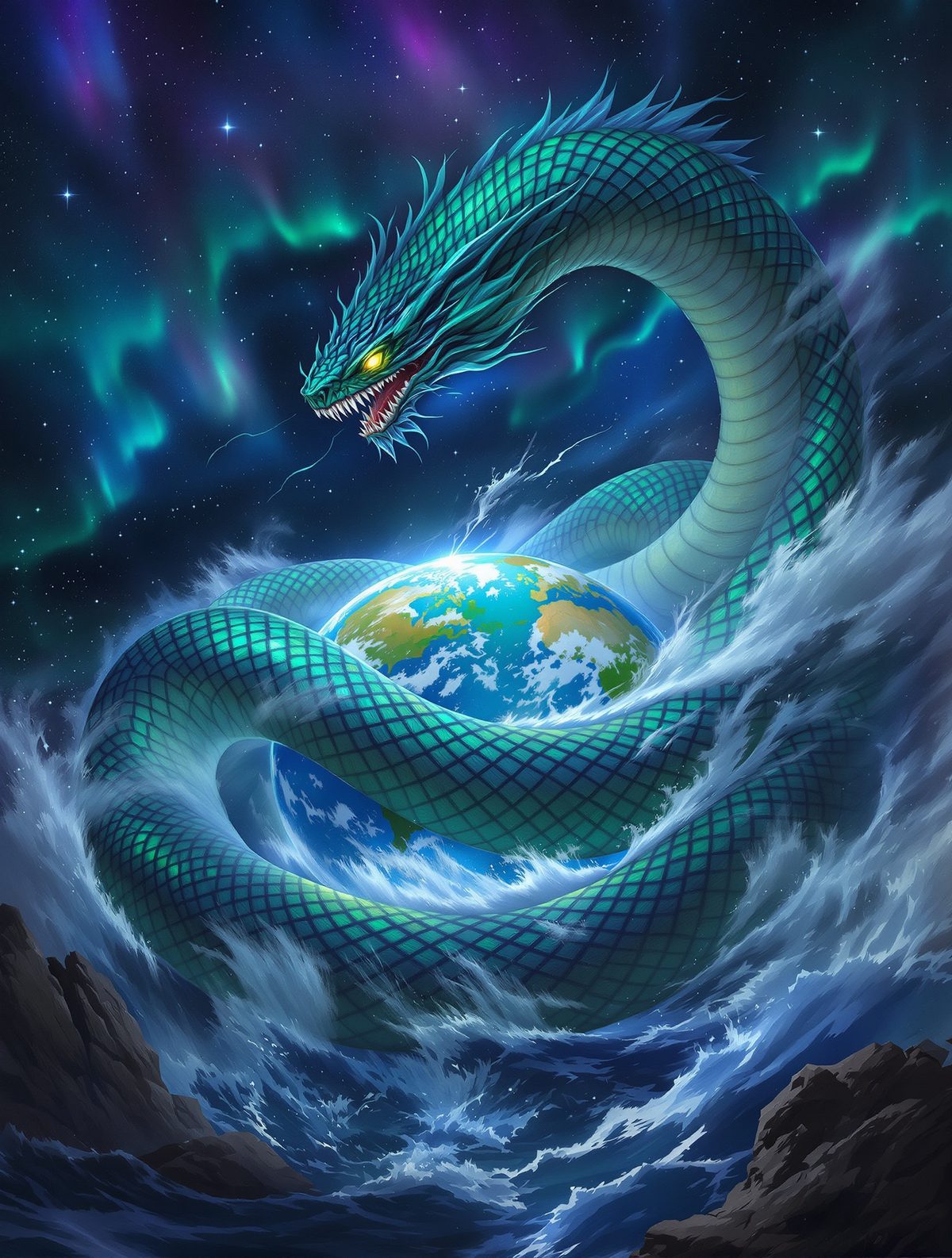
In the blackened waters beneath Midgard, something stirs. Something so vast that its coils could wrap around continents like yarn around a spindle. The creature's head disappears into darkness on one horizon while its tail vanishes into shadow on the other, and somewhere in the crushing depths between—flesh meets flesh as the monster devours its own end. This is Jormungandr, the World Serpent, and when he finally releases his tail from his venomous jaws, the world will end.
The Norse knew this. They told the story around fires that flickered against the long northern nights, voices dropping to whispers when they spoke of the serpent that held their world together by holding himself. But here's what they understood that we've forgotten: sometimes the very thing that destroys us is also the only thing keeping us whole.
The Trickster's Monstrous Legacy
To understand Jormungandr, you must first understand his father—Loki, the shape-shifting god whose silver tongue could talk the dead back to life or convince the sun to set at noon. But Loki's greatest trick wasn't one of words. It was of flesh and blood and scales that would grow beyond all reckoning.
The Prose Edda, written by Snorri Sturluson around 1220 CE, tells us that Loki's affair with the giantess Angrboda produced three children that would haunt the gods' nightmares: Fenrir the wolf, Hel the half-dead goddess, and Jormungandr. But here's the detail that gets lost in most retellings—these weren't just random monsters. Each represented a fundamental force that the gods both needed and feared.
When the serpent was still small enough to hold, the gods faced a terrible choice. Prophecies foretold that Loki's children would bring about Ragnarok, the twilight of the gods. They could kill the young serpent, but that would make them child-murderers. Instead, Odin made a decision that reveals the complex Norse understanding of fate: he cast Jormungandr into the sea surrounding Midgard, hoping distance might diminish the threat.
It was the worst possible choice.
Growth Beyond All Measure
In the ocean's limitless expanse, Jormungandr found something the gods hadn't anticipated: perfect conditions for growth. The Gylfaginning describes how the serpent fed on whales and sea-monsters, but archaeological evidence suggests the Norse understood something profound about marine ecosystems that we're only now rediscovering.
Medieval Icelandic texts describe the serpent's growth in terms that sound almost mathematical. The Völuspá mentions that Jormungandr "grew so large that he lies in the midst of the sea around all lands and grasps his own tail." But the lesser-known Húsdrápa, a 10th-century skaldic poem, gives us more specific imagery: the serpent's body became so massive that sea-levels rose, creating the fjords and inlets that define Scandinavia's coastline.
Think about the audacity of this image for a moment. The Norse were accomplished seafarers who understood ocean currents and tidal forces better than most civilizations. Yet they imagined a creature so enormous that its very presence reshaped geography. Modern calculations suggest that a serpent large enough to encircle Earth at the equator would need to be approximately 24,901 miles long—and that's assuming it could somehow maintain a uniform thickness of, say, 100 feet in diameter.
The physics are impossible. The symbolism is perfect.
The Ouroboros of the North
When Jormungandr finally grew large enough to encircle Midgard and grasp his own tail, he became something unique in world mythology: a Norse ouroboros. But unlike the Egyptian and Greek symbols of eternal renewal, the World Serpent's self-consumption carried a distinctly Nordic twist—it was simultaneously protective and apocalyptic.
Here's where the story gets fascinating: Norse cosmology describes nine worlds connected by the world-tree Yggdrasil, but only Midgard—the world of humans—gets a guardian serpent. Why? Some scholars argue that Jormungandr represents the Norse understanding of boundaries and their necessity. The serpent doesn't just surround the human world; he defines it. His coils mark where civilization ends and chaos begins.
But there's a deeper layer. Archaeological evidence from Viking-age settlements shows that Norse communities were obsessed with circular fortifications. Ring-forts, circular temples, round shields—everywhere you look, you find the Norse using circles as symbols of protection. Jormungandr is this concept taken to its ultimate extreme: a living fortification that protects by encompassing.
The detail about the serpent biting his own tail isn't just mythological decoration. It's a sophisticated metaphor for closed systems and the tension between stability and stagnation. As long as Jormungandr holds his tail, the world remains intact. But that same grip prevents growth, change, and ultimately, renewal.
Thor's Eternal Enemy
No discussion of Jormungandr is complete without exploring his relationship with Thor, the thunder god whose hammer could crack mountains. Their enmity represents one of the most psychologically complex rivalries in world mythology—not just because they're destined to kill each other at Ragnarok, but because they need each other to exist.
The Hymiskviða, one of the poems in the Poetic Edda, tells the famous story of Thor's fishing expedition where he hooks Jormungandr and nearly pulls him from the sea. Most versions focus on Thor's strength and the serpent's fury, but they miss the crucial detail that Snorri preserves: when Thor raised his hammer to strike the killing blow, the giant Hymir—terrified of what would happen if the serpent died—cut the fishing line.
Even the giants understood that killing Jormungandr would be catastrophic.
Recent analysis of Viking-age art reveals just how central this relationship was to Norse thinking. Thor's hammer amulets—found by the thousands across Scandinavia—often feature serpentine decorations. The thunder god and the World Serpent weren't just enemies; they were complementary forces. Thor represented active, aggressive, protective power. Jormungandr embodied passive, encompassing, preserving power. Together, they maintained cosmic balance.
But balance, as the Norse understood better than most cultures, is always temporary.
The Release That Ends Everything
The prophecy is specific: Ragnarok begins not with war or fire or the death of gods, but with a simple act—Jormungandr releases his tail from his mouth. In that moment, the protective circle breaks, the boundaries dissolve, and chaos floods back into the ordered world.
The Völuspá describes this moment with terrifying economy: "The serpent turns in giant rage and stirs the waves." But it's the consequences that reveal the Norse understanding of systems collapse. When Jormungandr releases his tail, he doesn't just stop protecting Midgard—he actively destroys it, spewing poison across the sky and land as he thrashes toward his final battle with Thor.
Archaeological evidence suggests this imagery may have been inspired by real environmental disasters. Core samples from Greenland ice show evidence of massive volcanic eruptions during the Viking Age, including the catastrophic eruption of Eldgjá in 934 CE, which spewed poison gases across northern Europe for years. The Norse may have witnessed their world literally being poisoned from the sky.
But here's the twist that makes Norse mythology so sophisticated: Jormungandr's release isn't presented as evil or good—it's presented as necessary. The world has grown stagnant under his protection. Change requires destruction. Renewal demands an end to the old order.
The Serpent's Modern Coils
Why does a story about a mythological sea serpent matter in our world of climate science and global connectivity? Perhaps because we're living inside our own version of Jormungandr's coils.
Consider the systems that encircle our modern world: global supply chains, internet networks, financial markets, climate patterns. Like the World Serpent, these systems protect and define our civilization. They've grown so vast and interconnected that they've begun to bite their own tails—supply chains that depend on themselves, markets that trade in their own derivatives, social networks that amplify their own echo chambers.
The Norse understood something we're rediscovering: the very systems that protect us also constrain us. The boundaries that define us also limit us. And eventually, every system that grows by consuming itself reaches a point where it must either release its tail and transform, or strangle itself to death.
Jormungandr's story isn't just about a serpent in the sea—it's about the price of safety, the necessity of boundaries, and the terrifying truth that sometimes the only way forward is through the end of everything we've known. The Norse told this story not to frighten themselves, but to prepare for the moment when the protective circles break and the real adventure begins.
In the depths beneath our modern world, something vast still stirs. And someday, it will have to let go.