Imagine a time when all the world's wisdom—every secret of medicine, agriculture, governance, and magic—was locked away in a single calabash gourd, hanging in the heavens beyond mortal reach. While humans stumbled through darkness, making the same mistakes over and over, one eight-legged trickster gazed upward and decided that the gods had been hoarding knowledge for far too long.
This is the story of the greatest heist in African mythology, when Kwaku Anansi—the spider who would become West Africa's most beloved and feared trickster—spun a thread to heaven itself and changed the fate of humanity forever.
The Calabash of Infinite Knowledge
In the sprawling oral traditions of the Akan people of Ghana, dating back over a millennium, Nyame ruled as the supreme sky god from his celestial palace. Unlike the distant deities of many mythologies, Nyame was intimately involved in earthly affairs—he controlled the rains, blessed the harvests, and watched over the intricate web of human relationships that defined Akan society.
But Nyame possessed something that made him truly omnipotent: a calabash gourd containing nyansa—all wisdom, all knowledge, all understanding that had ever existed or ever could exist. Within this vessel swirled the secrets of iron-working that had revolutionized West African civilization around 500 BCE, the agricultural techniques that allowed kingdoms like ancient Ghana to flourish, and the complex social structures that would later give rise to the mighty Ashanti Empire.
The sky god guarded this treasure jealously. Why should mortals possess wisdom they might misuse? Better to dole out knowledge sparingly, keeping humanity dependent on divine guidance. It was a perspective that reflected the hierarchical nature of traditional Akan society, where wisdom flowed downward from elders to youth, from rulers to subjects, from the divine realm to the earthly one.
But among the creatures of earth, one figure chafed at this cosmic inequality.
The Web-Spinner's Rebellion
Kwaku Anansi was no ordinary spider. In Akan cosmology, he occupied a unique position—neither fully divine nor entirely mortal, but something altogether more dangerous: a being with godlike powers but decidedly human appetites and ambitions. His name itself reveals his dual nature: "Kwaku" was traditionally given to boys born on Wednesday, marking him as connected to human society, while "Anansi" simply means "spider," linking him to the natural world.
Archaeological evidence suggests that spider symbolism held profound significance in West African cultures long before the rise of the great medieval kingdoms. Intricate spider motifs appear on bronze artifacts from the Igbo-Ukwu archaeological sites, dating to the 9th century CE, while spider divination practices can be traced through oral histories across dozens of ethnic groups from Senegal to Cameroon.
What made Anansi so compelling to these diverse cultures was his embodiment of a revolutionary principle: that intelligence and cunning could triumph over raw power, that the small could outwit the mighty, and that established order was not necessarily just order. In societies where wisdom was traditionally the province of age and authority, Anansi represented the subversive idea that knowledge belonged to whoever was clever enough to claim it.
As Anansi gazed up at Nyame's celestial realm, he saw not a benevolent god but a cosmic tyrant hoarding humanity's birthright. The time had come for the greatest web ever spun.
The Silver Thread to Heaven
What happened next defied every law of physics and possibility—which was exactly Anansi's specialty. Drawing silk from his own body, the spider began to weave not just any web, but a thread strong enough to bear his weight across the vast expanse between earth and sky. In some versions of the tale, this thread gleamed like molten silver; in others, it shimmered with all the colors of the rainbow, each strand containing a fragment of earthly hope.
The image of Anansi's celestial climb has captivated storytellers for over a thousand years, and for good reason. This wasn't merely a physical journey but a profound metaphysical transgression. In traditional Akan belief, the separation between earth and sky was absolute—a cosmic boundary that maintained the stability of existence itself. By crossing this divide, Anansi was essentially declaring war on the fundamental order of reality.
Contemporary accounts from early European missionaries in the Gold Coast, recorded in the 17th and 18th centuries, noted with fascination how Akan storytellers would mime Anansi's climb, their hands moving in intricate patterns that seemed to weave the very air. Children would crane their necks skyward, following the invisible thread with wide eyes, while adults nodded knowingly at the deeper implications of the spider's rebellion.
As Anansi climbed higher, the world below shrank to a patchwork of forests and rivers, villages and farmlands. The Volta River became a silver ribbon, the great forests of the interior mere green smudges. Yet with each strand of web he climbed, the spider's resolve only grew stronger. Somewhere above, behind walls of cloud and starlight, lay the calabash that would change everything.
The Heist of the Millennium
Nyame's celestial palace was everything mortal imagination could conjure and more—walls of crystallized lightning, floors of polished moonbeams, and gardens where the flowers were living constellations. But Anansi had not come as a tourist. His eight eyes quickly located what he sought: a simple calabash gourd, unremarkable except for the way it seemed to pulse with inner light.
The theft itself was almost anticlimactic. For all his divine power, Nyame had never imagined that anyone would be audacious enough to invade heaven itself. The sky god was elsewhere—perhaps tending to the complex business of managing weather patterns across West Africa, or mediating disputes between lesser deities. In that moment of divine distraction, Anansi struck.
But here the story takes a turn that reflects deep truths about human nature and the pursuit of knowledge. As Anansi began his descent, calabash clutched in his many arms, pride began to swell in his spider heart. He had accomplished the impossible! He had outwitted the king of the gods! Surely this made him the wisest being in all creation!
It was this hubris—this all-too-human flaw in the divine trickster—that sealed wisdom's fate.
The Shattering That Changed the World
The fall happened in an instant, but its consequences would echo through eternity. Some versions blame Anansi's swelling pride, which made him careless with his grip. Others suggest that Nyame, discovering the theft, shook the very fabric of heaven in his rage. A few claim that the calabash wanted to be broken, that wisdom itself had grown tired of captivity.
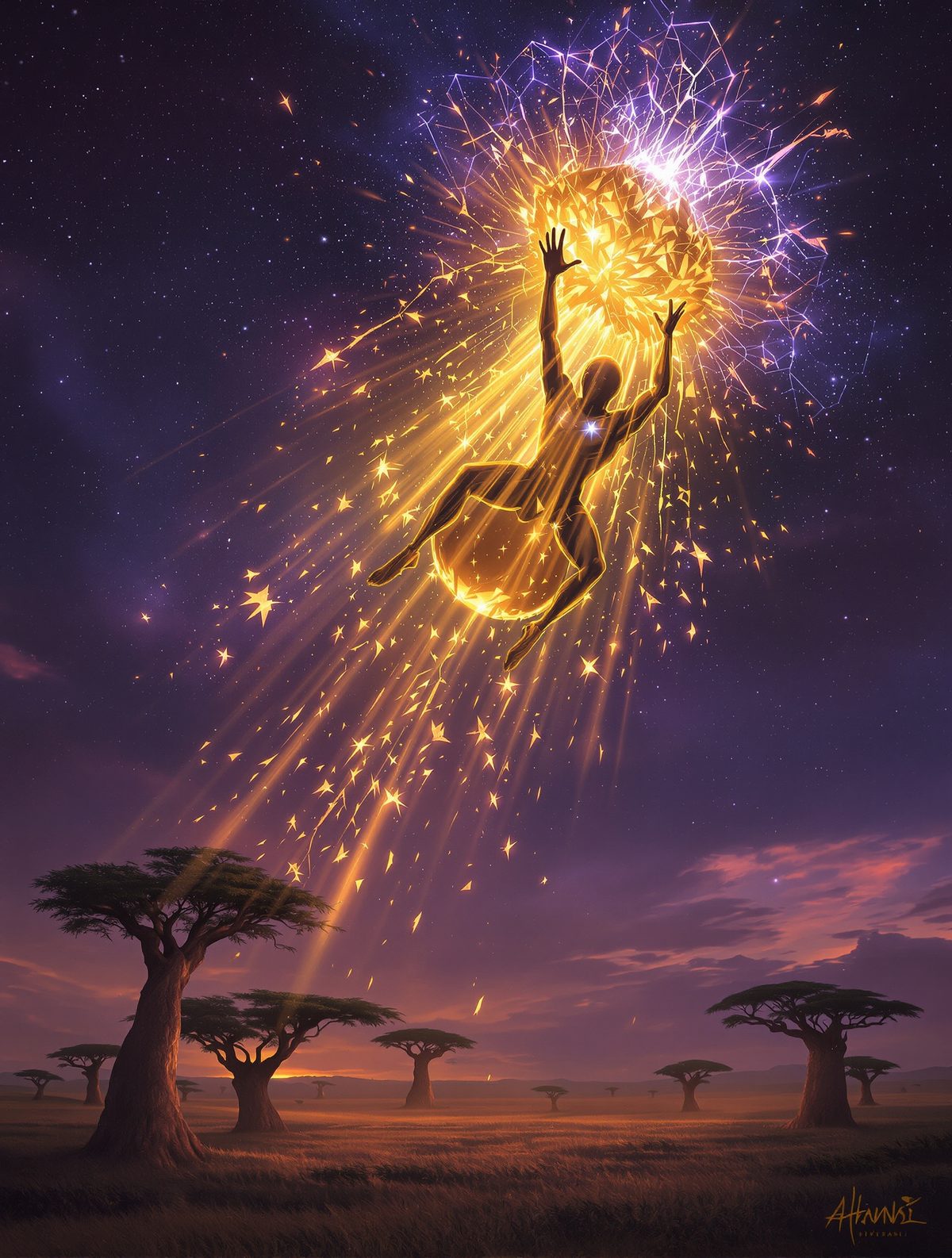
Whatever the cause, the result was catastrophic and beautiful beyond measure. The calabash struck the earth and shattered into countless fragments, each piece containing a portion of universal knowledge. Wisdom exploded outward like the birth of stars, scattering across mountains and valleys, rivers and forests, villages and kingdoms.
In that moment, the fundamental nature of existence changed forever. Knowledge was no longer the monopoly of gods or kings or elders—it became humanity's common inheritance, available to anyone with the wit to recognize it and the courage to claim it. A farmer might suddenly understand the secret of crop rotation while watching the fragments fall. A young mother could grasp the healing properties of forest herbs. A child might gain insight into the movement of stars.
This democratization of wisdom reflected profound changes occurring in West African society during the medieval period. As trade routes expanded and kingdoms grew more complex, traditional systems of knowledge transmission were being challenged. The rise of Islamic scholarship in empires like Mali and Songhai brought new forms of learning that existed alongside ancient oral traditions. Anansi's story became a way of processing these changes—acknowledging both the value of traditional authority and the revolutionary potential of knowledge freely shared.
Echoes Across Time
The impact of Anansi's great heist extends far beyond the boundaries of any single culture or historical period. When enslaved Africans were forced across the Atlantic, they carried these stories with them, weaving new versions that spoke to the particular challenges of survival in the Americas. In the Caribbean, Anansi became a symbol of resistance against oppression. In the American South, his tales offered coded lessons in outsmarting those in power.
But perhaps the most profound legacy of this ancient story lies in its central insight: that the pursuit of knowledge is inherently democratic and revolutionary. Every time a student questions received wisdom, every time a researcher challenges established theories, every time someone refuses to accept that certain knowledge is "not for them," they echo Anansi's ancient rebellion against the hoarding of wisdom.
In our current age of information abundance and inequality—where vast databases of human knowledge exist alongside persistent educational disparities—the calabash's shattering feels remarkably contemporary. The story reminds us that wisdom scattered can never be fully contained again, that once knowledge is freed into the world, no authority can completely control its flow. It's a lesson that speaks as powerfully to modern debates about intellectual property, educational access, and information freedom as it did to medieval West African societies grappling with changing systems of authority and knowledge.
The spider's thread to heaven may have been spun from mythology, but its legacy is woven into the very fabric of human aspiration—the eternal conviction that wisdom belongs not to the few, but to all who are bold enough to reach for it.