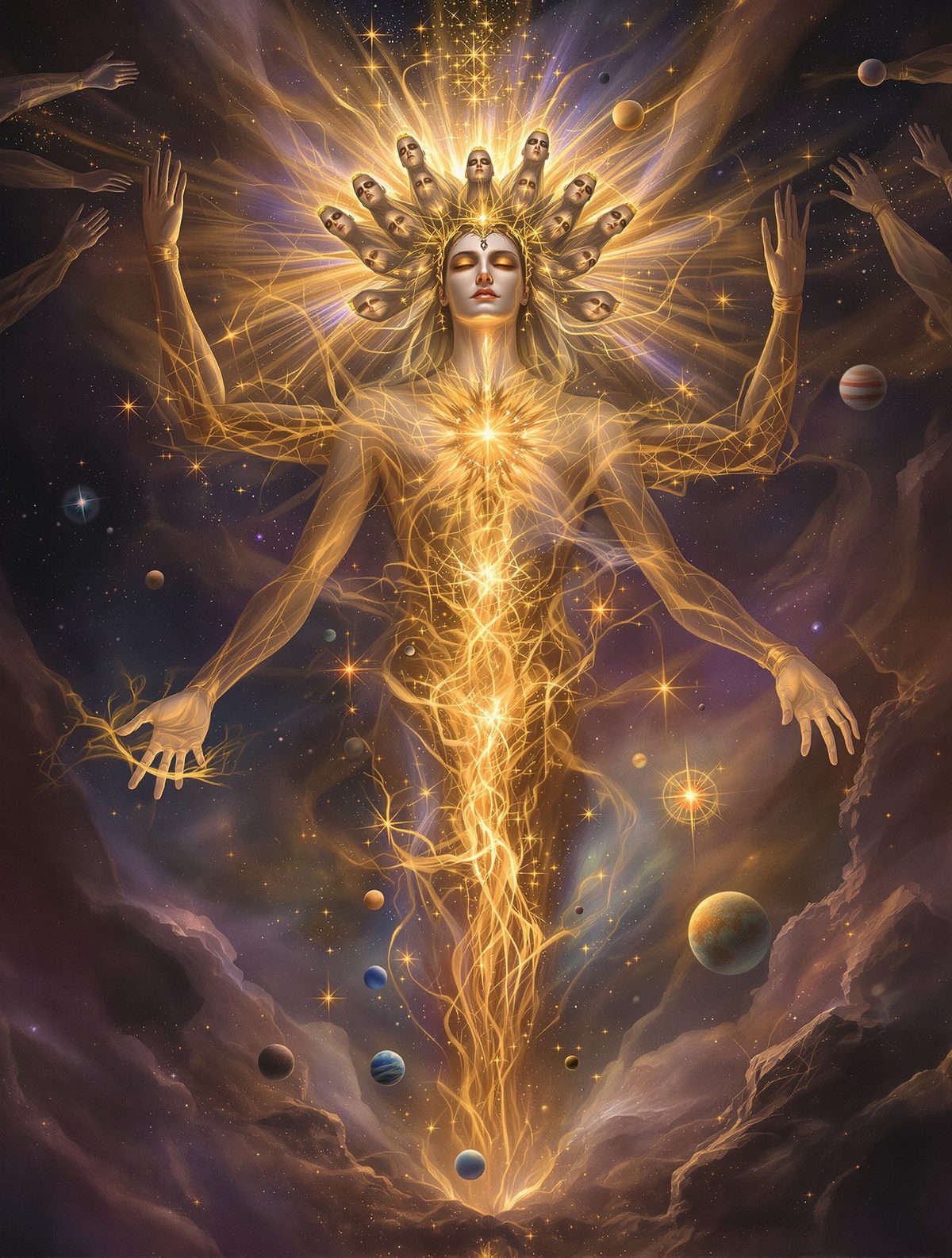
Imagine the ultimate act of divine self-sacrifice: a cosmic giant with a thousand heads, a thousand eyes, and limbs stretching beyond the horizon, willingly offering his body to be torn apart so that you—and everything else in existence—could be born. This isn't the stuff of modern fantasy novels. This is Purusha, the primordial being whose voluntary dismemberment became the blueprint for reality itself, and whose cosmic death gave birth to gods, humans, animals, and the very social order that would define civilization for millennia.
While most creation myths speak of gods breathing life into clay or speaking worlds into existence, the ancient Vedic seers of India told a far more visceral tale. In their vision, creation required the ultimate price—and one being was willing to pay it.
The Being Before Beginning
The Purusha Sukta, found in the tenth mandala of the Rig Veda—one of humanity's oldest religious texts, dating back to approximately 1500 BCE—opens with a description that would make even today's science fiction writers pause in awe. Purusha wasn't just large; he was existence itself given form. The Sanskrit verses describe him as having sahasra-shirsha (a thousand heads) and sahasraksha (a thousand eyes), with hands and feet extending in every direction.
But here's where the story takes its first surprising turn: despite his cosmic proportions, Purusha wasn't alone in an empty void. The hymn tells us that even though he filled all of creation, he simultaneously transcended it by "ten fingers' breadth"—a poetic way of saying that the infinite somehow contained even more infinity. This wasn't a being trapped by his own vastness, but one who chose his fate with full awareness of what lay beyond.
The Vedic poets weren't describing a mindless cosmic force. They were painting a portrait of conscious, willing divinity—a being who looked at non-existence and chose to transform himself into everything that could ever be.
The Sacred Mathematics of Sacrifice
What makes the Purusha story particularly fascinating is its mathematical precision. The hymn doesn't just say "he became everything"—it provides exact cosmic accounting. According to the Vedic calculation, only one-quarter of Purusha became the manifest universe that we can see and touch. The remaining three-quarters? That became the immortal realm, forever beyond human perception.
This wasn't random divine bookkeeping. The ancient seers were encoding profound philosophical concepts into their creation story. They understood that any universe capable of containing consciousness and complexity couldn't possibly represent the totality of existence. There had to be something more—something that remained forever mysterious and untouchable.
The sacrifice itself followed a precise ritual structure that would later influence thousands of years of Vedic practice. The gods—who, intriguingly, seem to appear from Purusha himself—arranged the cosmic sacrifice using the three seasons (spring, summer, and autumn) as their sacred implements. Spring became the clarified butter, summer the fuel for the fire, and autumn the offering itself. Even time, it seems, was born from this primordial dismemberment.
From Flesh to Civilization
Here's where the Purusha myth reveals its most controversial and lasting impact on human society. As the gods began their sacred work of dismemberment, each part of the cosmic giant's body became a specific element of the world—and crucially, a specific class of human society.
From Purusha's mouth came the Brahmins, the priestly class who would speak sacred words and maintain the cosmic order through ritual. His powerful arms transformed into the Kshatriyas, the warriors and rulers who would protect and govern. His thighs became the Vaishyas, the merchants and farmers who would sustain society through trade and agriculture. And from his feet emerged the Shudras, those who would serve the other classes.
This wasn't merely a creation story—it was a divine mandate for social hierarchy. The varna system, which would later evolve into the complex caste structure that still influences Indian society today, traces its mythological origins to this cosmic moment. The hymn suggests that social inequality isn't a human invention, but a reflection of cosmic reality itself.
But the body-to-cosmos transformation didn't stop with human society. From Purusha's mind came the moon, from his eyes the sun. His breath became the wind god Vayu, while his navel transformed into the atmosphere. The earth emerged from his feet, and the heavens from his head. Even the cardinal directions sprouted from his ears.
The Birth of Sacrifice Itself
Perhaps the most mind-bending aspect of the Purusha story lies in its recursive logic. The hymn tells us that from this primordial sacrifice came not just the physical universe, but sacrifice itself as a cosmic principle. The ritual that created everything became the template for all future rituals.
This created a profound theological puzzle that would occupy Indian philosophers for millennia: if sacrifice as a concept was born from Purusha's dismemberment, what power made that original sacrifice possible? The Vedic answer was as elegant as it was mysterious—Purusha sacrificed himself to himself, becoming simultaneously the offerer, the offering, and the recipient of the sacrifice.
This wasn't just abstract philosophy. The Purusha Sukta became one of the most frequently recited hymns in Vedic ritual, chanted at ceremonies ranging from daily prayers to elaborate royal consecrations. When ancient Indian kings underwent the ashvamedha (horse sacrifice) to legitimize their rule, priests would invoke Purusha's cosmic sacrifice as the ultimate precedent. Every ritual fire, they believed, was a small reenactment of that original cosmic dismemberment.
The Paradox of Willing Destruction
What sets the Purusha myth apart from other creation stories is its unflinching focus on voluntary self-annihilation as the ultimate creative act. Unlike the Greek Titans who were violently overthrown, or the Mesopotamian Tiamat who was slain in cosmic battle, Purusha actively chose his own dismemberment. The Sanskrit word yajna (sacrifice) carries connotations not just of offering, but of joyful giving.
This theme of creative destruction would echo throughout Indian thought. The Hindu concept of lila—the divine play in which gods create and destroy worlds for the sheer joy of it—finds its earliest expression in Purusha's willing transformation. Later Hindu deities like Shiva, who dances the universe into existence and dissolution, are philosophical descendants of this cosmic giant who saw death not as ending, but as the ultimate beginning.
The hymn even suggests that this wasn't a one-time event. The closing verses hint that Purusha, having created the universe through self-sacrifice, somehow reconstituted himself and "went beyond" his own creation. Death and rebirth, destruction and renewal—these weren't just natural cycles, but the fundamental rhythm of divine existence itself.
The Giant's Living Legacy
Today, more than three millennia after the Purusha Sukta was first chanted, its influence extends far beyond Hindu temples and Sanskrit scholarship. The hymn's vision of reality as an interconnected web—where every part contains and reflects the whole—resonates with modern ecological thinking and systems theory. When environmentalists speak of humans as part of nature rather than separate from it, they're echoing insights first encoded in this ancient tale of cosmic dismemberment.
But the Purusha story also forces us to confront uncomfortable questions about hierarchy and social justice. If the hymn provided divine justification for inequality, can we separate its profound spiritual insights from its social implications? Modern Hindu reformers and scholars continue to wrestle with this tension, some arguing that the cosmic vision transcends its social applications, others insisting that the myth's hierarchical elements cannot be divorced from its spiritual content.
Perhaps most provocatively, the Purusha myth suggests that creation itself requires sacrifice—not just the sacrifice of a cosmic giant in primordial time, but ongoing sacrifice from all of us. Every breath we take, every meal we eat, every choice we make involves the transformation of one form of existence into another. We are all participants in the cosmic sacrifice that began with Purusha's willing dismemberment.
In a world increasingly aware of its interconnectedness—where every action ripples across global systems of ecology, economy, and information—the vision of Purusha offers both inspiration and warning. We are all part of something infinitely larger than ourselves, the story reminds us. The question is: what are we willing to sacrifice to keep the cosmic dance going?