
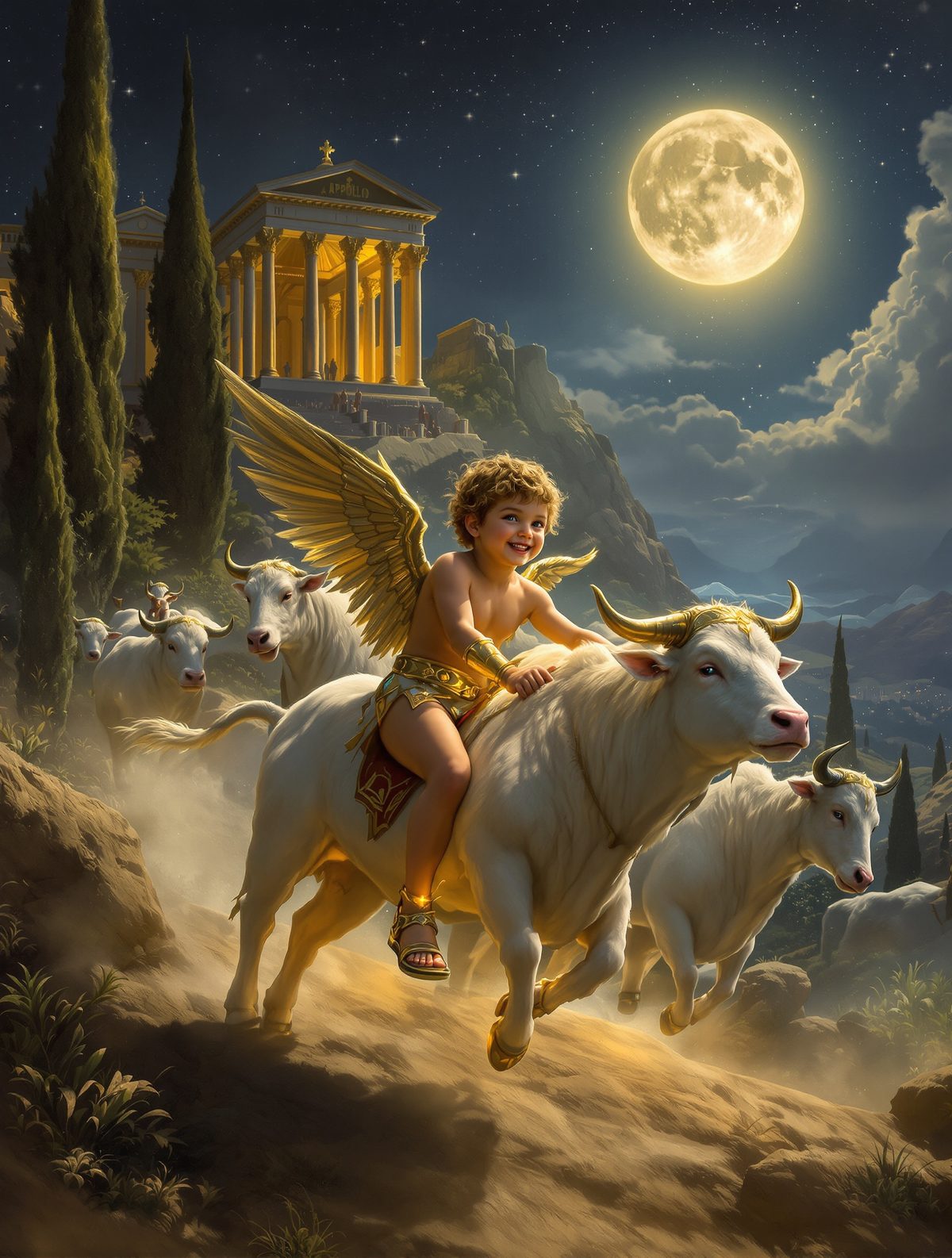
Picture this: the sun is setting over Mount Cyllene in ancient Arcadia, and in a humble cave, something extraordinary is stirring. A newborn infant, barely hours old, opens his eyes with the cunning gleam of a master criminal. While most babies spend their first day crying for milk, this divine child has his sights set on something far more ambitious—orchestrating what would become the ancient world's most audacious cattle heist.
This wasn't just any baby. This was Mercury, known to the Greeks as Hermes, son of Jupiter and the nymph Maia. And before his first sunset, this precocious godling would pull off a crime so clever, so perfectly executed, that it would echo through mythology for millennia—stealing the sacred cattle of Apollo, the mighty sun god himself.
The Divine Escape Artist
According to the Homeric Hymns, particularly the Fourth Hymn to Hermes composed around the 7th century BCE, Mercury's criminal career began with what can only be described as the ancient world's most impressive jailbreak. The infant god, swaddled tightly in his cradle, somehow managed to wriggle free from his bindings while his mother Maia slept soundly in their cave on Mount Cyllene.
But here's where the story gets deliciously improbable: this wasn't a toddler stumbling around in diapers. Ancient sources describe how Mercury, despite being born that very morning, walked with purpose and cunning. The Roman poet Ovid, writing in his Fasti around 8 CE, noted that the god possessed supernatural intelligence from birth—a detail that Romans found particularly appealing, as they valued cleverness and strategic thinking above brute force.
What makes this escape even more remarkable is the location. Mount Cyllene, rising 2,376 meters above sea level in the Peloponnese, was no gentle hillside. It was rugged, dangerous terrain where even experienced travelers feared to venture at night. Yet here was an infant, padding through the darkness with the confidence of a seasoned mountain guide.
The Perfect Crime Takes Shape
As Mercury descended the mountainside, he spotted his target: a magnificent herd of cattle belonging to Apollo, grazing peacefully in the meadows of Pieria. These weren't ordinary livestock—they were the sacred white cattle of the sun god, said to number exactly fifty head, each one perfect and unmarked.
Now here's a detail that most retellings gloss over: according to the mythographer Apollodorus, writing in the 2nd century BCE, Mercury didn't just stumble upon these cattle. He had planned this heist. The infant god had somehow acquired knowledge of Apollo's daily routines, knowing that the sun god would be occupied with his duties of driving the solar chariot across the sky and wouldn't return to check on his herd until dawn.
But Mercury's masterstroke wasn't the theft itself—it was the method. The clever godling drove all fifty cattle backwards, forcing them to walk in reverse so their hoofprints would point in the wrong direction. Any tracker following the trail would assume the herd had traveled toward Apollo's pasture, not away from it.
Roman writers particularly admired this detail because it demonstrated virtus—not just courage, but intelligent courage. The 1st-century historian Diodorus Siculus noted that this backward cattle drive became a standard trick used by actual cattle rustlers throughout the Mediterranean world, suggesting that life imitated art in this case.
The Sun God's Investigation
When Apollo returned at dawn and discovered his cattle missing, his rage reportedly caused the morning sun to burn brighter than usual—a detail preserved in various Roman astronomical texts that attempted to explain unusually intense sunrises. The sun god immediately began tracking the thieves, but the backward hoofprints had him thoroughly confused.
According to Hyginus's Fabulae, compiled in the 1st century CE, Apollo spent hours following false leads. The tracks seemed to indicate that cattle had arrived at his pasture rather than departed from it. Some versions of the myth suggest that Apollo consulted the Oracle at Delphi—his own oracle—for guidance, only to receive the cryptic advice to "seek the child born today."
What's particularly fascinating is how Roman sources emphasized Apollo's methodical investigation. Unlike Greek versions that portrayed him as hot-headed, Roman tellings depicted a more systematic approach—very much in line with Roman legal procedures. Apollo questioned witnesses (other gods and nymphs who might have seen something), examined physical evidence, and followed logical deduction.
Eventually, divine intuition led Apollo to Mount Cyllene and the cave where Maia lived with her newborn son.
The Greatest Performance in Divine History
The confrontation that followed has been called by classical scholars "the birth of divine diplomacy"—and it's easy to see why. When Apollo burst into the cave, demanding the return of his cattle, he found what appeared to be a completely ordinary baby, swaddled innocently in his cradle, making soft cooing sounds.
Mercury's performance was Oscar-worthy. Roman poet Propertius, writing in the 1st century BCE, described how the infant god managed to produce tears on command, stretch his tiny arms appealingly, and even manufacture what appeared to be genuine baby drool. When Apollo accused him of theft, Mercury responded with perfectly timed gurgles and cries of apparent confusion.
"How could I steal cattle?" Mercury allegedly asked in perfectly articulated Latin (according to Roman sources, naturally). "I was born today! I can barely lift my own head, let alone drive fifty bulls across mountain terrain. Look at me—I'm a baby who thinks only of milk and sleep!"
The act was so convincing that even Maia, his own mother, began to doubt her son's guilt. Ancient sources suggest she had no idea Mercury had even left the cave, making her protestations of his innocence completely genuine and therefore more convincing.
Divine Justice and Unexpected Consequences
But Apollo wasn't fooled for long. Divine intuition, combined with some clever detective work, eventually led him to the hidden cattle. Some versions of the myth describe how Mercury had concealed the herd in a cave near Pylos, while others suggest he had driven them all the way to southern Italy—a detail that Roman audiences particularly appreciated, as it connected the myth to their own peninsula.
When confronted with the evidence, Mercury finally dropped his innocent act and revealed his true nature. But instead of punishment, something unexpected happened: Apollo was impressed. The sun god had never encountered such creative criminal thinking, such perfect execution, such convincing deception.
According to the Bibliotheca attributed to Apollodorus, this confrontation led to one of the ancient world's first recorded plea bargains. Mercury offered to return the cattle in exchange for amnesty, but he sweetened the deal by presenting Apollo with a gift he had crafted during his brief criminal career: the first lyre, made from a tortoise shell he had found on his way to steal the cattle.
Apollo was so enchanted by the music Mercury produced that he not only pardoned the theft but essentially hired the infant god as his agent and messenger.
Why Ancient Rome Loved This Story
This tale of divine cattle rustling resonated deeply with Roman audiences for reasons that go far beyond simple entertainment. In a society that prized cleverness, strategic thinking, and the ability to turn disadvantage into opportunity, Mercury represented the perfect Roman hero—even as a criminal.
The story also reflected Roman attitudes toward justice and redemption. Unlike many mythological punishments that involved eternal torment or transformation into animals, this myth demonstrated that even serious crimes could be forgiven if the perpetrator showed genuine cleverness and offered appropriate restitution. This aligned perfectly with Roman legal principles that emphasized restoration over pure punishment.
Perhaps most importantly, the myth of Mercury's first crime established him as the divine patron of commerce, negotiation, and yes, even beneficial deception. Roman merchants, diplomats, and lawyers all claimed Mercury as their guardian, seeing in his infant caper a template for turning conflict into mutual benefit.
Today, as we navigate a world where innovation often disrupts established order, where the line between creative disruption and harmful deception grows ever thinner, Mercury's story offers a timeless lesson: true cleverness isn't just about getting away with something—it's about transforming confrontation into collaboration, turning theft into trade, and proving that even the youngest among us can change the rules of the game entirely.