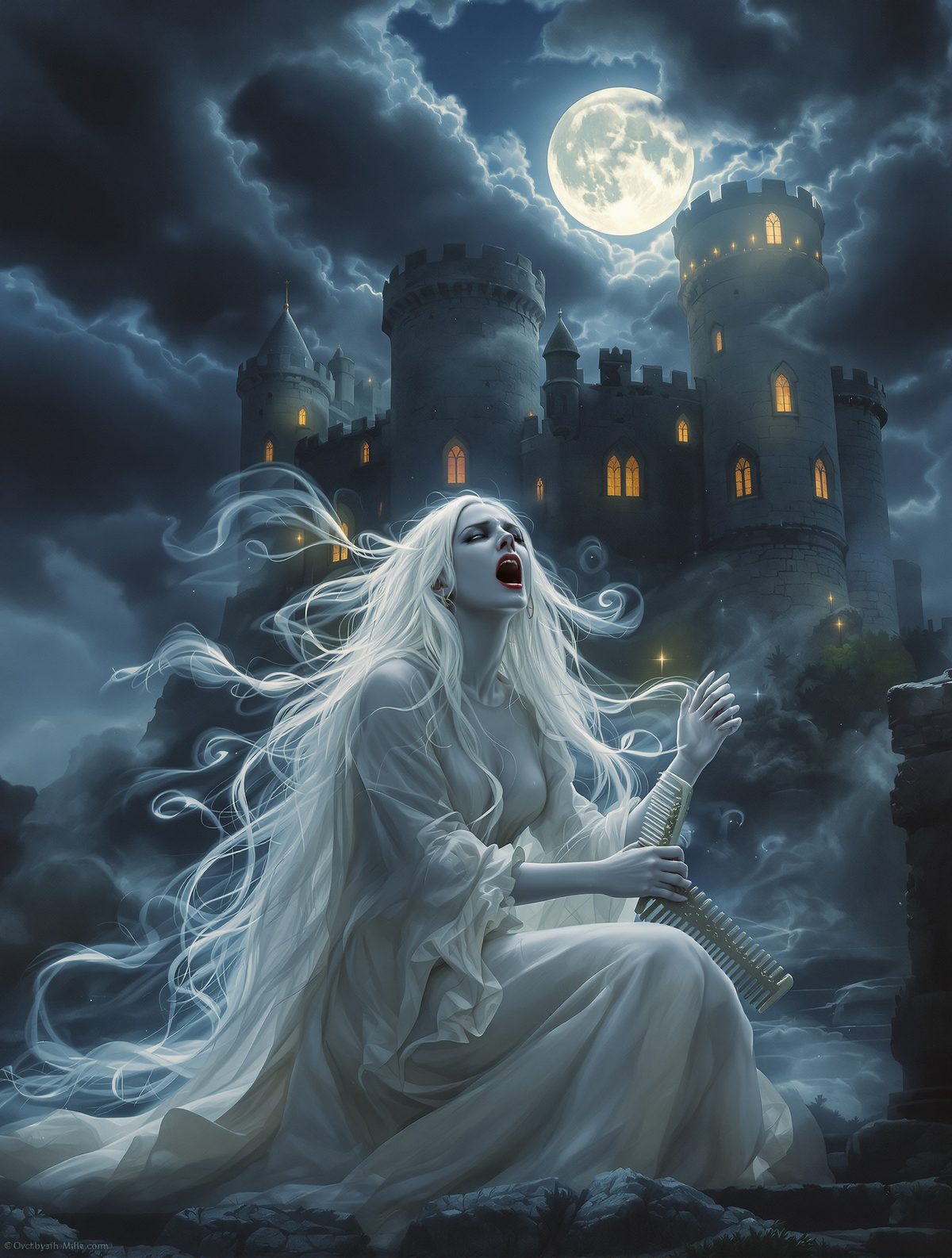
The mist clung to the ancient stones of Tara like ghostly fingers, and in that ethereal fog, she appeared. Her hair cascaded like liquid moonlight as she drew an ornate silver comb through its length, each stroke deliberate and ritualistic. The woman's voice rose into the Irish night—not quite human, not quite wind—a sound that seemed to emerge from the very bones of the earth itself. Inside the hill fort, High King Conn Cétchathach slept soundly, unaware that his fate had already been sealed by forces far older than his crown.
This was no ordinary mourner. This was the bean sídhe—the banshee—and her arrival at Tara in the 2nd century CE would mark the first recorded instance of the most chilling prophecy in Irish folklore. For when the banshee keens, death follows as surely as dawn follows night.
The Ancient Covenant of Sorrow
Long before Christianity set foot on Irish soil, the Celts understood that death was not merely an ending, but a transition requiring proper ceremony. The tradition of keening—professional mourning performed by women—was already ancient when the first banshees were said to have emerged from the síd, the otherworldly mounds scattered across Ireland's landscape.
According to the oldest manuscripts preserved in the Book of Leinster, banshees were originally mortal women bound to specific noble families through supernatural contracts forged in the mists of prehistory. These weren't random hauntings, but hereditary obligations that transcended death itself. The Annals of the Four Masters record that five royal bloodlines—the O'Neills, O'Briens, O'Connors, O'Gradys, and Kavanaghs—each had their own dedicated banshee, spiritual servants who would keen for their deaths across generations.
But Conn of the Hundred Battles, the legendary High King whose reign supposedly lasted thirty-five years, would become the first monarch whose death was foretold by the banshee's supernatural keen. The scribes at the monastery of Glendalough, writing centuries later, claimed that on the night before his final battle, every soul within five miles of Tara heard her voice—a sound they described as "more sorrowful than all the mothers of Ireland weeping for their lost children."
The Three Forms of Prophetic Grief
What made the banshee's keen so terrifying wasn't merely its supernatural origin, but its uncanny accuracy. Irish folklore describes three distinct manifestations of the banshee, each appearing according to the circumstances of the impending death.
The first form—and the one said to have appeared at Tara—was that of a young woman of ethereal beauty, her long silver hair flowing like water as she combed it beside sacred wells or ancient stone circles. This incarnation appeared for deaths that came too soon, for leaders cut down in their prime. Her beauty was said to be so haunting that mortal men who glimpsed her would forget all earthly concerns, consumed by longing for the otherworld.
The second manifestation appeared as a washerwoman by the river's edge, scrubbing bloody garments in the current. This was the bean-chorrán, and she emerged before deaths in battle. Warriors claimed they could identify their own clothing among the bloodstained fabrics she cleaned, sealing their doom with terrible certainty. The 8th-century saga Táin Bó Cúailnge describes the hero Cú Chulainn encountering such a figure washing his own armor the night before his final battle.
Most terrifying of all was the third form: an ancient crone in tattered grey robes, her face hidden beneath a hood, standing silent vigil outside the homes of the dying. This banshee appeared for deaths from old age or illness, and her presence meant that no earthly intervention could prevent what was coming. She would remain motionless for hours, sometimes days, until death finally claimed its victim.
The Science Behind the Supernatural
Modern researchers have uncovered fascinating explanations for the banshee phenomenon that make it no less remarkable. Dr. Patricia Lysaght of University College Dublin, who conducted the most comprehensive study of banshee accounts in the 1980s, discovered that many supernatural encounters could be traced to the behavior of the barn owl—Tyto alba—whose ghostly white appearance and blood-curdling shrieks often coincided with reports of banshee sightings.
But the correlation goes deeper than mere mistaken identity. Barn owls are exceptionally sensitive to atmospheric pressure changes and electromagnetic fluctuations that often precede severe weather. In ancient Ireland, where battles were frequently fought during seasonal transitions and where poor weather could mean death for the vulnerable, the owl's agitation might indeed have preceded human casualties.
Even more intriguing is the documented phenomenon of infrasound—sound frequencies below human hearing range—that can be produced by wind passing through certain geological formations. The ancient stone circles and passage tombs where banshees were most often reported are precisely the kinds of structures that could generate these inaudible vibrations. Research has shown that infrasound can trigger feelings of unease, depression, and even hallucinations in humans—sensations that might easily be interpreted as supernatural encounters.
When Legend Shaped History
The power of banshee belief extended far beyond mere folklore. Historical records show that reported banshee encounters could influence political decisions, military strategies, and even royal succession. In 1014 CE, before the Battle of Clontarf, multiple witnesses claimed to see banshees washing armor in the River Liffey. The sight was so unnerving that several of Brian Boru's allies reportedly withdrew their troops, potentially altering the course of the battle that would reshape medieval Ireland.
Perhaps most remarkably, banshee traditions served as an early warning system for political upheaval. The great Irish houses took these omens seriously enough to modify their behavior accordingly. When a banshee was reported near a chieftain's stronghold, it often triggered succession planning, alliance negotiations, and strategic preparations that helped clans survive leadership transitions more smoothly than they might have otherwise.
The practice persisted well into the modern era. As late as 1692, the death of King William III was reportedly preceded by banshee keening heard across County Cork, according to letters preserved in Trinity College Dublin's manuscript collection. Even the Great Famine of 1845-1852 was accompanied by widespread banshee sightings, as if the very land itself was mourning the catastrophe unfolding across Ireland.
The Last Keen
The final authenticated banshee encounter involving Irish royalty occurred in 1948, just months before the death of Lord Killeen, one of the last recognized chiefs of the O'Brien clan. Witnesses in County Clare reported seeing a figure in white combing her hair beside the ruins of his family's ancient castle, her keen echoing across the countryside for three consecutive nights. When Lord Killeen died of a heart attack six weeks later, newspapers across Ireland carried the story, marking what many consider the end of an era stretching back over two millennia.
Today, the physical evidence of banshee tradition remains scattered across Ireland's landscape. The "keen stones" where professional mourners once gathered still stand in graveyards from Cork to Donegal. The sacred wells where banshees supposedly appeared continue to draw visitors who leave offerings of coins and ribbons. Most poignantly, recordings made in the 1950s captured some of the last traditional keening performances, preserving the haunting vocal techniques that may have inspired the banshee legend itself.
Echoes Across Time
In our age of medical monitoring and predictive algorithms, it's tempting to dismiss the banshee as mere superstition. Yet the tradition reveals something profound about humanity's relationship with mortality and our need to find meaning in loss. The banshee wasn't just a harbinger of death—she was a guardian of memory, ensuring that no death went unmourned, no life passed without acknowledgment.
Perhaps that's why banshee stories persist in modern Ireland, adapted for contemporary anxieties. Urban legends speak of ghostly figures appearing before car accidents, or mysterious phone calls that precede family tragedies. The form may evolve, but the fundamental human need to believe that death has meaning—and that someone, somewhere, will mourn our passing—remains as powerful today as it was when that first supernatural keen echoed across the hill of Tara.
The banshee's greatest gift wasn't prophecy, but perspective: a reminder that in a world where death is certain, how we honor that reality defines not just our legends, but our humanity itself.