In a world where gods toyed with mortals and myths lived alongside men, one story stands as a testament to the power of art to transcend the realms of the living and the dead. It whispers through the annals of Greek mythology as a haunting lullaby, a ballad of love and loss, a symphony echoing in the shadows of Hades’ domain. This is the tale of Orpheus, the celebrated bard whose music pierced the veil between life and afterlife, leaving even death in tears.
The Mortal Minstrel Who Could Enchant the Gods
Orpheus, born of the muse Calliope and the Thracian king Oeagrus, possessed an unmatched musical prowess gifted by Apollo himself. Legends speak of how, with a divine lyre, Orpheus could charm the trees into dancing and the stones into forming bridges. Birds would cease their songs just to listen, and wild beasts lay tamely at his feet, lulled by the strains of his enchanting melodies.
Yet, it was not his divine parentage or his supernatural skills that painted Orpheus into the cosmic tapestry of legend; instead, it was a love so profound that it defied death itself. Eurydice, a woman of ethereal grace, captured his heart, and they became inseparable. However, tragedy soon struck when a serpent's fangs claimed Eurydice’s life, casting Orpheus into an abyss of grief.
A Descent into Darkness
In an audacious act of defiance against the natural order, Orpheus resolved to retrieve his beloved from the clutches of the Underworld. It wasn't unheard of for mortals to enter Hades' domain—after all, Heracles and Theseus had done so—but rarely did anyone leave unchanged, if at all. Undeterred, Orpheus set forth alone, his lyre his only companion, threading the path to Hades with the determination only a heartbroken lover could muster.
The myth tells that as Orpheus journeyed deeper into the realm of darkness, his music flowed like a river over jagged rocks, smoothing the harsh edges of despair that surrounded him. Charon, the taciturn ferryman, was so moved by Orpheus’ song that he carried him across the Styx without demand. Cerberus, the formidable three-headed hound, lay docile, lulled by the soothing strains of Orpheus' lyre.
When Death Wept
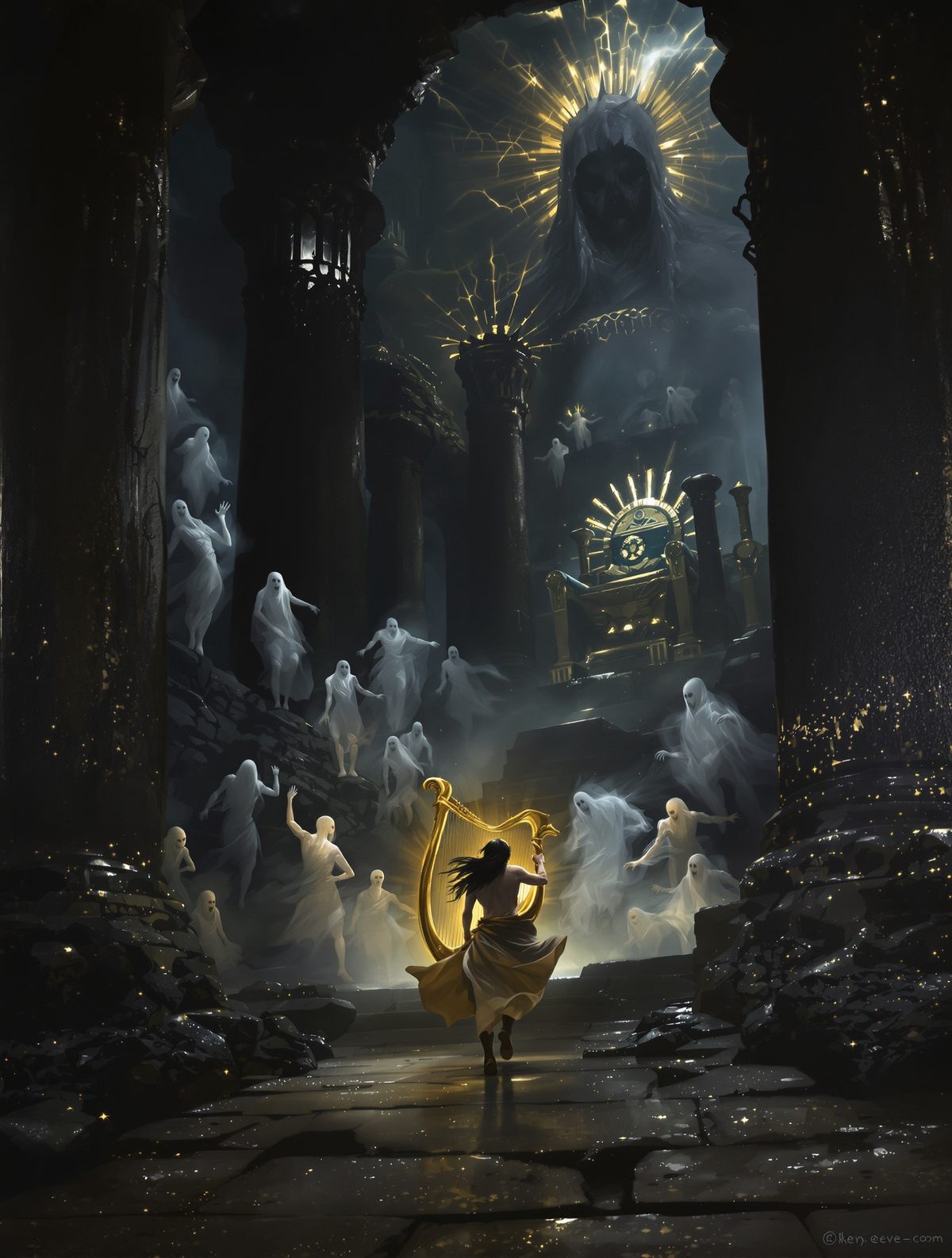
In the great hall of the Underworld, amidst shadows thick as night, Orpheus stood before the solemn king Hades and his queen Persephone. He played not a dirge, but a song of longing so pure that it pierced the very essence of the Underworld. The cold, shadowy spirits paused in their eternal torment, and for the first time, the unyielding faces of the rulers of death softened.
Hades, whose heart was thought to be as unyielding as the adamantine gates of his realm, was moved to tears, as was Persephone, who herself knew something of longing after having been torn from the springtime world. Never before had such a plea been echoed in those dark halls. It was not only his skill but the truth of his grief and unyielding love that broke the heart of the Lord of the Dead.
A Conditional Reprieve
An impossibility was granted. Eurydice could return with him to the realm of the living, but there was one solitary, treacherously simple condition: Orpheus must never once look back at her until both had set foot in the light of the upper world. It seemed a small price for such a significant gift, yet on this delicate thread hung the weight of Orpheus' undying hope.
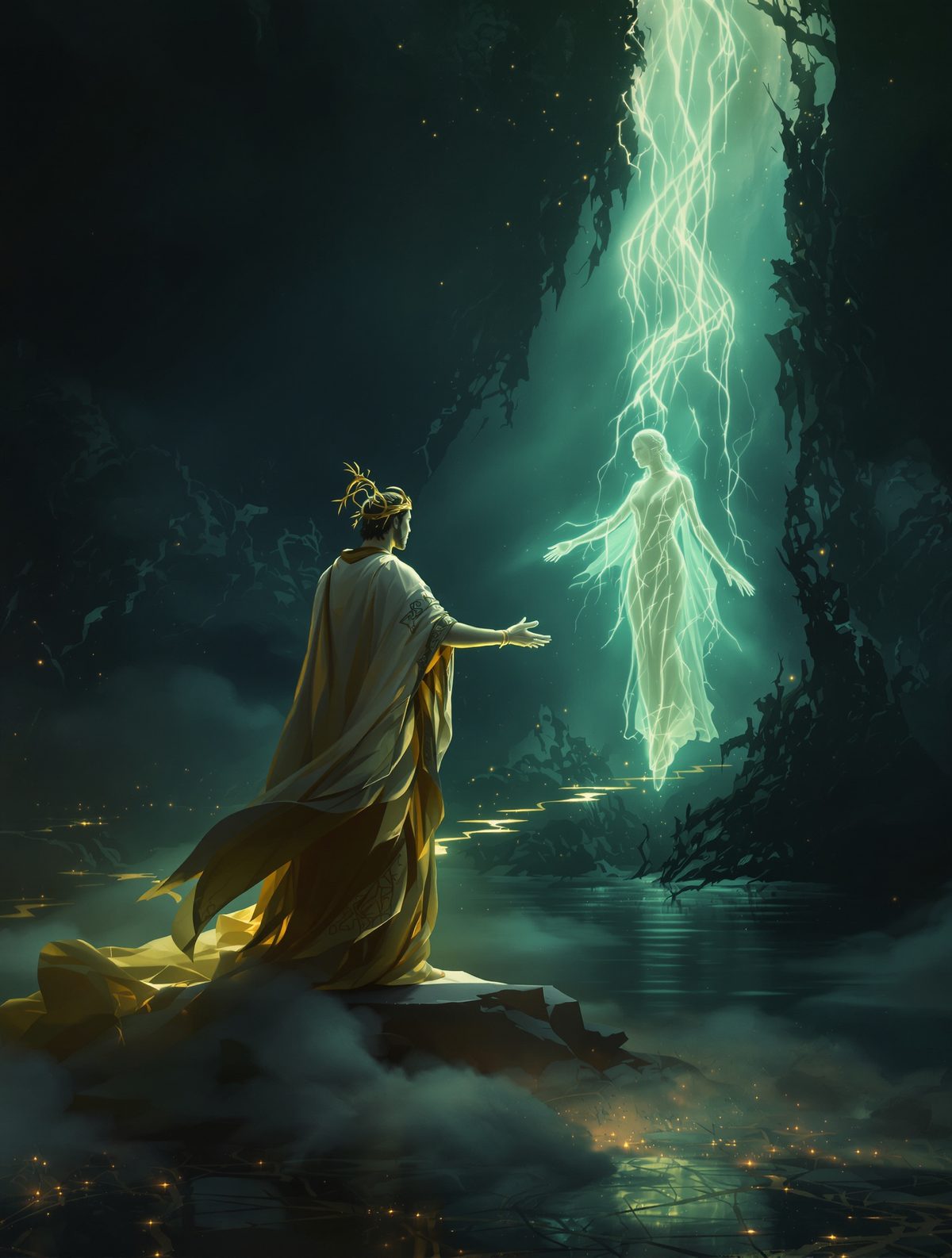
Hand in hand, they ascended the dim and winding path. What Orpheus did not realize was that the weight of longing and the strain of doubt could be a heavier burden than the Underworld itself. As they traversed the liminal space between life and death, silence surged behind him like a tidal wave. Every footfall was a test of faith, every shadow a reminder of his solitude. The world closing in around him, Orpheus felt the gravitational pull of fear—the fear that she was not truly there, that Hades had played a cruel jest.
The Cost of a Glance
The mouth of the cave emerged ahead, light piercing through—a beacon of salvation and heartache. As Orpheus stepped into the realm of mortals, his heart, once a vessel of music and hope, froze with doubt. Against all caution, driven by the primal need to confirm truth, he turned to glimpse his beloved. But Eurydice was still within the shadows—a mere breath from the world of the living. In that moment, she began to slip away, her specter drawn back into the abyss, her voice whispering a farewell he could not hear.
There, at the threshold, Orpheus stood alone once more, his lament a silent scream that resonated through both worlds. His journey, which had transcended life and death, ended in the cruel irony of a backward glance—a movement so simple, yet infinitely profound.
Echoes that Resonate Today
The myth of Orpheus and Eurydice is a timeless lesson about love, faith, and the human condition. It speaks to the eternal struggle between hope and despair, courage and doubt. In today's world, where uncertainty often pervades our consciousness, the story of Orpheus serves as a potent reminder of the power of art and emotion to catalyze change—even in the face of insurmountable odds.
Much like Orpheus, we are all journeying towards the light, burdened by the past and yearning for a future colored by love and connection. Perhaps his tale reminds us that beauty, even born of tragedy, can bridge the chasm between darkness and dawn, serving as a beacon guiding us through our own shadowy underworlds—daring us not to look back, but ever forward.