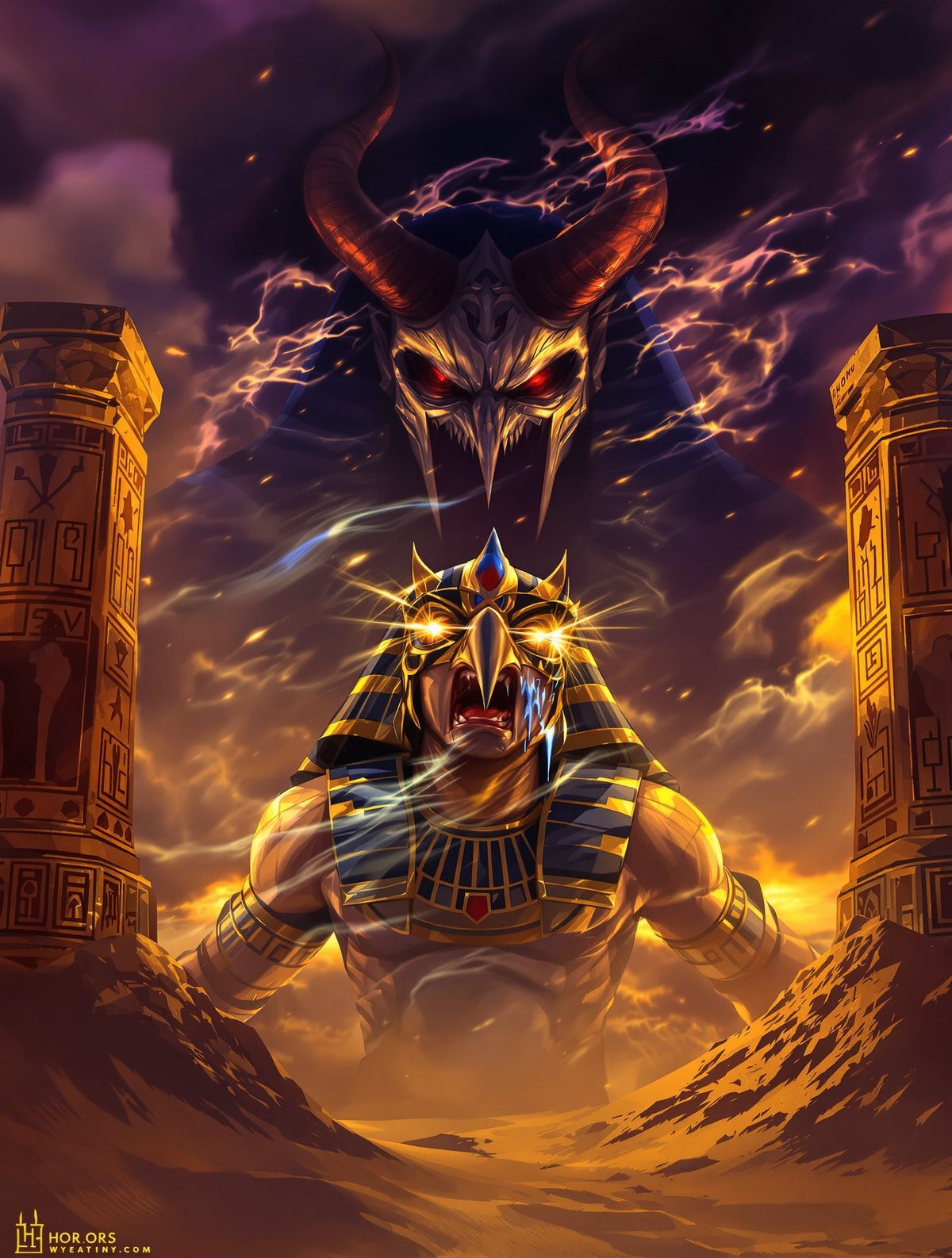
In the swirling mists of ancient times, where divine beings roamed the deserts of Egypt, a battle unfolded that would etch its agony into the annals of mythology forever. It was not a war waged by legions, but by gods, as Set and Horus clashed in a cataclysmic duel over Egypt's sacred throne. The stakes were cosmic, the grudges deep. As thunder rumbled across the Nile, history would remember this battle for Set's treachery and the gruesome moment when he gouged out Horus's eye, a simple act of violence that would resound through the ages.
The Divine Rivalry: Bloodlines and Betrayals
To comprehend the gravity of the duel between Horus and Set, one must first unravel the tangled web of their divine lineage. In the pantheon of Egyptian gods, these two figures were polar opposites, fated to eternally clash. Set was the god of chaos, storms, and deserts, a figure under whose shadow lurked betrayal and defiance. Horus, on the other hand, was the god of the sky and kingship, the embodiment of light and justice.
Set's infamous deed had its roots in the murder of Osiris, the father of Horus and Set's brother. In an ambitious grab for power, Set killed Osiris, scattering his remains across Egypt. It was Isis, Osiris's wife and Horus's mother, who retrieved and reassembled her husband's body, thus granting him eternal life in the realm of the dead. But Horus, Osiris's son, could not accept such a fate and vowed to reclaim his father's throne—a birthright usurped by Set.
The Cataclysmic Clash: God Against God
The battle that ensued was not merely about power—it was vengeance personified. Fought over eighty years (so legends say), their conflict spanned deserts and riverbanks. Each encounter was as merciless and ferocious as the last. Set, wielding the power of storms, hurled sands and chaos at his nephew. Horus, in contrast, harnessed the strength of the falcon, striking with precision and unyielding determination.
It was during one of these brutal confrontations that Set committed the heinous act that would immortalize their rivalry. With a move that remains infamous to this day, Set tore the Eye of Horus from its socket, leaving his nephew maimed and the celestial balance threatened. In ancient Egyptian belief, the eye symbolized protection, health, and restoration—elements which now lay in tatters.
Healing by Moonlight: Thoth's Divine Intervention
As Horus lay wounded, the universe seemed to shudder. But where chaos threatened to prevail, order was restored by an unlikely ally. The moon god Thoth took upon himself the delicate task of healing Horus's grievous wound. Loving and wise, Thoth meticulously restored the eye, employing a magic that was as precise as it was powerful.
The restored eye was not just a display of Thoth's divine abilities; it became the "Wedjat" or "Eye of Horus," a symbol of healing and protection. However, here's a detail that astonishes many—Thoth did not restore the eye simply out of kindness. In some myths, he did so to win Horus's favor during a subsequent trial over the throne, thus ensuring the continuation of ma'at, or divine order.
The Eye that Watched Over Egypt
The Eye of Horus, painstakingly restored, transcended its symbolism as a mere mythic artifact. It became the talisman of ancient Egypt itself. Often depicted on amulets, pendants, and the prows of seafaring vessels, it was believed to ward off evil and offer protection. Some pharaohs even went to battle with the emblem emblazoned on their chariots, seeking to channel its protective power.
Interestingly, modern scholars have noted another layer of intrigue—a mathematical one. The Eye of Horus was also used to represent fractional measurements in Egyptian accounting, with each part of the eye symbol corresponding to fractions of a whole. This unexpected connection underlines the eye's deep-seated influence, extending beyond the spiritual into the realms of daily life and trade.
Legacy Beyond Ragnarok: Why It Matters Today
The epic battle between Horus and Set transcends myth, resonating with timeless themes of justice, resilience, and healing in the face of chaos. As we delve into the rich tapestries of Egyptian mythology today, the story challenges us to reflect on the dualities within our own lives: order versus chaos, creation versus destruction, vengeance versus forgiveness.
In a world constantly grappling with its battles, the Eye of Horus stands as a reminder of resilience and recovery. It teaches us that even when the divine—or the human—order is disrupted, healing and restoration are possible, and justice can prevail. Much like Horus, who rose from injury to reclaim his rightful place, we too can find balance amidst disorder.
The legends of Horus and Set are not confined to the dusty pages of antiquity; they reverberate in every struggle where light combats darkness. To look upon this ancient tale is to glimpse the eternal dance of conflict and harmony, a saga as relevant today as it was in the sands of Egypt millennia ago.