
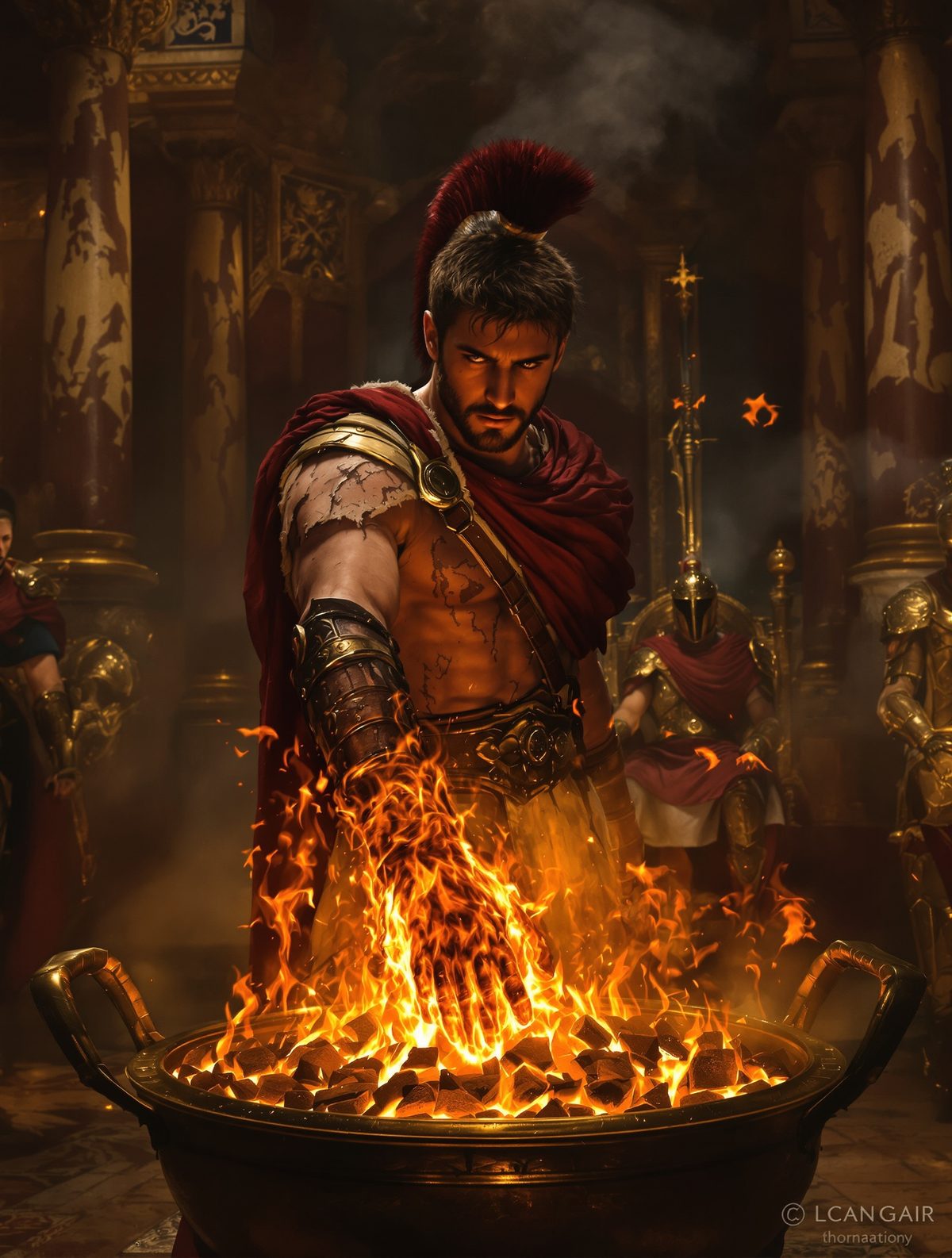
Imagine standing in an ancient Etruscan throne room, where flickering shadows dance across stone walls and the scent of burning wood hangs heavily in the air. Before you, a Roman stands resolute, his arm thrust defiantly into a brazier of roaring flames. His expression is calm, composed, as though the searing agony were but a fleeting discomfort. Witnessing this visceral testament of courage, even the Etruscan king trembles. This is the story of Gaius Mucius Cordus, history's fearless exemplar of unwavering will.
The Daring Plot: Mucius's Bold Endeavor
It's the year 508 BCE, and Rome is locked in a deadly struggle with Lars Porsenna, the powerful king of Clusium, a key city of the Etruscan League. The Etruscan siege of Rome threatens the very survival of the nascent Republic. The stakes have never been higher. Enter Gaius Mucius Cordus—later renowned as Scaevola—as he resolves to shift the tide of this grueling conflict. His plan is audacious, yet simple: infiltrate the enemy camp and assassinate King Porsenna.
The stealthy cloak of night shields Mucius as he creeps into the enemy stronghold. Tension hangs thickly in the air as he scans for his target. Yet, even the most carefully crafted plans can unravel in the face of uncertainty. Unable to distinguish Porsenna from his retinue, Mucius's hand wavers, and a servant becomes his unintended victim. The clamor alerts the guards, and Mucius soon finds himself seized, destined to face the formidable king he sought to eliminate.
The Captive's Conviction: Challenge and Defiance
Dragged before Porsenna's throne, Mucius stands unyielding. The king's eyes burn with a mixture of anger and intrigue as he addresses the bound Roman. Mucius, neither pleading for mercy nor bending under pressure, calmly explains his purpose. His words carried the iron resolve of Rome: a conviction that impressed even seasoned warriors.
As Porsenna threatens Mucius with torturous death by fire, the Roman seizes the narrative. With resolute serenity, he turns casually to a brazier simmering nearby. Mucius thrusts his right hand into the heart of the flames. Time dilates in an eternal moment of pain and power. He doesn't flinch, doesn't cry out—won't cry out. Instead, he holds his gaze firm upon Porsenna, his resolve as enduring as Rome itself, branding his legend with flesh and flame.
Astonishing Courage: The Aftermath of the Flames
The throne room stands stunned by the scene, as Porsenna, astounded by such a fierce display, hesitates. How could one man so willingly endure agony? Mucius, unbothered by the acrid smell of burning flesh, declares boldly that Rome hides within her belly three hundred more just as prepared to sacrifice themselves. The Etruscan king, shaken to his core by this revelation, understands the futility of breaking Roman spirit through intimidation or force.
In a gesture surprising both to his captors and Mirces himself, Porsenna orders Mucius's release. The demonstration of such courage demanded respect, a respect that could not be bound by chains. Inspired, Porsenna makes peace with Rome, lifting the siege and ensuring the survival of an empire destined to leave an indelible mark on history.
Beyond the Flames: Mucius's Enduring Legacy
From that day forward, Mucius bore the moniker Scaevola, meaning "left-handed" in Latin, a reminder of the hand he sacrificed for his city. But this tale is more than flesh and blood; it resonates deeply through Rome's collective identity. Historians may debate the veracity of legend versus reality, yet the story of Mucius Scaevola transcends minutiae. It embodies the archetypal Roman virtues of gravitas, virtus, and pietas—dignity, courage, and duty.
Even Cicero, writing centuries later, praised Scaevola’s act as a pinnacle of virtus, a testament not only to individual bravery but to the indomitable spirit of an entire people. This narrative, recounted through ages and artists, became a formative mythos shaping Roman ethos and identity. It embolded future generations to stand steadfast against overwhelming odds, shaping the Roman ideology that would forge an empire.
Lessons in Resolve: Reflections for Our Time
Mucius Scaevola's legend challenges us to reflect on the measures of courage and conviction in our modern world. At a time when we often measure success through binary outcomes, Scaevola's act reminds us that sometimes the true victory lies in steadfast dedication to one's principles. As we navigate the complexities and moral challenges of today's global landscape, we might ask ourselves: What is the fire we would willingly endure to safeguard what we hold most sacred?
Ultimately, the tale of Mucius Scaevola burns brightly in the annals of history, reminding us that sometimes our greatest strength is not the force we project upon others, but the fire of our own unyielding spirit.