
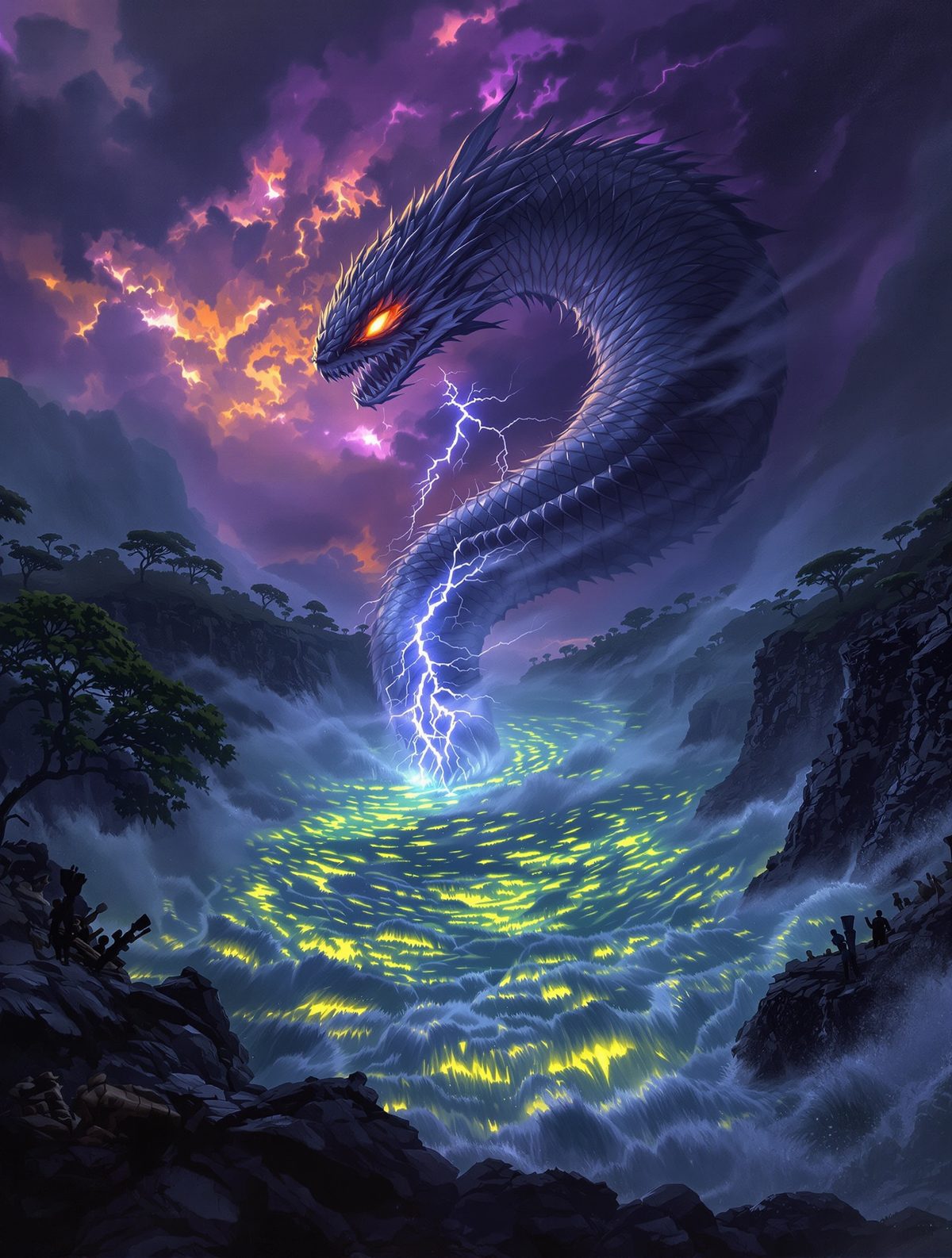
In the swirling depths of the mighty Zambezi River, the air thrums with a legend both awe-inspiring and cautionary. It is the whispered story of Nyaminyami, the serpent god whose domain shimmers under the African sun. The Tonga people, who have lived alongside these waters for centuries, tell of the day men blinded by ambition built a wall across his home, unknowing, unthinking. And so, the floods came, and they always come.
The Serpent Beneath the Surface
The life-giving waters of the Zambezi carve their path through the landscape, a force of nature teeming with mystery and reverence. To the Tonga people, who call the river banks home, this river is not merely a geographic feature but a living entity, a source of sustenance and spirit bound intimately with their lives. Central to their belief is Nyaminyami, the god of the river, a serpent of staggering length and power who reposes beneath its current.
According to their tales, Nyaminyami, a being of both creation and destruction, was once united with his wife beneath the river. Together, they presided over the balance of life, often emerging to provide abundance and prosperity. Yet, like the unpredictable waters of the Zambezi, their natures could turn tempestuous, bringing floods and famine when angered. The Tonga people, respectful and wise, understood that to live peacefully by the Zambezi was to honor these dual aspects, to live harmoniously with the river and the spirits that governed it.
Men and Machines: The Inception of the Dam
The story takes a dramatic turn in 1956, when the towering ambitions of men converged upon the tranquil banks of the river. Led by a vision of harnessing the muscular might of the Zambezi, engineers descended upon the land, their blueprints framing a vision of economic prosperity. Their mission was the construction of the Kariba Dam, a colossal project intended to transform the river's raw energy into electricity for the growing demands of Southern Rhodesia and Zambia.
The Tonga, with their ancestral knowledge, warned the newcomers of Nyaminyami's presence, their pleas laced with tales not written in engineering textbooks. But the warnings were mere whispers against the cacophony of progress, ignored as folklore in the face of steel and concrete. Many of the workers, local to the region, shared the Tonga's apprehension, their trepidation swirled with the waters where the river god dwelt. Yet, the die was cast, and the dam's construction commenced, an irresistible force meeting an immovable belief.
Nyaminyami's Wrath Unleashed
It was not long before Nyaminyami's fury roared through the valley. In 1957, a year after construction began, unprecedented floods surged through the Zambezi. Torrents of water violently claimed the progress men had carved into the earth, tearing apart the infant structure with an ease that defied the efforts painstakingly invested. By February, the floodwaters rose to towering heights, sweeping away machinery, hastily constructed shelters, and tragically, lives—a grim testament to the power of scorned deities.
The engineers, stunned yet undeterred, set to rebuilding. Again, in 1958, the river's roar crescendoed. Another flood of catastrophic magnitude descended, its ferocity more than nature was believed capable of unleashing twice in such a short span. Many laborers withdrew, haunted by whispered truths of the eternal battle between nature's divine consort and their concrete ambitions.
The Appearance of Redemption
Yet, with persistence as their shield, the builders endured, and by 1960, the Kariba Dam was completed. They had harnessed the river, at least on the surface, and tamed the god, or so they thought. The breath of Nyaminyami, they mused, had been only a temporary squall in their permanence narrative. But the Tonga knew better—the floods were not mere tales; they were a harbinger of larger tales unwritten, residing in the deep where Nyaminyami continued his watch.
To this day, those transient torrents are considered among the worst floods on record in the southern hemisphere, a testament to what the Tonga still believe was Nyaminyami’s longing to be reunited with his beloved wife, a cycle yet interrupted by man's folly. After the dam's completion, the river's god faded into near-mythical obscurity, but his story was far from finished.
The Modern Echo of Ancient Legends
So why does Nyaminyami's tale matter in the digital age, where ancient myth may seem submerged beneath currents of emails and data streams? At its heart, Nyaminyami embodies the intersection of humanity and nature, a reminder of the delicate balance that is too easily tipped when human endeavors wage battles against natural forces.
The history of the Kariba Dam stands as a parable of humility, underscoring that even the most sophisticated of today's technologies must still learn to respect the earth and its ancient guardians. Nyaminyami, the serpentine spirit, serves as a symbol of nature's enduring authority—and a beacon of understanding that beneath every river runs a story we have yet to fully grasp.
As with all legends, the lesson we draw from Nyaminyami’s rage is one of coexistence. The earth whispers its wisdom through its waters and lands, through myths carried on the breath of ancestors. In honoring these, modern society might better navigate the tempestuous relationship with nature, learning not just to build or dam, but to listen—and to heed.