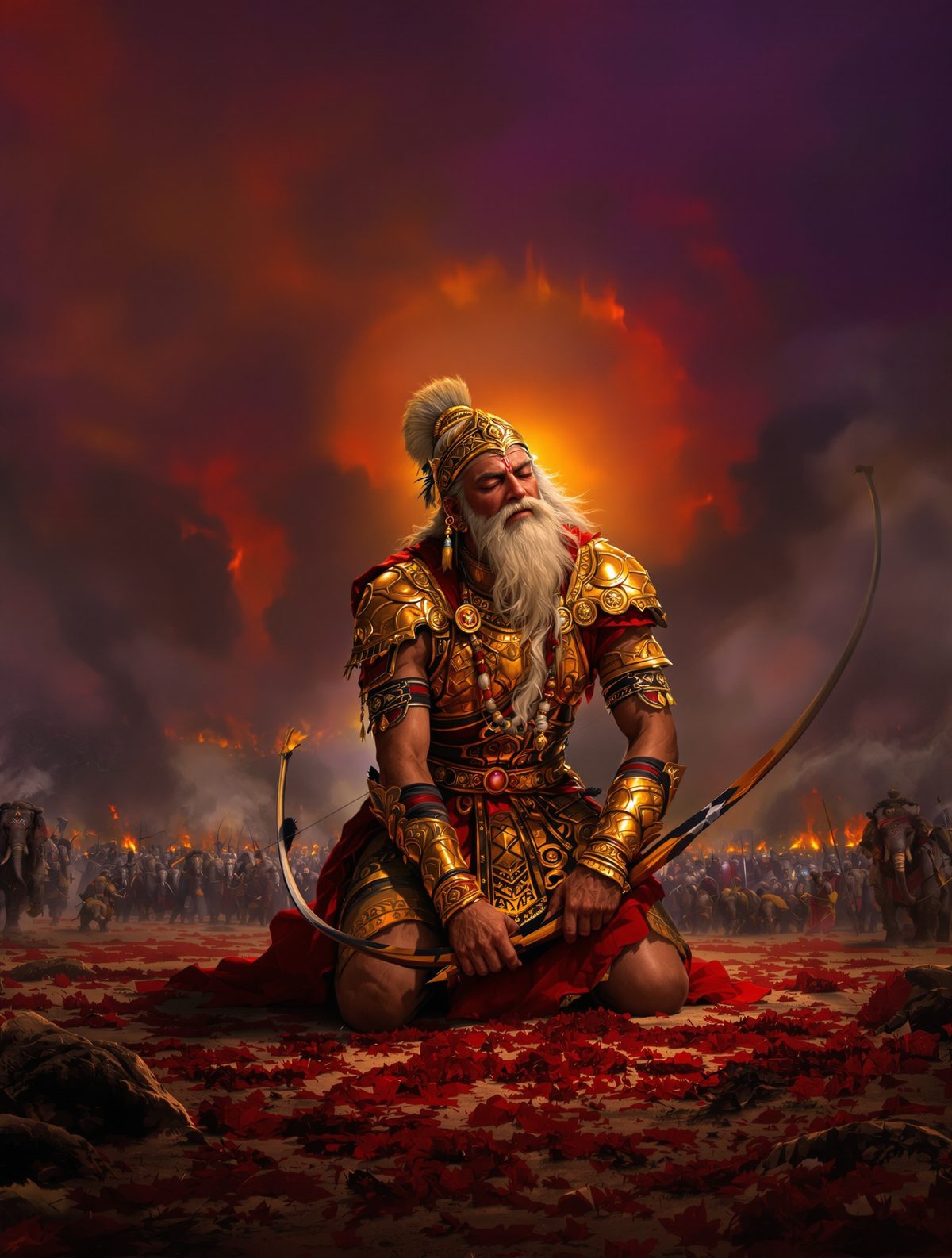
The sun blazed mercilessly upon the blood-soaked plains of Kurukshetra. Thousands of warriors lay strewn across the battlefield, their tales etched in the dust. Yet among these stories of might and valor, one stands apart — the tale of Drona's final hours. A once invincible warrior, respected and feared by all, Drona’s demise was not brought about by weapon or duel, but by the power of a single, damning whisper.
The Unbeatable Guru
Drona, the illustrious preceptor of the Pandavas and the Kauravas, was no ordinary teacher. Born in the sacred city of Ahicchatra, circa 950 BCE, he was the son of the sage Bharadwaja. Trained alongside the formidable Parashurama, Drona mastered the arts of warfare, eventually emerging as the unrivaled archery teacher of his era. The wooden longbows bent willingly to his will, and his arrows flew true, a mere extension of his intent. He was a genius marked by discipline and unattainable precision.
As the Kurukshetra war raged on, Drona led the Kaurava forces with an efficiency that seemed almost divine. He had once taught the very men now arrayed against him, and each of them knew the near impossibility of besting their former master. On the 13th day of the war, Drona achieved the highly improbable — he decimated ten thousand soldiers in a single day, his bow never faltering, his resolve unwavering.
Every time Drona took to the battlefield, the Pandava ranks shuddered. No blade could pierce his defenses, no strategy could draw him out. Among the countless tales of valor and treachery from the Mahabharata, Drona's prowess and unwavering commitment to his duty stands as a beacon of warrior excellence.
Krishna's Whispered Deception
Yet, no fortress is impregnable, and no warrior invincible. Krishna, the kaleidoscopic deity and astute strategist for the Pandavas, understood this universal truth better than anyone. The Pandavas needed to overcome the machine of war that was Drona, but there was no honorable way to achieve this on the battlefield. Thus, in Drona's case, the sword was set aside in favor of whispered, cold-blooded deceit.
With keen eyes on the battlefield, Krishna saw the only possible chink in Drona's armor — his unwavering love and trust for his son, Ashwatthama. The plan conceived was deviously simple: to convince Drona that his beloved son had been slain. Once disbelief shattered his composure, Drona would lay down his bow, and his end would come swiftly.
On Krishna's prompting, Yudhishthira — the paragon of truth and eldest of the Pandavas — was coerced into deceiving the guru. A man who had never spoken an untruth in his life, Yudhishthira reluctantly pronounced, "Ashwatthama is dead." The words hung in the air, charged with the gravity of myth. However, he added in a hushed breath, "The elephant, not the man." Yet, in the din of battle, only the first part of the sentence was heard by Drona, shattering his resolution.
A Father's Agony
The power of deception is not merely in what is said, but in the heart that receives it. Drona, upon hearing the falsehood, felt the quicksand of despair pulling him under. His noble mind struggled against it, hoping it was just a cruel jest of war. Yet, seeing Yudhishthira's bowed head, he yielded to despair.
In those terse moments, Drona transformed from invincible warrior to grieving father. The lament of the battlefield fell into silence as Drona laid aside his bow, the emblem of his power, in acceptance of what he believed was his son's demise. The whispers of treachery had claimed their first victim.
The Reaper's Blade
Enter Dhrishtadyumna, the vengeful son of King Drupada. Trained from birth to be the némesis of Drona, Dhrishtadyumna's moment had arrived. As Drona meditated in resignation, seeking solace in the eternal sound of the Vedas, Dhrishtadyumna decapitated him with a single, merciless stroke.
Drona’s slumped form fell to the earth, an unceremonious end to the greatest archer the world had known. In that instant, the tides of Kurukshetra shifted. The loss of Drona was not just a tactical blow to the Kauravas but a somber reminder of how even the mightiest fall when the battlefield employs the mind as a weapon.
Lessons from Legends
Today, Drona's story reverberates through the annals of time as a testament to the complexities of duty, loyalty, and human frailty. His death teaches us that not all victories are tangible, nor are all defeats absolute. This legend, often left unsung in textbooks, unveils the layers of human emotion interwoven with duty and honor.
The Mahabharata, more than a tapestry of myth, is a mirror showing the myriad ways of life. In our modern world, where information (and often misinformation) spreads quicker than a wildfire, Drona's tale reminds us of the potent capability of words to both wound and heal. It prompts us to question what we hold sacred — truth or victory, integrity or ambition.
As we reflect on Drona's fall, are we, too, unwitting couriers of whispers, or do we stand potent in silence against the clamor? The choice remains ours as we navigate the battlefields of our own making.