In the cosmic darkness before dawn, when the world lay shrouded in perpetual night, the gods faced their greatest crisis. The fourth sun had died, plunging the universe into an endless void where no maize could grow, no children could play, and no prayers could rise to the heavens. Around a towering divine bonfire that crackled with the essence of creation itself, the Aztec deities gathered for the most momentous decision in cosmic history: who among them would sacrifice their immortal life to become the fifth sun and illuminate the world once more?
Two volunteers stepped forward from the divine assembly. One was everything you'd expect of a god chosen to light the universe—the other was everything you wouldn't.
The Tale of Two Gods: Beauty Versus Humility
Tecuciztecatl, whose name meant "Lord of the Snails," embodied divine perfection. Adorned in magnificent quetzal feathers that shimmered like liquid emeralds, his jewelry crafted from precious jade that caught and reflected light like captured starfire, he was the obvious choice. This was a god who had never known want, never experienced pain, never doubted his own magnificence. When he made offerings to prepare for his cosmic role, he presented quills of pure gold instead of humble maguey spines, emerald-encrusted balls of copal instead of simple incense, and coral-tipped arrows instead of reeds.
But beside this paragon of divine beauty stood an unlikely volunteer: Nanahuatzin, the "Diseased Lord." His body was covered in painful buboes and festering sores that wept continuously. Where Tecuciztecatl gleamed, Nanahuatzin oozed. Where the beautiful god commanded attention and admiration, the diseased deity inspired only pity and revulsion. Yet when the call went out for a volunteer to leap into the cosmic flames, this humble god raised his pustule-covered hand.
His offerings reflected his humble station: simple maguey thorns stained with his own blood, balls of hay instead of precious copal, and arrows made from common reeds. The other gods likely exchanged glances—surely this pathetic figure was merely making a gesture of respect to the magnificent Tecuciztecatl?
Four Days of Sacred Preparation
For four sacred days—a number of profound significance in Aztec cosmology—both gods underwent ritual purification at Teotihuacán, the "City of the Gods." This wasn't the ruins we see today, but a living, breathing cosmic center where pyramids pierced the sky and divine energy flowed like rivers of liquid light.
Archaeological evidence suggests that this creation myth was intimately connected to the actual Pyramid of the Sun at Teotihuacán, which was precisely oriented to astronomical phenomena. The pyramid's base measurements of 215.5 meters per side weren't arbitrary—they reflected sophisticated mathematical knowledge that allowed the structure to serve as a cosmic calendar, tracking the movement of celestial bodies with startling accuracy.
During these four days, both gods fasted, meditated, and made their offerings. Tecuciztecatl's rituals were elaborate affairs involving hundreds of lesser deities, clouds of precious incense, and ceremonies that lasted from sunset to sunrise. His confidence never wavered—after all, wasn't he the natural choice? Didn't his beauty and perfection make him the obvious candidate to become the sun?
Meanwhile, Nanahuatzin performed his rituals alone, his diseased body wracked with pain as he pushed thorns through his rotting flesh, his blood the only precious offering he could make. Yet historical sources suggest something remarkable: while Tecuciztecatl's offerings were magnificent to behold, they were also cold, lacking the spiritual heat necessary for cosmic transformation. Nanahuatzin's humble offerings burned with an inner fire that the other gods could feel but didn't yet understand.
The Moment of Truth: When Beauty Fails
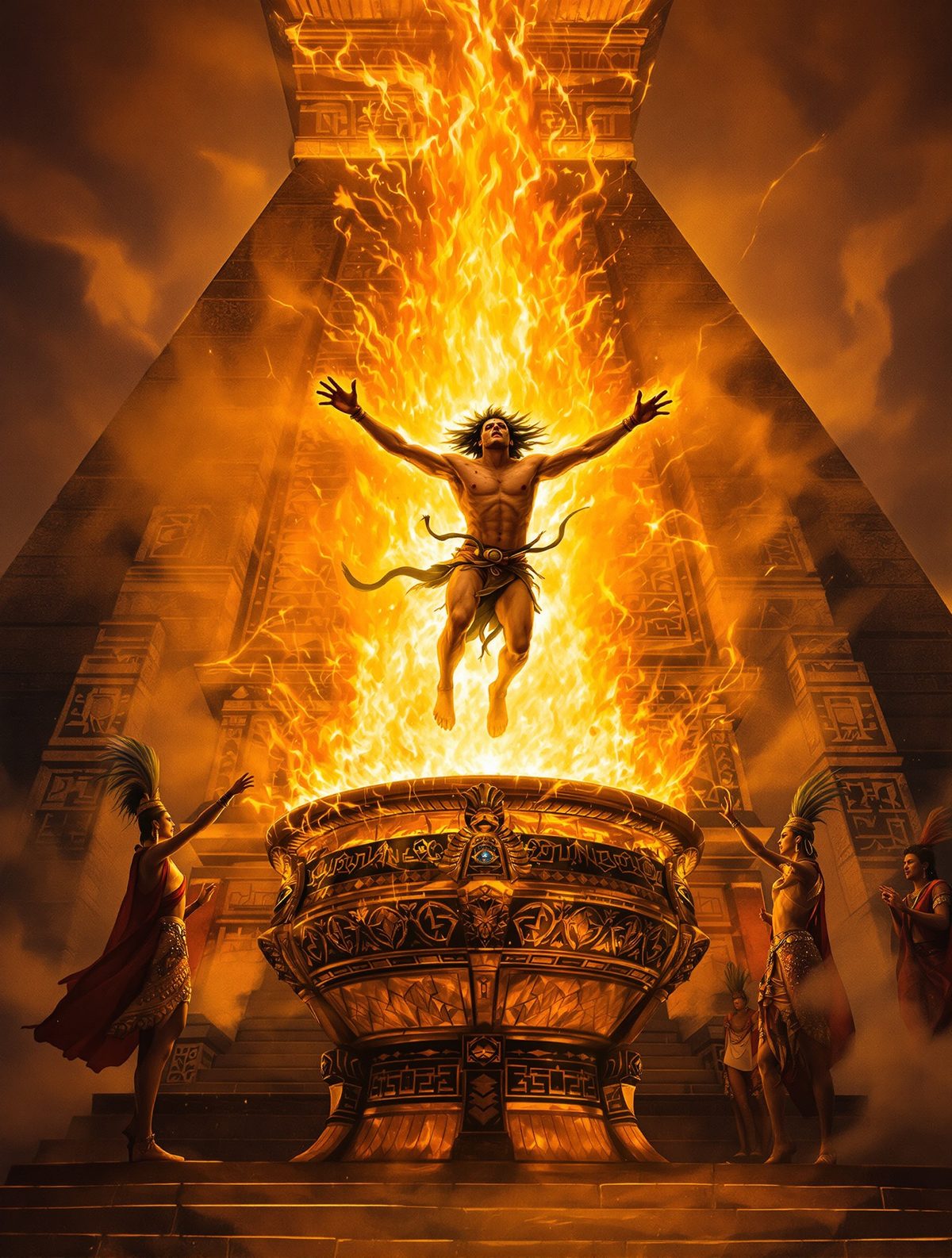
On the appointed night, as the cosmic fire roared with flames that reached toward the star-filled sky, the moment of ultimate truth arrived. The bonfire wasn't merely large—it was a conflagration that had been burning for years, fed by divine essence and cosmic energy. Standing before it, even the gods could feel their immortal flesh shrinking back from the incomprehensible heat.
This was no metaphorical trial. To become the sun required complete annihilation in the cosmic flames, a death so total that it would unmake the very essence of divinity before remaking it as the life-giving solar disk. The beautiful god would need to sprint directly into this inferno and allow it to consume every atom of his being.
Tecuciztecatl approached the flames with divine fanfare. Trumpets made from conch shells announced his arrival, while lesser gods chanted his praises. He stood at the fire's edge, his beautiful features illuminated by the dancing light, and... hesitated.
The heat was unbearable, even for a god. He stepped back, gathered his courage, and approached again. Once more, he faltered. A third attempt ended the same way, then a fourth. Each time, his perfect features grew more strained, his confidence more shaken. The beautiful god, for all his magnificence, could not overcome his attachment to his own perfection.
Here was a detail that Aztec storytellers emphasized with particular relish: it wasn't that Tecuciztecatl was a coward in the traditional sense, but that his very perfection became his weakness. How could such beauty be destroyed? How could such magnificence be unmade? His hesitation wasn't born of fear, but of an inability to conceive of his own annihilation.
The Diseased God's Fearless Leap
As the divine assembly watched in growing dismay, the gods called upon Nanahuatzin. "You try, diseased one," they said, perhaps not expecting much from this humble volunteer.
What happened next became the stuff of cosmic legend. Without hesitation, without fanfare, without even a moment's pause to consider the magnitude of what he was doing, Nanahuatzin ran straight into the roaring flames. There was no dramatic speech, no final gesture—just a diseased god who understood that sometimes the greatest act of love is the willingness to completely cease to exist.
The moment his pustule-covered body hit the cosmic fire, something extraordinary occurred. The flames, which had seemed almost reluctant to accept even the beautiful Tecuciztecatl, embraced Nanahuatzin with explosive joy. The fire roared higher, burned brighter, and began to transform. The diseased god's willingness to sacrifice everything—his immortality, his consciousness, his very existence—generated a spiritual heat that the cosmic flames had been waiting for.
Witnessing this incredible act of courage, Tecuciztecatl was shamed into action. He too leaped into the flames, but as a follower rather than a leader, as one inspired by another's bravery rather than driven by his own inner fire.
The Birth of Sun and Moon: An Unexpected Hierarchy
From the cosmic pyre emerged not one but two celestial bodies, though not in the order anyone expected. Nanahuatzin, the diseased and humble god, rose as Tonatiuh—the magnificent sun whose light would nourish all life on Earth. His diseased flesh had been transformed into blazing perfection, his humility into cosmic power, his willingness to sacrifice into the ability to give life to countless generations.
Tecuciztecatl emerged as the moon, forever destined to be secondary to the sun, his perfect features now pale and cool compared to the blazing glory of the one who had shown greater courage. The Aztecs explained that the moon's dimmer light was a divine reminder that beauty and privilege mean nothing without the courage to sacrifice for others.
But here's a detail that many miss: according to some versions of the myth, the moon initially shone as brightly as the sun, creating a cosmic crisis. To resolve this, one of the gods threw a rabbit at Tecuciztecatl's face, dimming his light and creating the shadowy features we still see on the lunar surface today. This wasn't mere cosmic reorganization—it was a divine statement about the proper relationship between humility and pride, sacrifice and privilege.
Why the Diseased God's Sacrifice Still Matters
In our age of celebrity worship and social media perfection, Nanahuatzin's story carries a profound message that transcends its ancient Mesoamerican origins. The Aztecs understood something that we often forget: true greatness rarely comes from those who seem destined for it, but from those willing to give everything for something greater than themselves.
This wasn't just a creation myth—it was a sophisticated meditation on the nature of leadership, sacrifice, and worthiness. In Aztec society, where ritual sacrifice was central to cosmic balance, the story of Nanahuatzin provided the ultimate template: the gods themselves had established that the greatest sacrifice must come from the greatest love, not the greatest beauty or power.
Every sunrise became a daily reminder of this cosmic truth. When Aztec farmers watched the sun rise over their maize fields, they weren't just seeing daylight—they were witnessing the continuing sacrifice of a diseased god who had chosen love over self-preservation, service over safety, cosmic responsibility over personal comfort.
Today, as we face our own moments of choice between the easy path and the necessary one, between protecting our own comfort and serving something greater, Nanahuatzin's fearless leap into the cosmic fire reminds us that the light the world needs most often comes from the most unexpected sources—and that sometimes, the greatest beauty emerges only after we're willing to be completely transformed by the flames of selfless love.