Picture this: a woman, nine months pregnant, her belly swollen with twins, standing at the starting line of a racetrack. Her opponents? The king's finest horses, bred for speed and trained for victory. The crowd jeers, certain they're about to witness a humiliating defeat. But what they're actually watching is the prelude to one of the most devastating curses in Celtic mythology—a curse that would echo through generations and leave an entire kingdom's warriors writhing in agony when they needed their strength most.
This is the story of Macha, a goddess whose final act of defiance would reshape the fate of Ulster forever. It's a tale that reveals the complex intersection of divine justice, mortal pride, and the terrible price of forcing the divine to prove itself to unbelieving eyes.
The Mysterious Woman Who Fell from the Sky
The story begins in the misty hills of ancient Ulster, sometime during the legendary age when gods walked among mortals without fanfare. Crunnchu mac Agnomain, a wealthy farmer and widower, lived alone on his prosperous lands until the day a strange woman simply appeared at his door. She was beautiful beyond description, with an otherworldly grace that should have been his first clue that she was no ordinary woman.
This mysterious figure was Macha—though she never revealed her true nature to Crunnchu. She moved into his home without invitation or explanation, taking over the household duties with supernatural efficiency. Under her care, Crunnchu's lands flourished like never before. His crops grew taller, his livestock multiplied, and his wealth increased beyond his wildest dreams. For a time, they lived in perfect harmony, and eventually, Macha became pregnant with what would prove to be twins.
But Macha came with one unbreakable condition: Crunnchu must never speak of her to anyone. Not her beauty, not her abilities, not even her existence. It was a simple rule that would prove impossible for a proud man to follow.
The Fatal Boast That Changed Everything
The trouble began at the great festival of Samhain, when all of Ulster gathered at the royal court of King Conchobar mac Nessa at Emain Macha—ironically, a place named after another incarnation of the same goddess. The festivities included elaborate horse races, with the king's prized steeds competing against each other in displays of speed that left the crowds breathless with excitement.
Crunnchu, emboldened by wine and surrounded by boastful nobles, made the fateful mistake that would destroy his happiness. As the crowd cheered the victory of the king's fastest horses, he couldn't contain himself any longer. "Those horses are swift," he declared loudly, "but my wife could outrun them all!"
The words cut through the celebration like a blade. King Conchobar, his honor challenged before his entire court, immediately seized Crunnchu and demanded proof of this outrageous claim. When messengers brought the heavily pregnant Macha to the royal court, she pleaded with the king and his nobles for mercy. "I am with child," she explained, her voice carrying an authority that should have given them pause. "Wait until after I give birth."
But the assembled crowd, drunk on spectacle and skeptical of what seemed like an obvious excuse, showed no compassion. They demanded the race proceed immediately. It was then that Macha revealed a glimpse of her true nature, asking a question that chills the blood: "What is your name?" When they told her it was Ulster, her response carried the weight of prophecy: "Then Ulster will suffer for this shameful deed."
The Race That Defied All Natural Law
What happened next defied every expectation. Despite being in the final stages of pregnancy, Macha took her position at the starting line alongside the king's champion horses. The crowd fell silent, perhaps finally sensing they were witnessing something beyond the ordinary. The starting signal was given, and what followed was a display of divine power masquerading as athletic prowess.
Macha didn't just keep pace with the horses—she outran them. Her feet seemed barely to touch the ground as she moved with inhuman speed, her pregnant form somehow transformed into something more graceful than the finest thoroughbreds. The horses, bred for generations for speed, found themselves eating the dust of a woman carrying twins.
She crossed the finish line clearly ahead of her competitors, proving her husband's boast in the most spectacular fashion imaginable. For a brief moment, the crowd erupted in cheers, caught up in the impossible spectacle they'd just witnessed. But their celebration was premature.
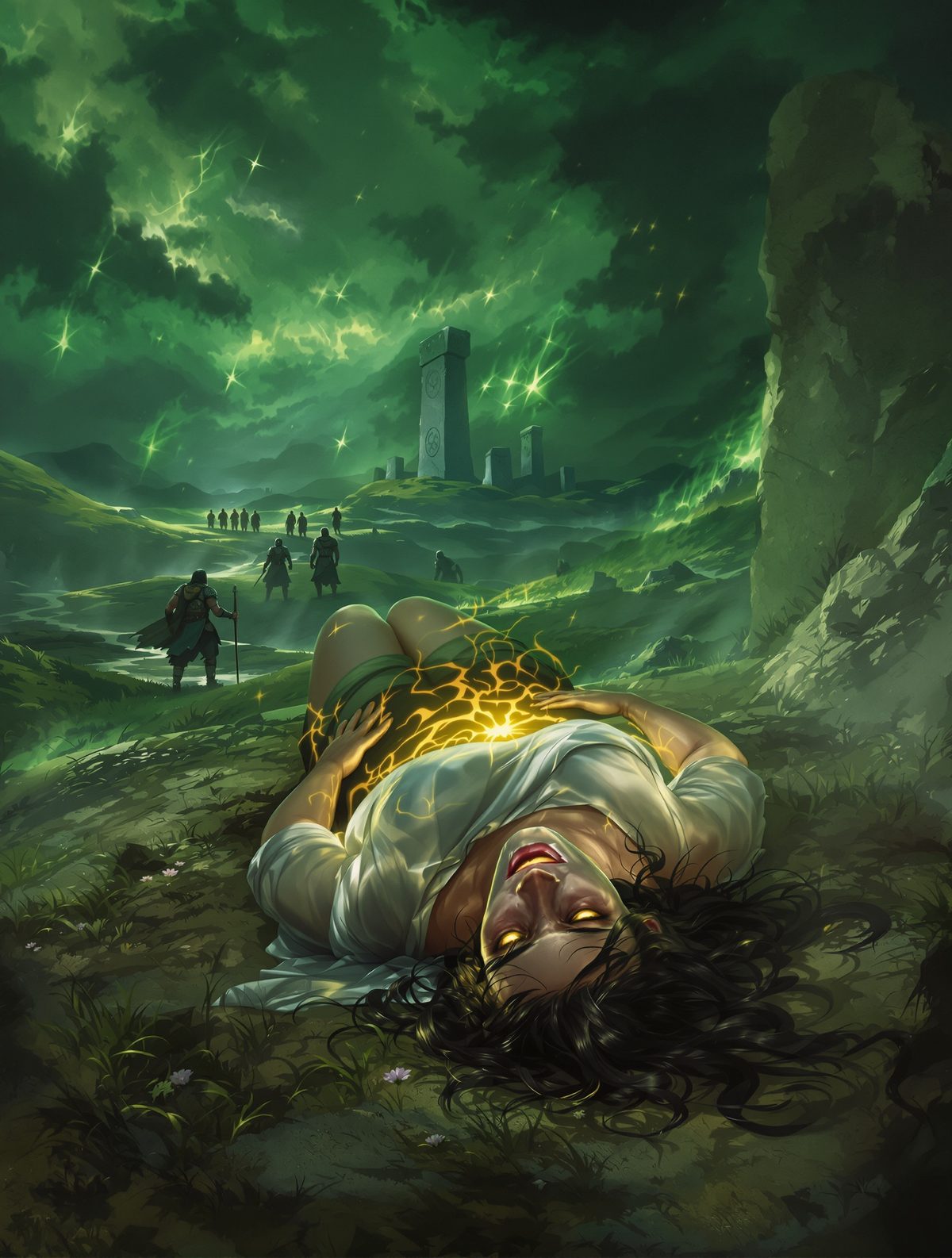
The moment her feet stopped moving, Macha collapsed. The supernatural effort required to outrun the horses while carrying twins had pushed even her divine constitution beyond its limits. There, in front of the entire assembly, she went into labor.
Birth, Death, and a Curse for the Ages
What followed was simultaneously beautiful and terrible. Macha gave birth to twins—a boy and a girl—right there on the racetrack, surrounded by the stunned crowd who were finally beginning to understand they had forced something sacred into a profane spectacle. The children were named Fír and Fial, and the place of their birth was forever after called Emain Macha—"the twins of Macha."
But the effort had cost Macha everything. As her life ebbed away, she revealed her true identity as one of the sovereignty goddesses of Ireland. With her dying breath, she pronounced a curse that would echo through Ulster's history: "From this day forth, when your enemies threaten Ulster and you most need your strength, the men of this province will suffer the pains of childbirth for four days and five nights. This curse will last for nine generations times nine."
The curse was specific, calculated, and utterly devastating. For nine times nine generations—essentially 729 years by some reckonings—whenever Ulster faced its greatest military threats, its warriors would be incapacitated by labor pains. The very men who had shown no mercy to a pregnant woman would experience the agony of childbirth at their most vulnerable moments.
When the Curse Came Home to Roost
The curse wasn't merely theoretical—it became a defining feature of Ulster's legendary history. The most famous instance occurred during the events of the Táin Bó Cúailnge (The Cattle Raid of Cooley), when Queen Medb of Connacht launched a massive invasion to steal Ulster's prized brown bull.
As Medb's armies crossed into Ulster territory, the curse activated with devastating efficiency. Every warrior in Ulster—from the mightiest champions to the humblest soldiers—was suddenly seized by labor pains so intense they couldn't stand, let alone fight. They lay writhing on the ground, experiencing exactly what Macha had endured, while enemy forces advanced unopposed across their lands.
Only one warrior remained unaffected: Cú Chulainn, the legendary Hound of Ulster. Some sources suggest his divine heritage protected him; others claim he was simply too young to be affected. Regardless, this seventeen-year-old hero found himself single-handedly defending an entire kingdom while its entire army lay incapacitated by supernatural labor pains.
The image is both absurd and terrifying: thousands of battle-hardened warriors reduced to helplessness by the ghost of a goddess's suffering, while one teenager held off an entire invasion through a series of single combats.
The Eternal Warning in Macha's Tale
Macha's curse speaks to something deeper than mere revenge—it's a story about the consequences of forcing divine beings to prove themselves to skeptical mortals. In Celtic tradition, the sovereignty goddesses represented the land itself, and their treatment reflected how the people would be treated in return. By showing no mercy to Macha in her most vulnerable moment, Ulster's people ensured they would receive no mercy in theirs.
But perhaps more significantly, Macha's story is about the power dynamics between men and women in ancient Irish society. The goddess's curse specifically targeted male warriors, forcing them to experience the physical reality of pregnancy and childbirth—something they had dismissed as weakness when it inconvenienced their entertainment.
In our modern world, where we still grapple with questions of bodily autonomy, the rights of pregnant women, and the consequences of toxic masculinity, Macha's tale feels remarkably contemporary. It reminds us that forcing others to prove themselves at the cost of their wellbeing creates wounds that echo across generations. Sometimes the price of spectacle is higher than we imagine, and sometimes the bills for our cruelty come due long after we've forgotten what we've done.
The curse of Macha stands as one of mythology's most pointed reminders that divine justice, while sometimes delayed, is never denied—and that the powerful ignore the suffering of the vulnerable at their own peril.