The hoofbeats thunder across the rainbow bridge like war drums announcing the end of the world. Eight legs pound against crystalline light as horse and rider plunge into a darkness so absolute it seems to swallow sound itself. This is no ordinary messenger racing through the Nine Realms—this is Hermod the Bold, riding Sleipnir through the gates of death on the most desperate diplomatic mission in Norse mythology.
Behind him, the gods of Asgard weep tears that will become morning dew. Ahead lies Helheim, where the goddess of death sits on her throne of bones, waiting to negotiate for a soul so pure that even the realm of the dead shines brighter in his presence. The fate of Baldr the Beautiful—and perhaps the fate of all the gods—hangs in the balance of this impossible journey.
When Light Dies in Asgard
The death of Baldr wasn't just a tragedy—it was a cosmic catastrophe that shattered the very foundations of the Norse universe. Son of Odin and Frigg, Baldr embodied everything the harsh Viking world desperately craved: beauty, purity, wisdom, and joy. The Prose Edda describes him as so radiant that light emanated from his very being, so fair that the whitest flower was named after him—Baldr's brow.
But here's what most people don't know: Baldr's death wasn't random violence or the result of battle. It was orchestrated by Loki through a weapon so humble it borders on absurd—a dart made of mistletoe. The plant was the only thing in all the Nine Realms that Frigg hadn't made swear an oath to never harm her son. She considered it too young and insignificant to pose a threat. In Norse mythology, it's often the smallest oversights that doom gods and men alike.
When the dart pierced Baldr's chest, guided by Loki's hand but thrown by blind Höðr, the light literally went out of the world. The gods stood in stunned silence around the body of their golden prince, and for the first time, they truly understood their own mortality. If Baldr—pure, beloved Baldr—could die, then Ragnarok wasn't just a distant prophecy. It was a clock that had started ticking.
The Volunteer for an Impossible Mission
In the depths of their grief, someone had to act. The sources vary on exactly why Hermod volunteered for the journey to Helheim, but most agree on one crucial detail: he was the only one brave enough—or perhaps foolish enough—to attempt it. Known as "Hermod the Bold," he was either Odin's son or his faithful messenger, depending on which version of the Edda you consult. What matters is that he possessed the two qualities essential for his mission: unwavering courage and diplomatic skill.
Odin himself provided the means for the journey—Sleipnir, the eight-legged horse that could travel between the worlds. Born from Loki's own bizarre pregnancy (another story entirely), Sleipnir was no ordinary mount. Archaeological evidence suggests that eight-legged horses appear frequently in Scandinavian art from the 6th to 11th centuries, often carrying riders between realms of the living and dead. The extra legs weren't just for show—they represented the horse's ability to gallop through dimensions that would trap any normal creature.
But here's a detail that's often overlooked: Hermod rode for nine full days and nights through valleys so deep and dark that he couldn't see his own hands. Nine was the most sacred number in Norse cosmology—nine realms, nine nights Odin hung on Yggdrasil, nine days to reach the land of the dead. This wasn't just a journey through space, but through the very structure of reality itself.
The Architecture of Death
When Hermod finally reached the gates of Helheim, he encountered Móðgud, the skeletal maiden who guards the bridge over the river Gjallarbru. In typical Norse fashion, even death's gatekeepers were pragmatic. She challenged him not with riddles or combat, but with simple observation: "You don't look dead. Five battalions of dead men passed this way yesterday, but the bridge didn't shake as much under their feet as it does under yours alone."
The geography of Helheim itself reveals fascinating insights into Norse beliefs about death. Unlike the Christian hell that would later dominate Scandinavian culture, Hel's realm wasn't necessarily a place of punishment. It was simply where most people went when they died—a cold, gray mirror of the world above. Warriors who died gloriously in battle went to Valhalla, but everyone else—children, the elderly, those who died of sickness—found themselves in Hel's domain.
The hall itself, called Éljúdnir, was built from bones and roofed with writhing serpents. Hel's dining table was called "Hunger," her knife "Famine," her bed "Sick-bed." These weren't just grim decorative choices—they reflected the harsh realities of life in medieval Scandinavia, where death by starvation and disease was far more common than death in glorious battle.
Negotiating with Death Herself
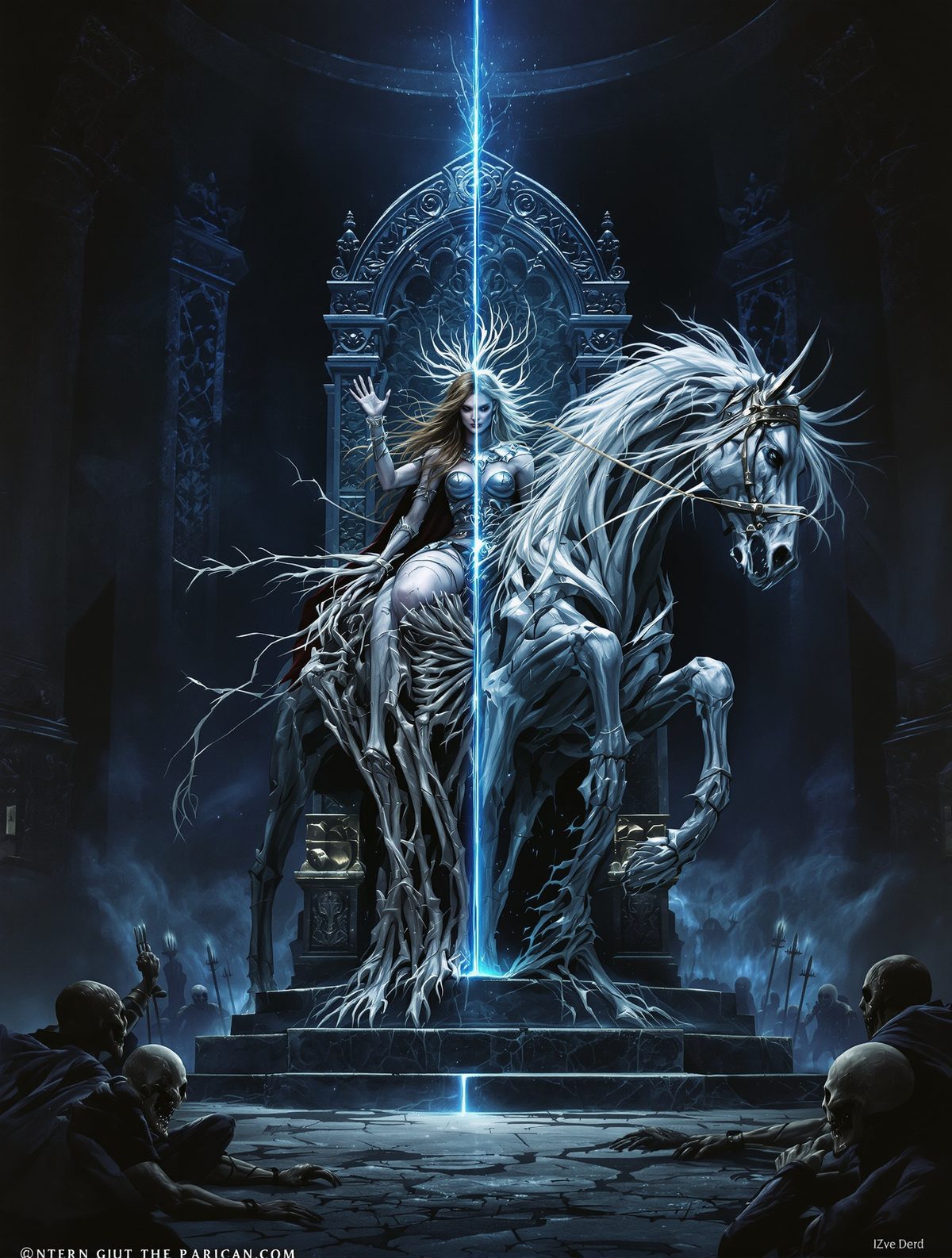
The goddess Hel presents one of the most striking figures in all of world mythology. Daughter of Loki and the giantess Angrboða, she was half living flesh and half corpse—beautiful on one side, rotting on the other. This wasn't mere supernatural horror for its own sake. Hel embodied the dual nature of death itself: both the end of life and the continuation of existence in another form.
When Hermod finally stood before her throne, he found Baldr sitting in the place of honor beside the goddess of death. Even in Helheim, Baldr's inherent nobility commanded respect. But here's where the story takes a turn that reveals the sophisticated legal thinking of Norse culture: Hel didn't simply refuse to return Baldr. She made a contract.
"If all things in the world, alive and dead, weep for Baldr," she declared, "then he shall return to the Æsir. But if any one thing refuses to weep, he stays with me." On the surface, this seems reasonable—if Baldr was truly as beloved as the gods claimed, surely everything in creation would mourn his passing. But Hel was too clever for such simple agreements. She had set a condition that appeared generous while being virtually impossible to fulfill.
The One Tear That Changed Everything
Hermod raced back to Asgard with news of Hel's bargain, and the gods immediately set about making it happen. They sent messengers throughout the Nine Realms, and the response was overwhelming. Men wept. Women wept. Children, animals, trees, stones, metals, fire, water—everything in creation mourned for the golden god. The very elements themselves shed tears for Baldr's loss.
Everything, that is, except for one ancient giantess found sitting in a cave. When asked to weep for Baldr, she refused with words that still echo through the halls of mythology: "Neither alive nor dead did I love Baldr. Let Hel hold what she has." Many scholars believe this giantess was actually Loki in disguise, ensuring that his masterpiece of destruction could never be undone.
But here's the detail that transforms this from a simple story of good versus evil into something far more complex: the refusal of a single being to mourn reveals the impossibility of universal love. In a world where even gods can be petty, jealous, and cruel, how can anyone—even someone as pure as Baldr—be truly beloved by all creation?
Why Death Won't Negotiate
Hermod's journey into Helheim resonates across cultures and centuries because it confronts the one negotiation every human being ultimately loses. We can bargain with kings, make deals with devils, and sweet-talk our way out of almost any earthly consequence. But death, as Hel demonstrates, operates by different rules entirely.
The Norse understanding of death wasn't about moral judgment—it was about cosmic balance. Hel keeps Baldr not because she's evil, but because some things, once lost, cannot be reclaimed by love alone. The story suggests that certain prices are too high, certain losses too fundamental to reverse, no matter how pure our intentions or how desperate our need.
In our own age, when technology promises to solve every problem and money seems capable of buying any solution, Hermod's failed mission reminds us that some frontiers remain uncrossable. The eight-legged horse can carry us to the very throne of death itself, but it cannot carry us back with everything we've lost. Sometimes, the bravest journey is also the most futile—and sometimes, that's precisely why it must be undertaken.