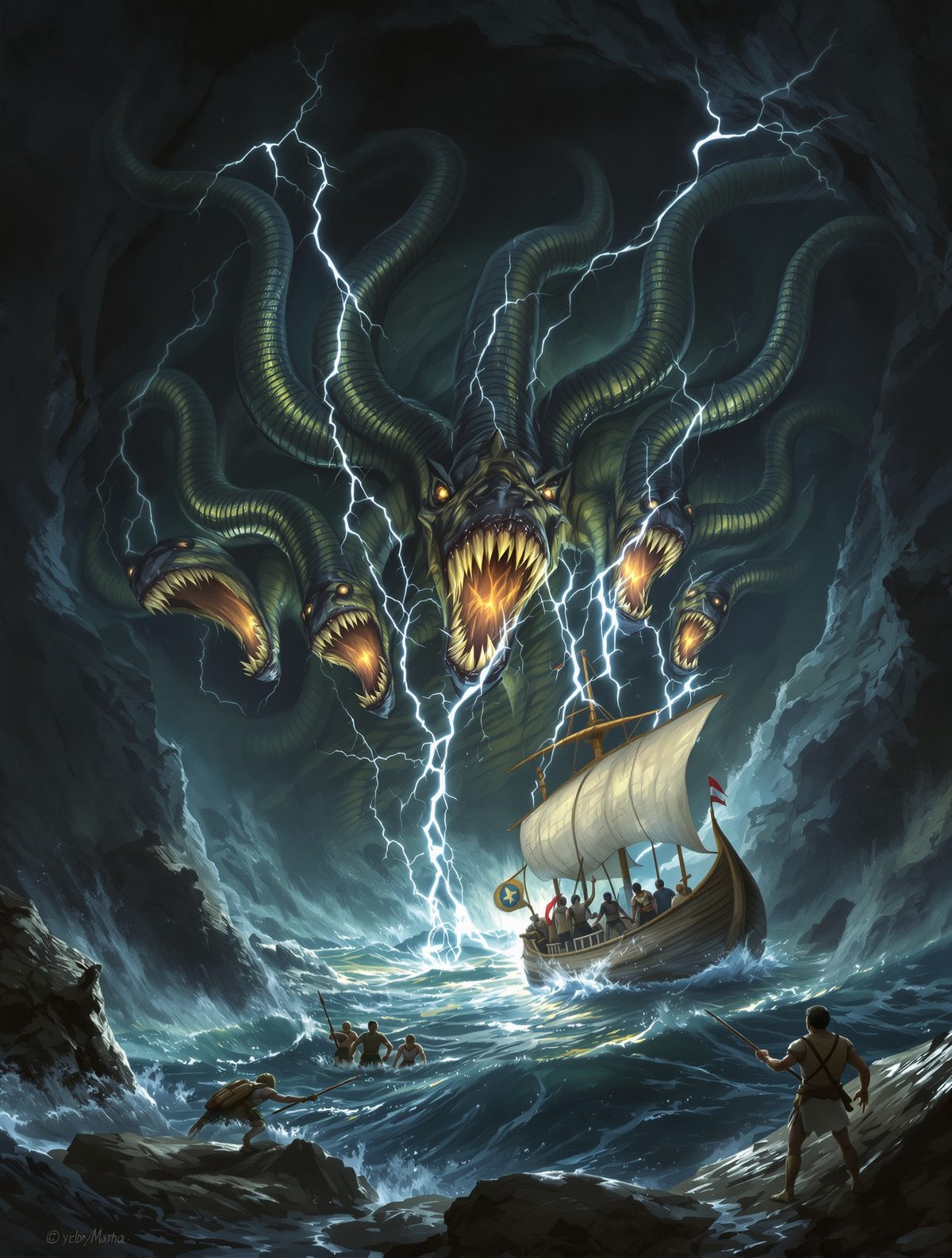
The screams echoed across the wine-dark sea for exactly six heartbeats—one for each sailor plucked from Odysseus's deck by the writhing necks of Scylla. In the space between one oar stroke and the next, six of Greece's finest warriors simply vanished into the gnashing maws of antiquity's most surgically precise predator. The hero who had outwitted gods, escaped sirens, and blinded a cyclops could only grip his steering oar and watch helplessly as his men disappeared into legend.
This wasn't random monster mayhem—it was calculated, inevitable, and absolutely terrifying in its precision. Welcome to the moment when even the craftiest hero in Greek mythology learned that some prices must be paid in full.
The Demon Geography of the Strait of Messina
Ancient Greek sailors didn't need GPS coordinates to know exactly where nightmare lived. The narrow channel between Sicily and mainland Italy—what we now call the Strait of Messina—was branded into every mariner's memory as the hunting ground of two monsters so perfectly positioned that escape from both was mathematically impossible.
On one side lurked Charybdis, the whirlpool monster who could swallow entire ships in her rotating maw three times daily. But it was her neighbor that truly haunted sailors' dreams. Scylla made her lair in a sea cave roughly sixty feet above the churning waters, positioned at exactly the right height to pluck men from passing vessels like olives from a tree.
Here's what the textbooks don't tell you: ancient navigation manuals actually included specific rowing instructions for this passage. Maritime archaeologist Dr. Maria Papadimitriou's research into recovered papyrus fragments reveals that Greek captains calculated precise distances—stay more than three ship-lengths from Scylla's cliff and you'd drift into Charybdis's pull. Venture closer than one ship-length and you'd sail directly under the six-headed terror's striking range.
The mythology wasn't metaphor—it was a survival manual wrapped in monster stories, passed down through generations of Mediterranean sailors who knew exactly which rocks would kill them.
The Monster Who Was Once Beautiful
Before Scylla became the stuff of nightmares, she was Scylla the nymph—beautiful enough to catch the eye of Poseidon himself. But in the twisted soap opera of Greek mythology, divine love affairs rarely ended well for anyone involved.
The sea god's jealous wife Amphitrite (or in some versions, the sorceress Circe, furious over romantic rejection) transformed the lovely sea nymph into something that would make sailors wake screaming for centuries. Six serpentine necks sprouted from her torso, each topped with a head containing three rows of razor-sharp teeth. Her lower body became a writhing mass of tentacles and snapping dog heads—twelve in total, according to Homer's precise accounting.
But here's the detail that makes Scylla truly terrifying: she retained her human consciousness. Unlike mindless monsters driven by hunger alone, Scylla remembered being beautiful, remembered being desired, remembered being human. Her attacks weren't random predation—they were calculated vengeance against a world that had stolen her humanity.
Ancient Greek vase paintings from the 5th century BCE consistently show her with a woman's torso and face, often depicted with an expression of intelligent malice rather than bestial hunger. This wasn't a creature acting on instinct—this was a former woman who had perfected the art of precise, surgical strikes against passing ships.
The Mathematics of Terror: Six Heads, Six Men, Perfect Precision
When The Odyssey describes Scylla's attack on Odysseus's ship, Homer's language becomes almost clinically precise. Each of the six heads strikes once. Each mouth claims exactly one sailor. No wasted motion, no random snapping—just six simultaneous strikes of supernatural accuracy.
Modern marine biologists studying predatory behavior have noted that this attack pattern mirrors the hunting strategies of actual sea creatures. Dr. James Morrison of the Woods Hole Oceanographic Institution points out that many cephalopods—octopi and squid—are ambush predators that strike with lightning speed and retreat immediately to avoid retaliation.
But Scylla's precision serves a darker purpose than mere efficiency. By taking exactly six men—no more, no fewer—she sends a message. She could have destroyed the entire ship, could have plucked every sailor from the deck. Instead, she chooses to let the survivors live with the memory, to spread the story, to ensure that her reputation would grow with each retelling.
The number six itself held significance in ancient Greek culture. Six was the number of balance, of perfect proportion—but also of incompleteness, always falling short of the perfect seven. Scylla's attack leaves Odysseus's crew diminished but not destroyed, powerful enough to continue their journey but forever marked by loss.
The Hero's Most Helpless Moment
Here stands Odysseus—the man who convinced the Trojans to wheel a wooden horse through their gates, who tied himself to a mast to hear the Sirens' song and live, who got a cyclops drunk and drove a burning stake through his eye. Yet faced with Scylla, the master strategist becomes completely, utterly helpless.
This wasn't an oversight in Homer's storytelling—it was the point. Even Circe, the sorceress who had warned Odysseus about the passage, told him bluntly: "You cannot fight her. She is deathless and dire, savage and fell and fierce and not to be fought with. There is no defense against her; the best way is to run."
The archaeological record suggests that ancient Greek military leaders studied this passage of The Odyssey intensively. Papyrus fragments found in the ruins of Alexandria's library include commentary noting that sometimes the mark of true leadership is accepting unavoidable losses rather than risking total destruction through futile heroics.
Odysseus makes the calculated choice to sacrifice six men rather than lose his entire crew to Charybdis's whirlpool. It's a decision that would haunt military commanders for millennia—the cold mathematics of leadership that reduces human lives to acceptable losses in service of a greater goal.
The Aftermath: Living with the Screams
Homer doesn't let Odysseus—or his audience—escape the psychological aftermath of Scylla's attack. The epic describes how the taken men "stretched out their hands to me in their last extremity of dying." These weren't anonymous casualties disappearing into the fog of war—these were named companions, men who had followed their leader through a decade of adventures, only to be plucked away in an instant of surgical precision.
The text specifically mentions that this was "the most piteous thing mine eyes have seen" in all of Odysseus's wanderings. More heartbreaking than the Cyclops's cave, more terrible than the Sirens' song, more devastating than watching his other ships destroyed by the Laestrygonian giants. Why? Because this time, he saw it coming and chose to let it happen.
Ancient Greek audiences would have recognized the deeper horror here. In a culture that prized kleos—undying fame achieved through glorious deeds—these six sailors died not in battle but as passive victims, their names remembered only as casualties in someone else's story. They achieved immortality not through heroism but through helplessness.
Why Scylla Still Matters: The Modern Monster in the Strait
The Strait of Messina is still there, still narrow, still dangerous. Modern ships navigate it daily, guided by GPS and radar rather than monster stories. But the mathematical precision of Scylla's ancient terror lives on in every calculated risk, every acceptable loss, every moment when leaders must choose between bad and worse.
Corporate executives speak of "right-sizing" and "strategic downsizing"—clinical terms for decisions that would have made perfect sense to Odysseus as he steered past Scylla's cave. Military planners still calculate acceptable casualty rates. Emergency responders still practice triage, choosing who to save first when resources are limited.
Scylla's six mouths have evolved into conference rooms where spreadsheets determine which branches close, which employees get laid off, which communities lose their hospitals. The monster is still there, still striking with surgical precision, still leaving survivors to live with the memory of the screams.
Perhaps that's why this ancient story retains its power to disturb us. Scylla represents the moments when even heroes must become monsters themselves—not through evil intent, but through the simple, terrible mathematics of survival. She reminds us that sometimes the most heroic choice is also the most human: to carry the weight of necessary decisions and continue sailing, even when the screams follow in your wake.