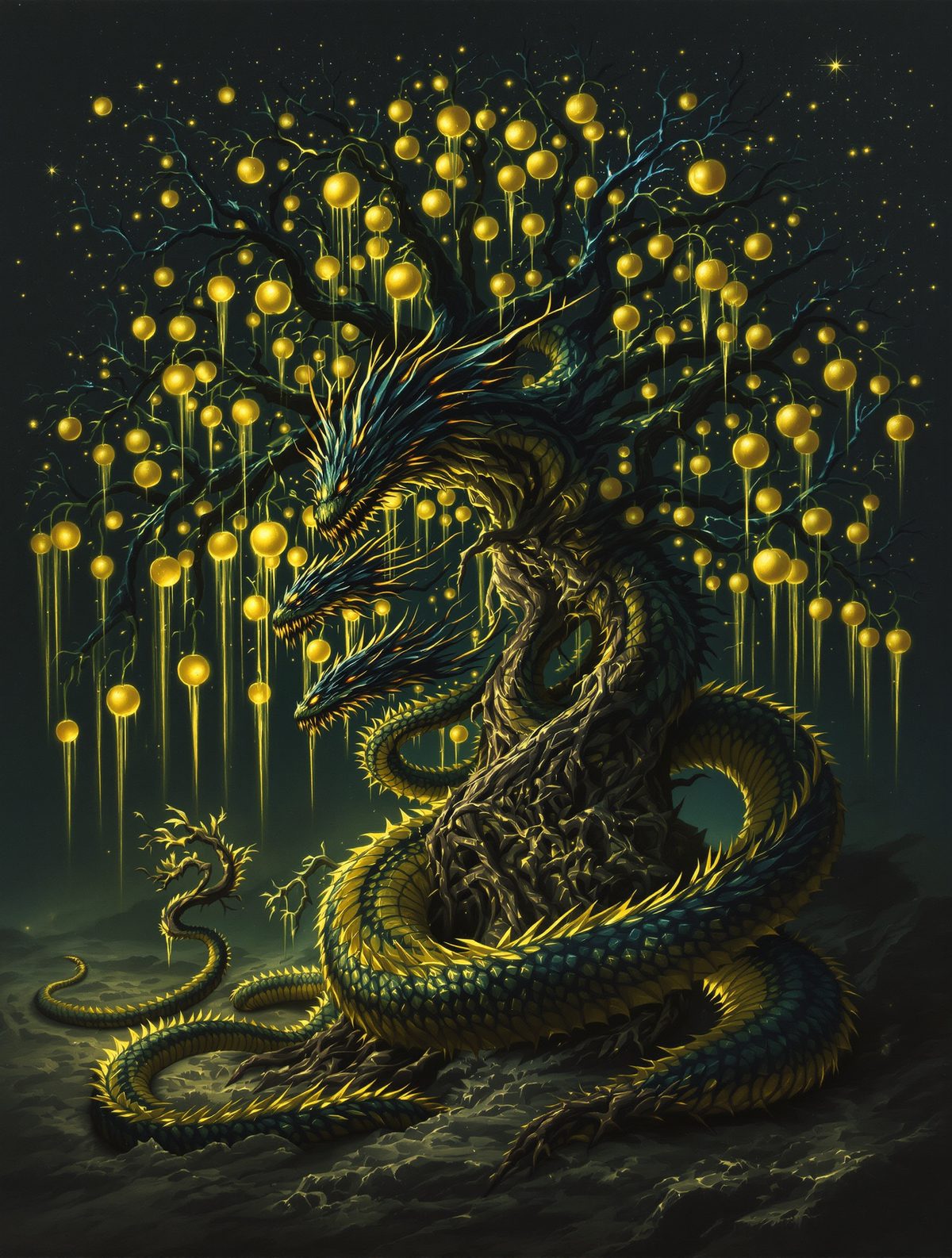
At the farthest edge of the known world, shrouded in the mist where the sea and sky embrace, there lies a mysterious garden. The air here hangs heavy with magic, brimming with scents so sweet that they might lull even the most steadfast traveler into a waking dream. But this is no ordinary garden, and the danger lurking beneath its boughs is an ever-watchful sentinel: Ladon, the sleepless dragon. Coiled tightly around the tree of the Hesperides, this ancient beast stands as the insurmountable guardian of the golden apples — fruits fashioned by the gods themselves that promise immortality to those daring enough to claim them.
The Dragon of a Hundred Heads
Imagine a creature of immense power and terrifying beauty. Ladon, with its hundred sinuous heads, bore eyes that shone like molten gold, ceaselessly scanning its surroundings. This was no mere beast, but an eternal being, designed to deter any who ventured near with the glint of desire for the legendary apples. Ladon was unlike any dragon of modern fantasy, brought to life in whispered tales long before knights in shining armor roamed the earth.
The origins of Ladon are as intriguing as the dragon itself. It is said that Gaia, the primordial Earth goddess, birthed the creature, and it was placed in service by Hera, the queen of the gods. But why would the queen of Olympus place such importance on a single tree? The answer resides in the apples themselves. Bestowed as a divine wedding gift, the fruits granted ultimate power and immortality — treasures no mortal, nor many immortals, were meant to wield.
The Garden of the Hesperides: A Deceptive Paradise
This sacred garden was the dominion of the Hesperides, nymphs known as the Daughters of the Evening. Dutifully, they tended to the grove, cloaked in veils of twilight, singing lullabies that danced on the air like stardust. But despite their efforts, Ladon was ever-alert; its hundred mouths whispering secrets to the stars above, its scales shimmering like a thousand mirrors in the sun or moonlight.
The true location of this mythical garden has been the subject of debate and wonder throughout history. Some myths place it among the Atlas Mountains near the northwest coast of Africa, while others allude to islands lost to time, tempting adventurers into the vast unknown. Yet, regardless of geography, one truth remains — Ladon's presence in the garden was as immovable as stone, a living relic of godly intent not to be trifled with.
Heracles and the Eleventh Labor
Enter Heracles: the hero of myth, born of Zeus and gifted with strength unrivaled. Fate decreed that Heracles must undertake twelve labors as penance for a crime born of Hera’s wrathful jealousy. Among these tasks lay the challenge to retrieve the golden apples of the Hesperides. Heracles, whose feet had trod across the bounds of possibility before, faced perhaps his most daunting trial yet.
To reach the garden, Heracles traveled to the ends of the earth, seeking guidance from the sea god Nereus to find the garden's secret location. With each step closer, the stakes soared like Icarus to the sun. Upon arrival, the sheer presence of Ladon, with its hundred heads hypnotically weaving like a dance of cobras, would have broken lesser souls. Yet, Heracles did not waver.
Through cunning or strength — or perhaps both in equal measure — Heracles managed to bypass the unconquerable guardian. One version of the myth suggests the hero employed the assistance of Atlas, who momentarily took the burden of the world from his shoulders, in exchange for retrieving the apples himself. Another tale tells of Heracles lulling the creature to sleep with hypnotic chants, a feat unheard of given Ladon's stated inability to rest.
A Legacy Written in Stars
The demise or departure of Ladon marked the end of its terrestrial watch, but not its lasting power. Hera immortalized the beast among the stars as the constellation Draco, ensuring that it would never truly perish and would keep watch over the night skies for eternity. To this day, the twinkling stars of Draco form a winding dragon, a cosmic reminder of Ladon's eternal struggle and its victory against time itself.
Interestingly, the legend of Ladon and the Hesperides has rippled through history in subtle yet profound ways. Hints of this myth can be traced in modern stories of magical guardians and forbidden fruits — motifs that reflect humanity’s timeless quest for eternal life and ultimate knowledge, often at great peril.
Why Ladon's Tale Still Matters
So why does the tale of Ladon matter thousands of years later? At its core, the story is about the boundaries we respect and those we dare to challenge. It is a narrative that speaks to the aspirations of humanity in our unending search for truth, understanding, and the transcendent. In a world that so often reveres progress and innovation, Ladon serves as a cautionary symbol — an eternal reminder that the path to enlightenment is not without its dragons.
The story of Ladon compels us to examine our own quests and the costs they entail. It challenges us to consider what we guard and why, to look beyond the gilded offerings of the world, and to acknowledge the tireless sentinels of wisdom and caution that lie within ourselves, constantly reminding us of the delicate balance between desire and restraint. So, as we gaze up at the stars tonight, Let us remember Ladon, the dragon who never sleeps, and allow its legend to guide us wisely on our own journeys.