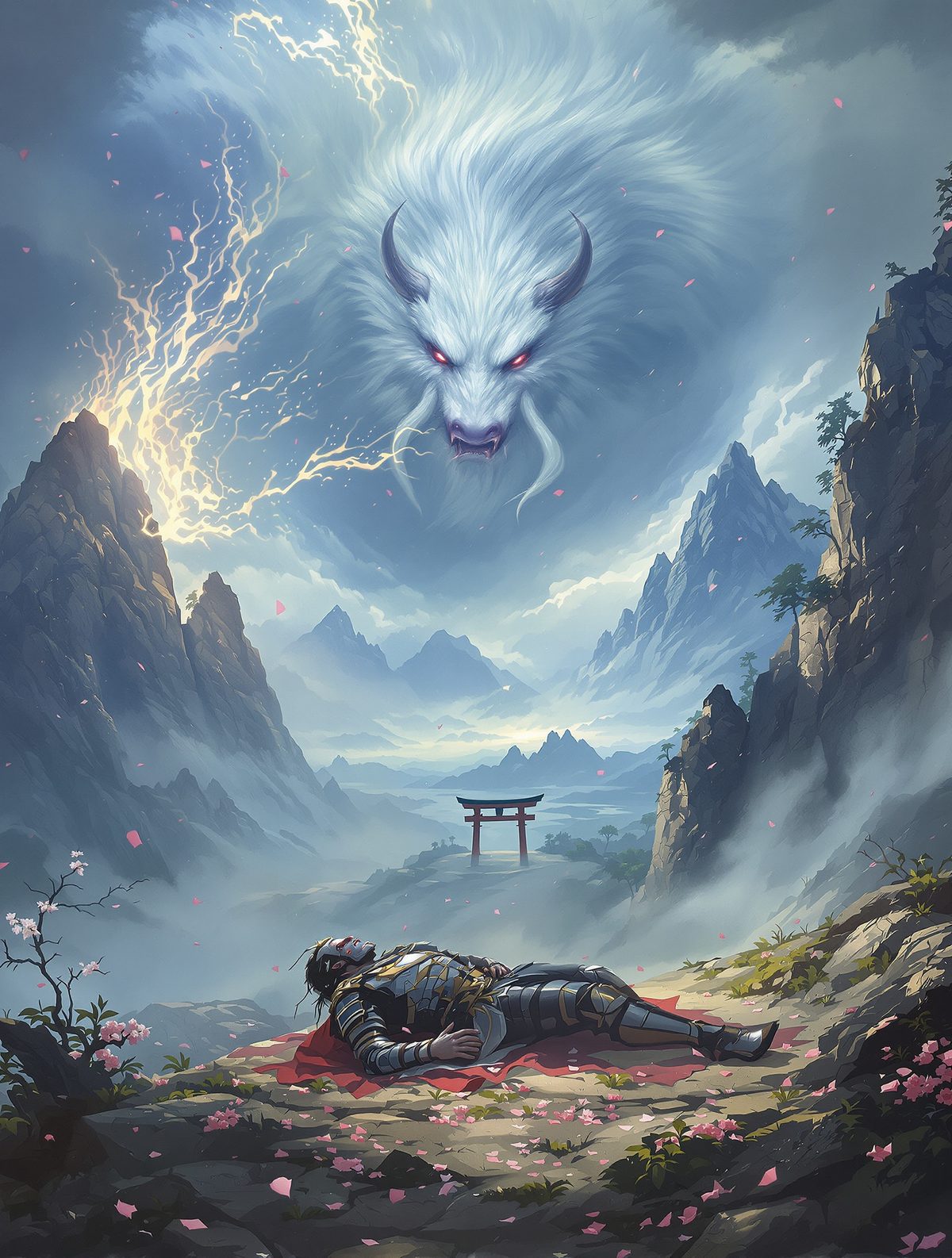
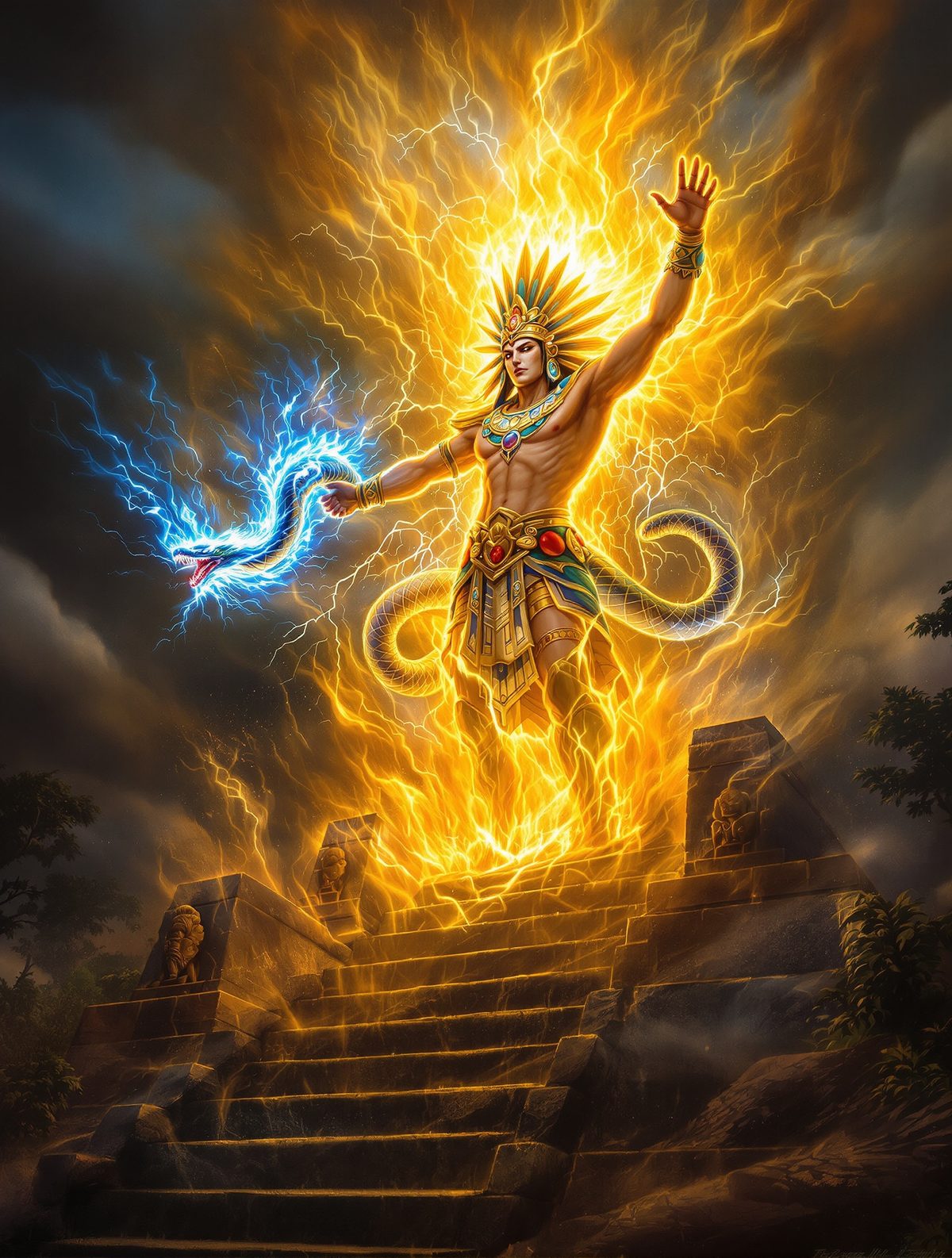
Picture this: a pregnant woman stands alone on a sacred mountain as four hundred of her own children march toward her with murder in their hearts. Their obsidian blades glint in the ancient sunlight, their war paint streaks across faces twisted with rage and shame. They believe their mother has dishonored them, and only blood can wash away the stain. But as they raise their weapons for the killing blow, the impossible happens—her unborn child explodes from her womb, not as a helpless infant, but as a fully-grown god of war, wielding a serpent made of pure fire.
This is the birth story of Huitzilopochtli, the Aztec god of war and the sun, and it's one of the most visceral and psychologically complex myths in all of Mesoamerican culture. Far from being a simple tale of divine intervention, this legend reveals the Aztecs' sophisticated understanding of family dynamics, political power, and the brutal mathematics of survival in a world where gods and mortals played by the same savage rules.
The Mother of Gods in Her Feathered Skirt
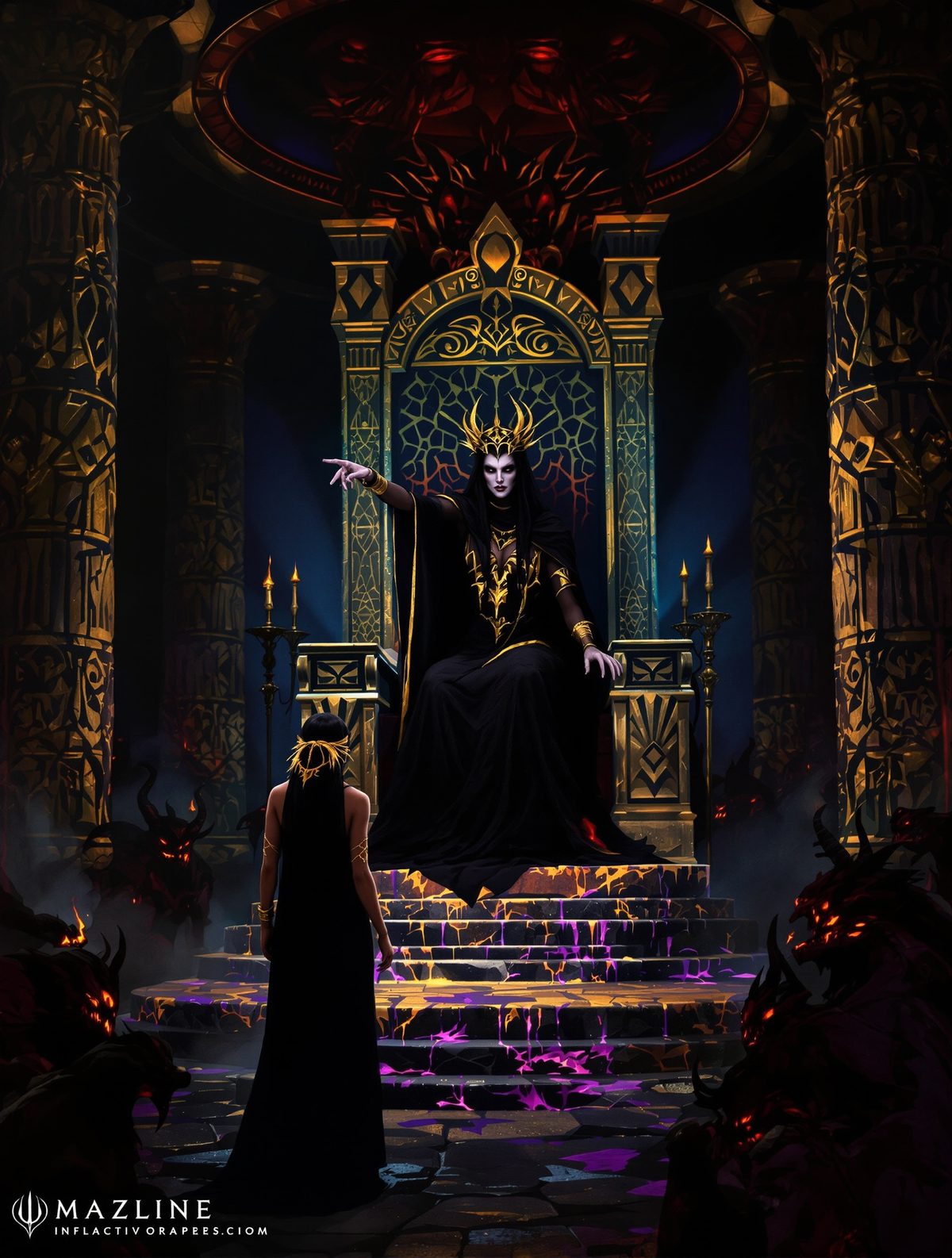
Our story begins with Coatlicue, whose name literally means "She of the Serpent Skirt." Imagine her: a goddess whose lower body writhed with living snakes, whose necklace was woven from human hearts and hands, and whose face was hidden behind a mask of two serpent heads kissing. She was the earth mother, the creator and destroyer, the one who gave life and devoured it with equal appetite.
Coatlicue lived on Coatepec, the "Serpent Mountain," where she served as a priestess, sweeping the sacred temple grounds in an act of devotion. She had already given birth to four hundred sons called the Centzon Huitznahua (the Four Hundred Southerners) and one daughter, Coyolxauhqui, whose name means "Golden Bells" for the way her face was painted with circles of gold.
But here's where the myth takes its first surprising turn: this earth goddess, this mother of hundreds, was still considered a virgin. In Aztec cosmology, divine virginity wasn't about sexual purity—it was about spiritual autonomy and creative power that belonged to no one but the goddess herself. This detail becomes crucial when we understand what happens next.
The Feathers That Changed Everything
One day, while Coatlicue swept the temple, a ball of hummingbird feathers floated down from the sky and nestled against her breast. In most tellings, she tucked these feathers into her clothing, close to her heart. What seems like a simple, even tender moment was actually a cosmic event—she had been impregnated by the god of war himself, though she wouldn't know it until the moment of crisis.
Hummingbirds held special significance for the Aztecs. These tiny creatures were seen as the souls of fallen warriors, forever hovering between earth and sky, life and death. The fact that Huitzilopochtli's conception came through hummingbird feathers wasn't random—it was a symbol that this child would be born to command the boundary between war and peace, life and death.
When Coatlicue discovered her pregnancy, her other children were outraged. Here was their mother, a sacred priestess, pregnant under mysterious circumstances. In their eyes, she had brought shame upon their divine family. But there's a deeper political reading here: the Four Hundred Southerners and their sister Coyolxauhqui may have represented the established order, the old gods who felt threatened by the emergence of a new power.
The March to Murder
Coyolxauhqui, the golden-faced daughter, became the ringleader of the rebellion. She convinced her four hundred brothers that their mother's dishonor could only be cleansed with blood. The number four hundred wasn't arbitrary—in Aztec cosmology, it represented completeness, infinity, the totality of existence. When four hundred divine beings unite in purpose, it should be unstoppable.
The siblings armed themselves with obsidian blades—volcanic glass so sharp it could cut at the molecular level, creating wounds that were both surgical and savage. They painted themselves for war, adorned themselves with feathers and jade, and began their march up Serpent Mountain. Some versions of the myth describe their approach as a thunderstorm of footsteps, their war cries echoing off the mountain walls like the screams of jaguars.
But here's a detail that most retellings miss: they weren't acting entirely in secret. One brother, Quauitlicac, broke ranks and warned Coatlicue of the approaching army. This internal betrayal within the rebellion adds another layer of complexity—even among the four hundred, there were those who questioned whether matricide was the answer to family shame.
The Impossible Birth
As her children surrounded her with weapons drawn, Coatlicue felt her unborn child speak to her from the womb: "Do not fear, mother. I know what I must do." At the exact moment the four hundred brought down their obsidian blades, Huitzilopochtli burst forth—not born so much as erupted—from his mother's body.
He emerged fully grown, fully armed, and fully enraged. In his hands blazed the Xiuhcoatl, the Fire Serpent—a weapon that some scholars interpret as lightning made manifest, others as a kind of divine flamethrower that could melt stone and vaporize enemies. His body was painted blue, the color of war and sacrifice. Hummingbird feathers crowned his head, and his left foot was decorated with feathers to replace the flesh—a detail that connected him to his divine father's avian nature.
The speed of his retaliation was as shocking as his birth. Without hesitation, without mercy, Huitzilopochtli struck down his sister Coyolxauhqui with the Fire Serpent. Some versions say he beheaded her; others describe him dismembering her entirely, scattering her golden body parts across the mountain. Then he turned his attention to his four hundred brothers, chasing them down the mountainside, slaughtering them as they fled in terror from this impossible newborn god.
The Cosmic Significance of Familial Violence
This wasn't just a story about a miraculous birth—it was the Aztec explanation for the daily cosmic drama playing out overhead. Huitzilopochtli became the god of the sun, and his sister Coyolxauhqui became the moon. Every day, as the sun rose, it symbolically defeated the moon and stars (the four hundred brothers) in eternal reenactment of that first battle on Serpent Mountain.
The Aztecs built their greatest temple, the Templo Mayor in Tenochtitlan, to represent this mythic mountain. At its base, archaeologists discovered a massive stone disk depicting the dismembered Coyolxauhqui, her body parts arranged in a pattern that mirrored the myth. When sacrificial victims were thrown from the temple's peak, they would land on this disk, symbolically reenacting the goddess's defeat and feeding the sun god with the blood he needed to continue his daily journey across the sky.
But here's what makes this myth particularly sophisticated: it acknowledges that power structures, even divine ones, are maintained through violence. Huitzilopochtli didn't become the supreme war god through birth alone—he earned his position by demonstrating his willingness to destroy even his own family to protect his mother and establish his authority.
Why Ancient Family Drama Still Matters
At first glance, this might seem like just another violent myth from a civilization we've been taught to see as bloodthirsty. But look deeper, and you'll find themes that resonate across cultures and centuries: the tension between old and new orders, the way families can become battlegrounds for power, and the sometimes terrible price of defending one's principles.
The story of Huitzilopochtli's birth also reveals something profound about how the Aztecs understood trauma and resilience. A child born into violence, who emerges not broken but powerful, who transforms victimization into strength—this resonates with anyone who has ever had to fight for their right to exist in a hostile world.
Perhaps most importantly, this myth reminds us that every sunrise is a victory earned, not a gift freely given. The Aztecs understood that light conquers darkness not through gentle persuasion but through daily battle. In our own era, when we often feel overwhelmed by the forces arrayed against progress and hope, there's something deeply empowering about a god who was literally born fighting—and who teaches us that sometimes, the most miraculous birth is the one that arrives armed and ready for whatever battles lie ahead.