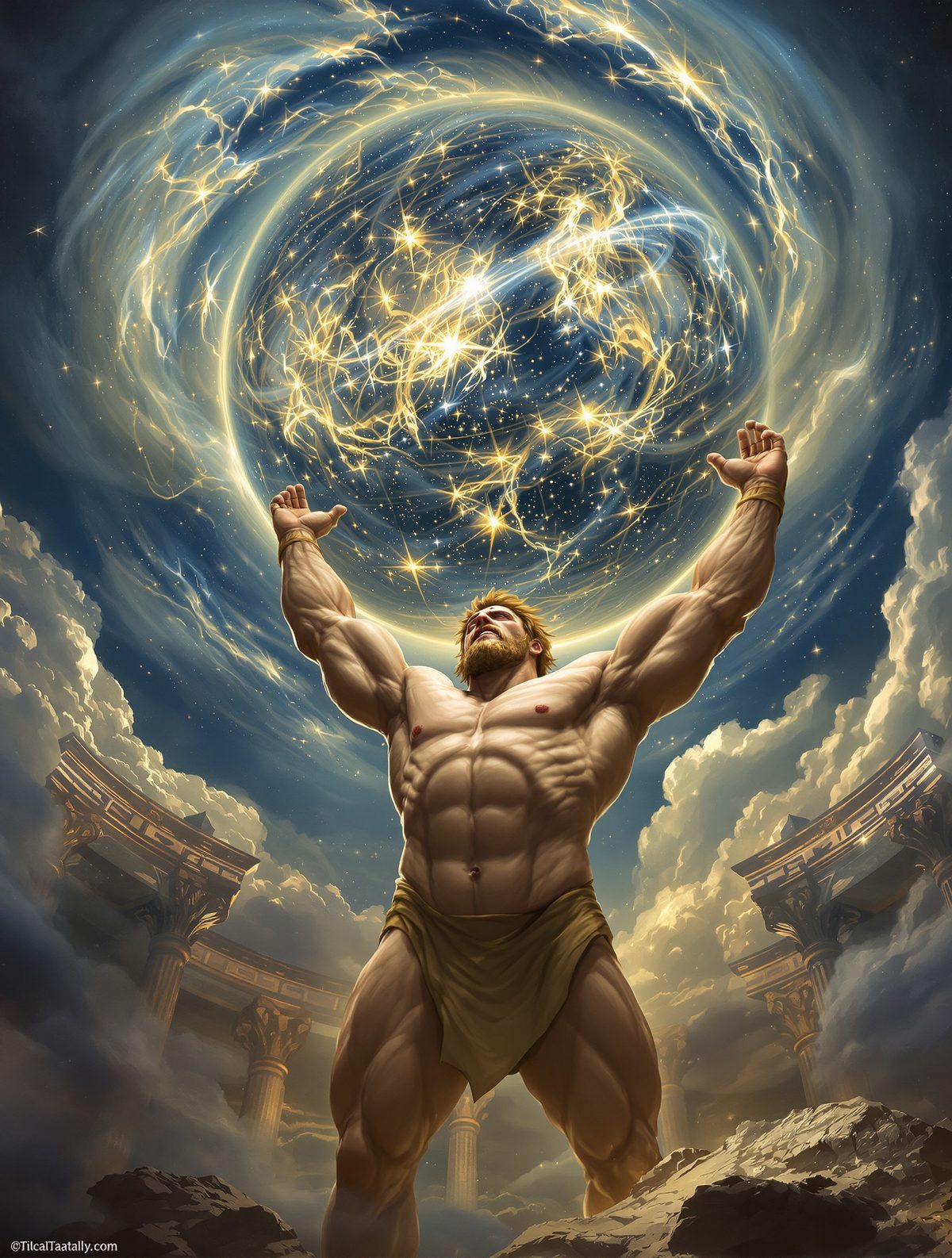
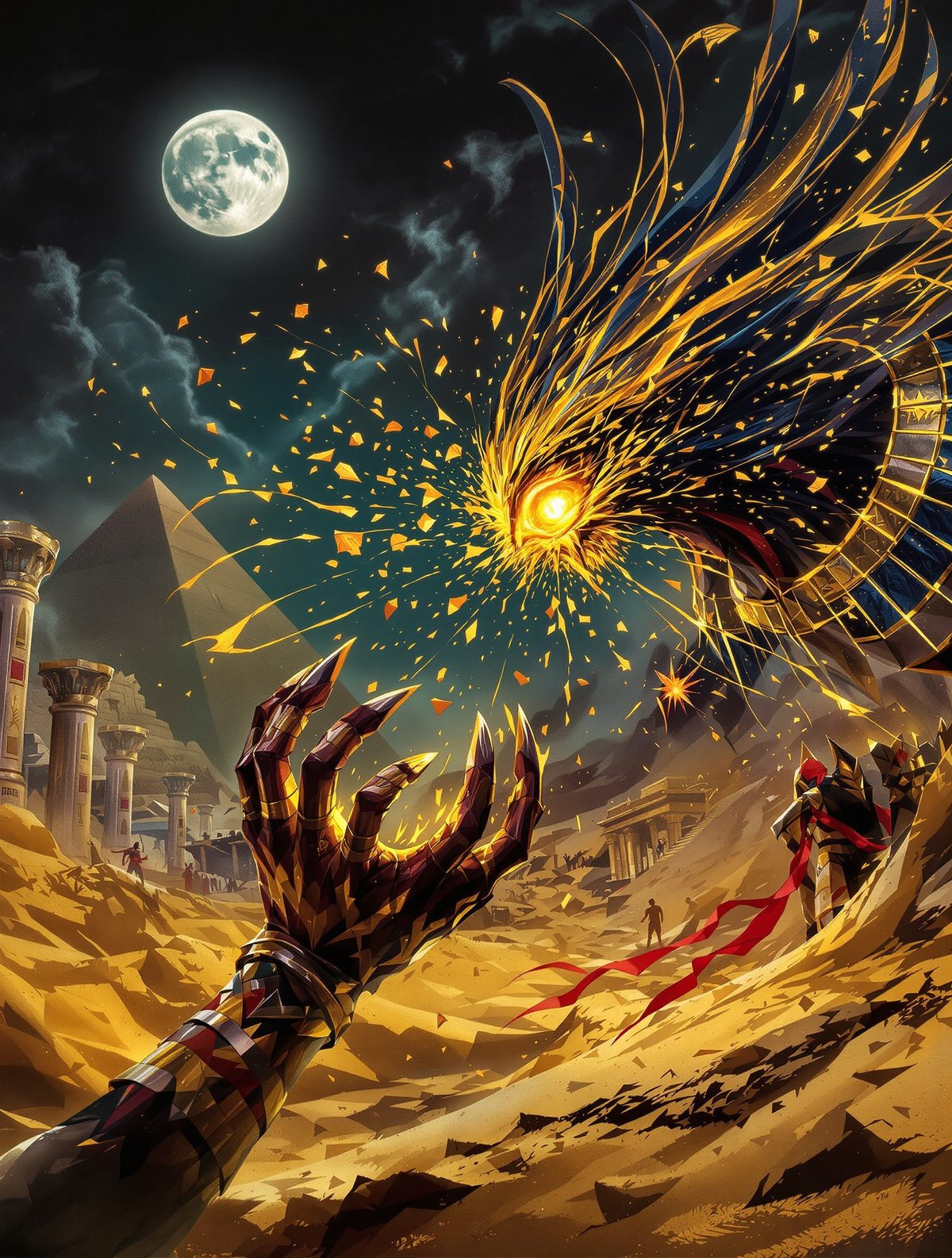
Picture this: across the star-drunk skies of ancient Egypt, two gods locked in cosmic combat while mortals below trembled and prayed. The younger god, his magnificent falcon head crowned with the double crown of Egypt, circled his uncle—a creature of chaos with the head of an unknown beast, red eyes blazing with murderous intent. This wasn't just a family feud. This was a battle that would literally reshape the heavens, tear the moon from its fullness, and create one of history's most powerful protective symbols.
What the scribes recorded on papyrus and carved into temple walls wasn't mere mythology—it was the foundational story that justified every pharaoh's right to rule for over 3,000 years. The battle between Horus and Set became so central to Egyptian civilization that even Cleopatra herself claimed to embody Isis, the mother who orchestrated her son's victory over chaos itself.
The Murder That Started a Divine War
To understand why Horus and Set fought with such primal fury, we must first witness the crime that set it all in motion. Osiris, the green-skinned god of fertility and rebirth, ruled Egypt during what Egyptians considered a golden age. His brother Set—whose strange animal head has puzzled Egyptologists for centuries—seethed with jealousy that curdled into something far darker.
The murder itself reads like something from a psychological thriller. Set didn't simply kill his brother; he orchestrated an elaborate trap. At a grand feast attended by 72 conspirators, Set presented a beautiful chest made of ebony and precious metals, claiming he would gift it to whoever fit inside perfectly. When Osiris lay down in the chest—which Set had secretly measured to his brother's exact dimensions—the conspirators slammed the lid shut, sealed it with molten lead, and hurled it into the Nile.
But Set's paranoia didn't end there. When Isis recovered Osiris's body and began the rituals to resurrect him, Set discovered the corpse and dismembered it into fourteen pieces, scattering them across Egypt. Only through Isis's desperate magic—and the help of her sister Nephthys, who was ironically married to Set himself—was Osiris restored enough to father a son: Horus.
The Falcon Prince Rises
Hidden in the papyrus swamps of the Nile Delta, Horus grew up knowing his destiny. Ancient texts describe him as having the keen sight of a falcon—capable of seeing a mouse from two miles away—and eyes that held the sun and moon themselves. His left eye was said to be silver like the moon, his right eye golden like the sun. When he reached divine maturity, around what mortals would consider eighteen years, Horus emerged to challenge his uncle's illegitimate rule.
What many don't realize is that this wasn't a quick battle. The Contendings of Horus and Set, recorded on the Chester Beatty Papyrus I (dating to around 1160 BCE), describes a legal and physical war that lasted 80 years. The gods themselves served as jury, with Ra initially favoring Set due to his greater age and experience, while most other deities supported Horus's legitimate claim as Osiris's heir.
The trials included everything from boat races using ships made of stone (Horus cleverly used wood painted to look like stone while Set's actual stone boat sank) to contests of strength and wisdom. But when legal maneuvering failed, the gloves came off, and the battle moved to a more primal arena.
The Night the Moon Was Torn Apart
The most catastrophic battle occurred during what Egyptian texts call "the great contest in the sky." Transformed into their animal forms—Horus as a massive falcon with wings that spanned the horizon, Set as his mysterious beast-form—they grappled among the stars themselves. Imagine the terror of ancient Egyptians watching this cosmic WWE match unfold above them, with shooting stars marking each blow and thunder rolling from their collisions.
The pivotal moment came when Set, driven to desperation, managed to pin down his nephew and literally tore out Horus's left eye. But this wasn't just any eye—it was the moon itself. Ancient texts describe how Set "trampled upon it" and "divided it into six pieces," which he then scattered across Egypt like his brother's dismembered corpse years before.
Suddenly, the night sky went dark. The moon, which Egyptians believed was Horus's eye traveling across the heavens, dimmed to nothing. Some versions say it disappeared entirely for three days, while others describe it as becoming permanently damaged—which is how Egyptians explained the moon's phases. Unlike the sun (Horus's right eye, which remained intact), the moon would forever wax and wane, never again maintaining its full, perfect brightness.
The symbolism here runs deeper than most realize. Eyes in Egyptian culture weren't just organs of sight—they were organs of truth. The hieroglyph for "to see" and "to know" were related, and the loss of an eye represented the temporary triumph of chaos and deception over order and truth.
Thoth's Midnight Surgery
Enter Thoth, the ibis-headed god of wisdom, writing, and magic—essentially ancient Egypt's combination of Einstein, Merlin, and Stephen Hawking. While Horus lay wounded and the world stumbled through moonless nights, Thoth embarked on what can only be described as the world's first divine medical mission.
Thoth gathered the six scattered pieces of the eye from across Egypt. Some texts say he found them buried in temple grounds, others claim they were hidden in the bodies of sacred animals. Using magic that the texts describe in tantalizingly vague terms—involving "words of power" and rituals performed at the exact moment when certain stars aligned—Thoth reconstructed the eye.
But here's where the story gets truly fascinating: Thoth didn't just restore the eye's physical form. He imbued it with protective power that extended beyond Horus himself. The restored eye became a talisman capable of safeguarding anyone who possessed its image or invoked its power. This is why the Eye of Horus (also called the wadjet) became ancient Egypt's most potent protective symbol.
The mathematical precision of the Eye of Horus symbol reveals Egyptian sophistication that many overlook. Each part of the eye represents a fraction: the pupil is 1/4, the eyebrow 1/8, the left side of the eye 1/16, the right side 1/32, the curved tail 1/64. These fractions add up to 63/64, with the missing 1/64 representing the magic that Thoth added—the divine element that mere mathematics couldn't capture.
Victory and the Crown of Two Lands
When Thoth restored Horus's eye, the tide of battle shifted permanently. The returned vision didn't just heal Horus—it enhanced him. Now he possessed not only his original divine sight but also the protective power that came from surviving Set's assault and being restored by the god of wisdom himself.
The final confrontation varied depending on which temple told the story. In some versions, Horus defeated Set in single combat and castrated him, ensuring his uncle could never father competing heirs. In others, the gods finally rendered their verdict after seeing Horus's superior moral character and legitimacy. The most psychologically complex version has Set eventually acknowledging his guilt and agreeing to serve as Horus's protector—transforming from chaos-bringer to defender of the rightful king.
Regardless of the specific ending, all versions conclude with Horus receiving the crown of Upper and Lower Egypt, becoming the template for every pharaoh who would ever rule. More importantly, his wounded and restored eye became a symbol that would outlast the civilization that created it.
The Eye That Still Watches
Walk through any museum with an Egyptian collection today, and you'll see it everywhere: on amulets, painted on coffin lids, carved into temple walls, even tattooed on modern skin. The Eye of Horus has transcended its mythological origins to become a universal symbol of protection and healing that spans cultures and millennia.
But perhaps its most profound legacy lies in what it represents about human resilience. Horus's story isn't really about gods and monsters—it's about justice emerging from injustice, strength growing from vulnerability, and wisdom arising from suffering. The eye that was torn out became more powerful than the eye that was never touched.
In our own age of division and uncertainty, maybe that's exactly the kind of ancient wisdom we need. Sometimes the things that wound us, that seem to diminish our power or darken our vision, become the very sources of our greatest strength. The Egyptians knew something we're still learning: that being broken doesn't mean being defeated, and that the most potent protection often comes from surviving what seemed unsurvivable.
The moon still waxes and wanes overhead, just as it did when ancient Egyptians first told this story. And somewhere in its changing phases, they would say, Horus's restored eye continues its eternal watch over a world that still desperately needs both justice and protection.