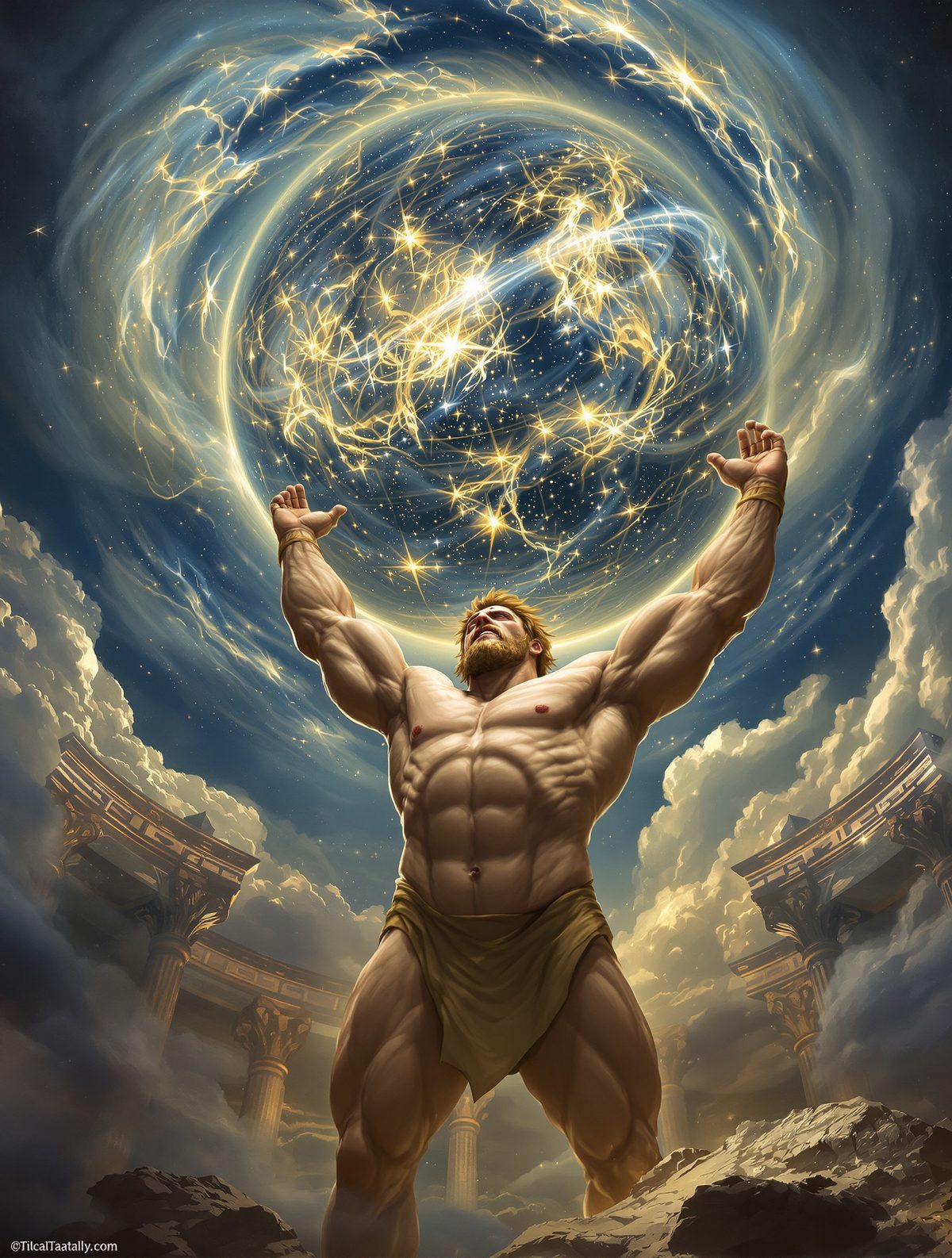
Imagine the weight of every storm cloud that has ever gathered, every star that burns in the night sky, every breath of wind that has ever blown across the earth. Now imagine carrying all of that—and infinitely more—on your shoulders. Forever. No rest, no reprieve, no hope of release. This is the curse of Atlas, the Titan whose crime against Zeus earned him the cruelest punishment in all of mythology.
While his fellow Titans screamed in the fiery depths of Tartarus, Atlas stood alone at the western edge of the world, his massive frame bent beneath a burden that would crush mountains to dust. His punishment wasn't just physical torment—it was a cosmic responsibility that, if he ever faltered, would bring about the end of everything.
The War That Shattered the World
The Titanomachy—the ten-year war between the Titans and the Olympian gods—was no mere family squabble. It was a conflict that literally reshaped reality itself. Ancient sources tell us this cosmic battle raged from approximately 1000 to 990 BCE in mythological time, though Homer and Hesiod place it in the distant past when the world was young and malleable.
Atlas wasn't just any Titan—he was the son of Iapetus and the oceanid Clymene, making him brother to Prometheus, Epimetheus, and Menoetius. Standing nearly 300 cubits tall (roughly 450 feet), Atlas commanded the western armies of the Titans with tactical brilliance that nearly brought Zeus to his knees. His very name, derived from the Greek "tlas" meaning "to bear" or "endure," would prove grimly prophetic.
When the tide finally turned in Zeus's favor—thanks largely to the Cyclopes' thunderbolts and the Hundred-Handed Ones' devastating assault—the fate of each Titan was decided based on their role in the rebellion. Most were hurled into Tartarus, that primordial prison beneath even Hades. But Zeus had something special in mind for Atlas.
A Punishment Worse Than Death
Why did Atlas receive such a unique torment? Ancient sources suggest it wasn't just his military prowess that earned Zeus's particular wrath—it was his knowledge. Atlas was said to possess complete understanding of the heavens' architecture, the secret paths of the stars, and the very pillars that separated earth from sky. Zeus needed someone capable of bearing such cosmic weight, and Atlas's expertise made him the only candidate.
The punishment itself defied conventional understanding. Atlas wasn't simply holding up a physical dome—Greek cosmology describes the heavens as having actual substance and infinite weight. Every constellation, every celestial sphere, every layer of the cosmic order pressed down on his shoulders. Ancient calculations by philosophers like Anaximander suggested the heavens extended at least 27 earth-diameters in every direction, creating a burden literally beyond mortal comprehension.
But here's what the textbooks rarely mention: Atlas's punishment was voluntary in the strictest sense. Zeus offered him a choice—accept eternal torment or watch the entire cosmos collapse into primordial chaos. For a being who understood the intricate beauty of celestial mechanics, there was really no choice at all.
The Geography of Endless Burden
Atlas's prison wasn't arbitrary—it was the westernmost point of the known world, where the Pillars of Hercules (modern-day Gibraltar) marked the edge of mortal geography. Here, at coordinates the Greeks calculated as 36°N, 6°W, the Titan took his eternal station. Ancient geographers like Strabo described the location as perpetually shrouded in mist, where the boundary between earth and sky grew thin.
The mountain range that bears his name—the Atlas Mountains of North Africa—was said to be formed by his very presence, his feet sinking deep into the earth under the cosmic weight. Local Berber legends, predating Greek influence by centuries, spoke of a giant who held back the "weight of forever" in these peaks, suggesting the Atlas myth may have roots in even older traditions.
What's fascinating is that ancient astronomers used Atlas's position as a fixed reference point. They calculated that from his location, the North Star appeared exactly 36 degrees above the horizon—a detail that shows the Greeks weren't just telling stories, but embedding real astronomical observations into their mythology.
The Titan Who Nearly Found Freedom
Perhaps the cruelest aspect of Atlas's fate was how close he came to escape—not once, but twice. The first opportunity came when Perseus, fresh from slaying Medusa, sought hospitality in Atlas's garden. When the Titan refused (having been warned that a son of Zeus would one day steal his golden apples), Perseus showed him Medusa's head, turning Atlas to stone. But even as a mountain, he continued to bear the sky's weight—the punishment transcended even petrification.
The second near-escape is less well-known but far more poignant. When Heracles arrived to steal the golden apples as his eleventh labor, Atlas offered a deal: he would retrieve the apples if Heracles would temporarily assume the burden. For perhaps an hour—the only respite in millennia—Atlas walked free, feeling wind on his face and taking steps without the cosmos pressing down on him.
The moment when Atlas returned and Heracles asked him to take back the weight "for just a moment" while he adjusted his cloak, Atlas knew it was over. The brief taste of freedom made resuming the burden infinitely more cruel. Ancient sources say this was the only time Atlas wept, and his tears became the springs that fed the Garden of the Hesperides.
The Titan's Hidden Influence
What the myths don't emphasize is Atlas's continued importance to the world above. Greek navigators offered sacrifices to him before ocean voyages, believing his knowledge of celestial mechanics guided their ships. The constellation we call the Pleiades—the Seven Sisters—were said to be Atlas's daughters, placed in the sky where he could always see them and draw strength from their presence.
Ancient texts from the Library of Alexandria describe Atlas as more than just a sufferer—he became a cosmic mediator, using his position to influence weather patterns, tides, and seasonal changes. When storms threatened Mediterranean trade routes, sailors would burn incense "for Atlas's favor," believing the Titan could ease the sky's weight just enough to calm the winds.
Even more remarkably, some sources suggest Atlas gradually grew stronger under his burden. After the first millennium, he could shift the weight from shoulder to shoulder. After the second, he could stand fully upright instead of bent. The eternal punishment was slowly forging him into something beyond even Titan strength—though still nowhere near powerful enough to simply cast off the heavens.
Why Atlas Still Matters
In our age of space exploration and quantum physics, Atlas's story might seem like quaint mythology. But perhaps we've never needed his legend more. At a time when humanity grapples with responsibilities that feel cosmic in scope—climate change, nuclear weapons, artificial intelligence—Atlas represents something profound about the weight of knowledge and the burden of capability.
Like Atlas, we often find that understanding the true scale of our challenges doesn't free us from responsibility—it binds us to it more completely. The Titan who held up the sky wasn't just a victim of divine wrath; he was the ultimate embodiment of duty without hope of reward, of bearing unbearable weight because someone must.
Every time we use his name—in atlases that map our world, in the Atlantic Ocean he was said to rule, in the vertebrae that hold up our skulls—we invoke his eternal vigil. In the end, Atlas's true punishment wasn't the physical weight, but the knowledge that his burden was both meaningless and absolutely essential. The sky would fall without him, yet the sky remained a prison he could never escape.
Perhaps that's the most human thing about this ancient Titan: he carried on anyway.