
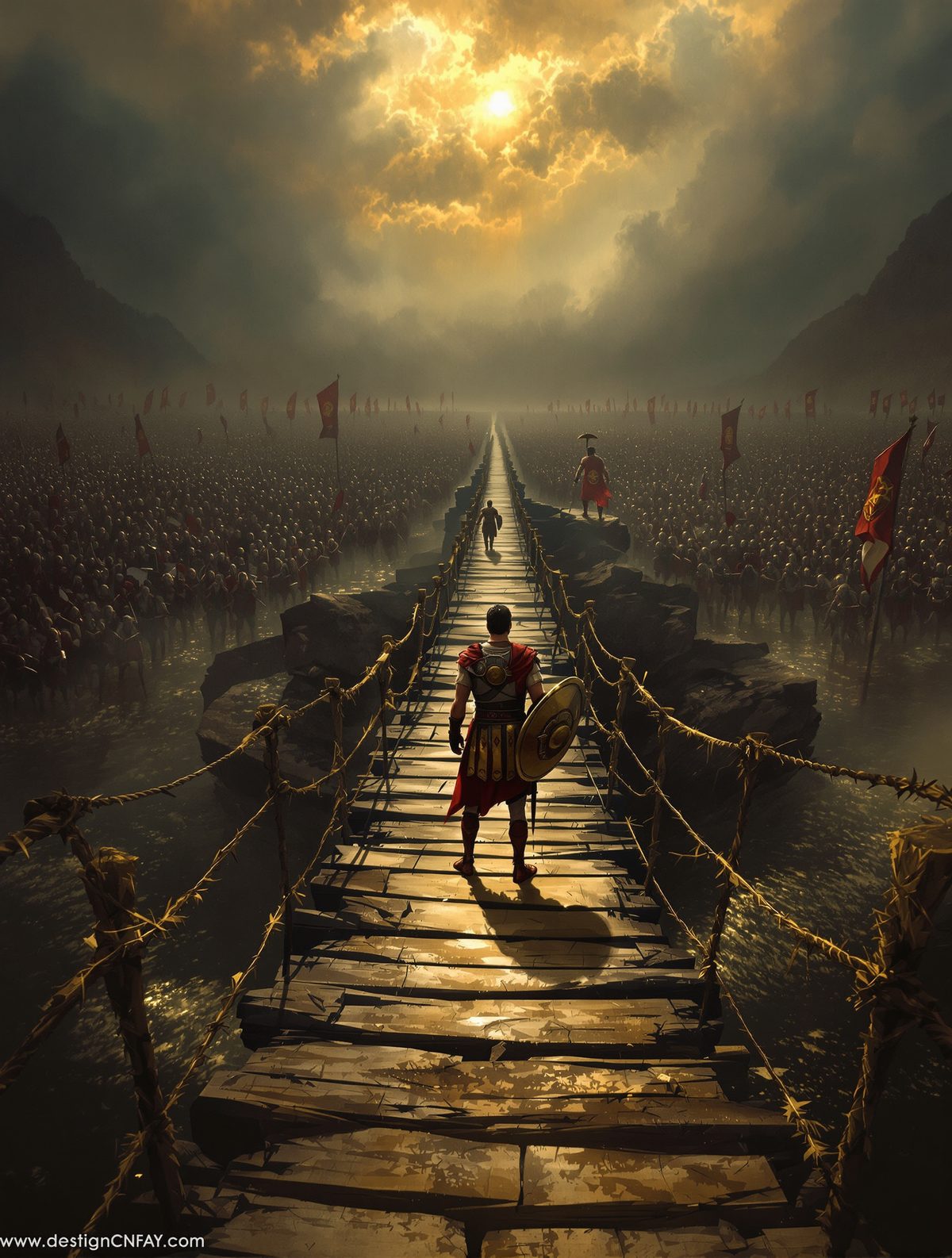
The sun glared down on the city of Rome, casting long shadows over the Tiber River. A single wooden bridge connected the city to looming peril. On one side lay the roaring threat of the Etruscan army; on the other, the open gates of Rome, vulnerable and exposed. As the dust of war settled and silence hung in the air, one man emerged as Rome’s lone sentinel. This is the story of Horatius Cocles — the man who stood alone, and with him, stood the very fate of Rome.
Clash at the Tiber: The Etruscan Threat
The date was around 508 BCE, a tumultuous period in Roman history. The young Republic was still in its infancy, having recently expelled the last Roman king, Lucius Tarquinius Superbus. In a volatile power shift, the newly minted republic lay exposed to both internal discontent and external threats. Chief among these threats was the Etruscan army, led by Lars Porsena, the formidable King of Clusium.
Lars Porsena, driven by ambition or perhaps allegiance to the deposed Tarquin, marched his armies towards Rome. The Etruscan forces, seasoned warriors adept at siegecraft, descended upon the wooden bridge spanning the Tiber, the Pons Sublicius. If they succeeded in crossing, not just the bridge but all of Rome would be laid bare before their might. Romans knew that if the Pons Sublicius fell, so too would the city itself.
The Unyielding Courage of Horatius
It is within this crucible of crisis that Horatius Cocles became the embodiment of Roman valor. Tradition describes Horatius as a man of broad shoulders, with a fierce face that belied his years. More than just a soldier, he was a symbol of Roman resolve. As chaos reigned, Horatius proposed a daring gamble — destroy the bridge while he held the line.
Horatius stood with only two companions, Spurius Lartius and Titus Herminius, who initially joined him on the bridge. As the Etruscan forces surged forward, baying for Roman blood, Horatius begged his comrades to destroy the bridge behind him. With each slash of his sword and thrust of his shield, he dared the entire Etruscan army to step forward.
The Battle of the Bridge
Imagine the clash of iron and the cries of men echoing across the Tiber. Faced with overwhelming odds, Horatius fought with the ferocity of a cornered lion. His shield, scarred and battered, withstood the rain of Etruscan weaponry. Legends tell of arrows bouncing off his armor as if the gods themselves shielded him.
With Lartius and Herminius retreating to finish dismantling the bridge, Horatius found himself alone before the invading tide. Yet, not for a moment did he waver. Horatius’ efforts gave valuable time to his fellow Romans, who frantically sawed and hacked at the timber beneath their feet.
In the heat of the battle, as hope turned to despair, a cheer erupted from the Roman banks. Against the odds, the last support planks fell away, and the bridge crumbled into the Tiber. Only then did Horatius turn and offer a silent prayer to the river goddess Tiberinus, seeking safe passage.
A Daring Escape
With the bridge collapsing into the swift-flowing waters, Horatius faced a new challenge — how to rejoin his people. The only path lay across the deep waters of the Tiber. Donning his heavy armor, Horatius leaped into the river below. Rome’s fate lay not just in his martial prowess, but in his very survival.
Accounts differ on the exact outcome, but many say the gods favored Horatius. Despite the weight of his armor, he swam with all the strength left in him, reaching the Roman shores exhausted but alive. His daring act became a legendary tale of courage and sacrifice, crossing into the realm of myth where fact and fiction blur.
Legacy Beyond the Legend
The tale of Horatius Cocles stands as a beacon of courage, a narrative woven into the fabric of Roman identity. Romans honored his bravery with statues and songs, ensuring Horatius’ story would echo through the ages. The Roman historian Livy and the poet Horace immortalized his deeds, ensuring that generations would remember the day one man stood in defiance of an entire army.
Historians debate the historicity of this vibrant tale, wondering where myth ends and reality begins. Yet, whether fact or embellished folklore, Horatius’ story resonates deeply, teaching lessons of bravery, sacrifice, and the power of one determined individual against overwhelming odds.
Why Horatius’ Stand Still Matters
In a world often beleaguered by strife, Horatius’ tale urges us to consider the courage of conviction. In a time when challenges may loom large and overwhelming, individual courage becomes a powerful force for change. Horatius Cocles’ legend challenges each of us to stand firm in our beliefs, to defend what we hold dear, no matter the odds.
As we reflect on history’s legends, the story of Horatius Cocles reminds us that the actions of one person can define the destiny of many. In holding the bridge, Horatius not only saved Rome but forged a legacy of heroism that whispers through the ages, asking what bridges we might stand upon today.