
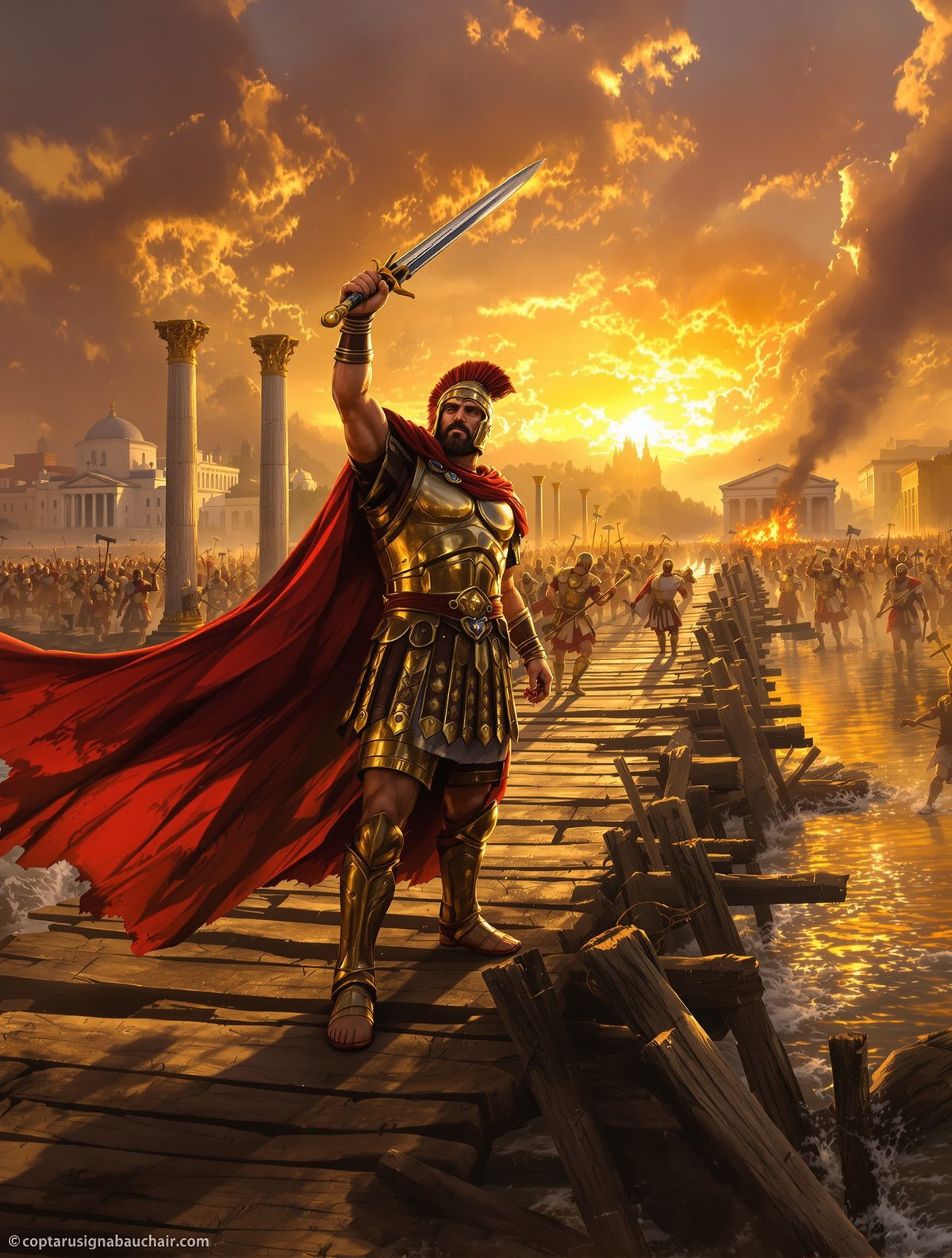
The wooden planks groaned under the weight of thousands of marching feet. Dust clouds rose like smoke signals of doom on the horizon as the largest army ever assembled against Rome thundered toward the city's heart. Between the unstoppable force of Etruscan steel and the eternal city stood one structure: the Pons Sublicius, a simple wooden bridge spanning the muddy waters of the Tiber. And in 508 BCE, as Rome's very existence hung in the balance, one man stepped forward to write his name in legend.
His name was Publius Horatius Cocles—though history would remember him simply as Horatius. Behind him, Romans wielded axes in desperate haste, chopping frantically at the bridge supports. Before him stretched an army that had never known defeat. What happened next would become the stuff of legend, inspiring poets for millennia and proving that sometimes, one person really can change the course of history.
The Tyrant King's Revenge
To understand why thousands of Etruscan warriors were bearing down on Rome, we must first meet one of history's most vengeful rulers: Lars Porsena, King of Clusium. The year 509 BCE had been catastrophic for monarchist forces in Rome. The last Roman king, Tarquinius Superbus—literally "Tarquin the Proud"—had been overthrown in a republican revolution led by Lucius Junius Brutus. The newly formed Roman Republic had barely celebrated its first birthday when Tarquin came knocking with powerful friends.
Porsena commanded not just his own formidable Etruscan forces, but a coalition that included exiled Roman nobles, mercenary bands, and allied city-states. Ancient sources describe his army as numbering in the tens of thousands—a staggering force for the ancient world. To put this in perspective, early Rome's entire population likely numbered fewer than 100,000 souls, including women, children, and slaves. This wasn't just an invasion; it was an existential threat.
The Etruscans were no mere barbarians, either. Their civilization had flourished for centuries before Rome was even a gleam in Romulus's eye. They possessed advanced metallurgy, sophisticated engineering, and military tactics that had conquered much of central Italy. Their bronze work was legendary, their chariots feared, and their infantry disciplined. Rome, by comparison, was still a scrappy upstart city-state learning to govern itself.
The Bridge That Held Destiny
The Pons Sublicius wasn't just any bridge—it was Rome's lifeline and its greatest vulnerability. Built entirely of wood without a single iron nail (a religious requirement honoring the river god), it was the only crossing point over the Tiber for miles in either direction. Control the bridge, and you control access to Rome itself.
What made this wooden span even more remarkable was its sacred nature. The bridge was maintained by the Pontifices—literally "bridge-builders"—a college of priests whose title would eventually evolve into our word "pontiff." Every timber was blessed, every repair ritualized. The Romans believed the gods themselves protected this crossing, making it both a practical necessity and a holy site.
But on this fateful day in 508 BCE, divine protection seemed absent. Porsena's scouts had identified the bridge as Rome's weak point, and his forces moved with terrifying efficiency. The Etruscan plan was brutally simple: storm across the Pons Sublicius before the Romans could react, establish a beachhead on the city side of the river, and watch Rome's defenses crumble from within.
One Man Against an Army
As Etruscan war cries echoed across the Tiber valley, panic seized the Roman defenders. Some called for immediate retreat behind the city's walls. Others argued for attempting to hold the bridge's far end. But one voice cut through the chaos with startling clarity: that of Horatius Cocles, a veteran centurion whose very nickname meant "one-eyed"—likely the result of an earlier battle wound.
Horatius proposed something that sounded like madness: he would hold the bridge's narrow entrance alone while engineers demolished it behind him. The plan required perfect timing, nerves of steel, and what the Romans called virtus—courage beyond ordinary human limits. Initially, two companions, Spurius Lartius and Titus Herminius, volunteered to stand with him. But as the work progressed and danger mounted, Horatius ordered them back, declaring he would make his stand alone.
What followed defied every principle of ancient warfare. Battles weren't supposed to hinge on individual heroics—they were won by disciplined formations, superior numbers, and tactical advantage. Yet here stood one Roman warrior, sword drawn, facing down an entire army at a bridge barely wide enough for three men to cross abreast.
The physics of the situation worked in Horatius's favor, but only just. The Etruscans couldn't deploy their overwhelming numbers effectively on the narrow bridge approach. They were forced to attack in small groups, allowing Horatius to face manageable odds—though "manageable" is relative when you're one man fighting for your life against rotating fresh opponents.
The Longest Minutes in Roman History
Ancient sources differ on exactly how long Horatius held the bridge—estimates range from minutes to the better part of an hour. What they agree on is the extraordinary nature of his defense. Armed with a gladius (the short Roman sword) and shield, Horatius fought with the desperation of a man who knew he was buying time with his blood.
The Etruscans, initially confident in their overwhelming advantage, grew increasingly frustrated. Their best warriors fell to Horatius's blade, their formations couldn't deploy properly, and precious time slipped away as Roman axes bit deeper into the bridge supports. Some accounts describe Etruscan attempts to flank the position by swimming the river, only to be driven back by Roman archers on the opposite bank.
Behind Horatius, the sound of splintering wood grew louder as Roman engineers worked with desperate efficiency. These weren't random civilians with hand tools—the Romans had developed sophisticated techniques for rapid military engineering. They used wedges, levers, and controlled stress points to bring down structures quickly and completely.
Then came the moment every Roman held their breath for: the sharp crack that announced the bridge's final moments. "Horatius!" came the shout from behind. "The bridge falls! Come back!" But the warrior was trapped—dozens of Etruscan soldiers blocked any retreat, their eyes gleaming with the promise of glory for killing Rome's defender.
The Leap of Faith
What Horatius did next would inspire Roman mothers to tell their sons his story for generations. Seeing no path back and hearing the bridge's death groans behind him, he did something that shocked both armies: he prayed. Not a desperate plea for rescue, but a formal invocation to Tiberinus, the river god himself.
"Holy Tiberinus," Livy records him saying, "I pray that you receive these arms and this soldier in your benevolent stream." Then, fully armored and still gripping his weapons, Horatius leaped into the muddy waters of the Tiber just as the bridge collapsed in a thunderous crash of splintering timber.
The Etruscans watched in stunned silence as their path to Rome disappeared into the river. Their target—that lone Roman who had denied an entire army—vanished beneath the dark waters. For long moments, both sides peered into the Tiber, wondering if they had witnessed a hero's death or salvation.
Then, impossibly, Horatius's head broke the surface. Swimming in full armor was nearly impossible, but somehow he fought against the current, struggled toward the Roman shore, and hauled himself onto the muddy bank to thunderous cheers from his countrymen. The gods, it seemed, had indeed honored his courage.
The Price of Heroism
Horatius's stand didn't end the war—Porsena laid siege to Rome for months afterward, and the city endured terrible hardships before the Etruscans finally withdrew. But it bought Rome something precious: time to organize its defenses, rally its allies, and prove that the new republic was worth defending.
The Romans honored their hero appropriately. Horatius received a grant of land "as much as he could plow in one day"—a generous reward in an agricultural society. A statue was erected in his honor, and his story became required learning for every Roman child. The poet Ennius immortalized him in verse, and centuries later, Livy would ensure his legend reached every corner of the growing empire.
Yet perhaps the greatest tribute to Horatius wasn't Roman at all. The Etruscans themselves, rather than vilifying their opponent, came to respect his stand. Later Etruscan art occasionally depicted the bridge scene, suggesting that even Rome's enemies recognized true virtus when they saw it.
In our age of global communications and instant connectivity, it's easy to forget how one person's actions could once change everything. Horatius Cocles reminds us that individual courage, deployed at the right moment, can indeed alter the course of history. His few minutes on a wooden bridge didn't just save Rome—they preserved the republic that would eventually transform the ancient world, spread Latin language and law across three continents, and lay foundations that still influence our civilization today.
The next time you face impossible odds, remember the one-eyed centurion who drew his sword when an army came calling. Sometimes, holding your ground is all it takes to change the world.