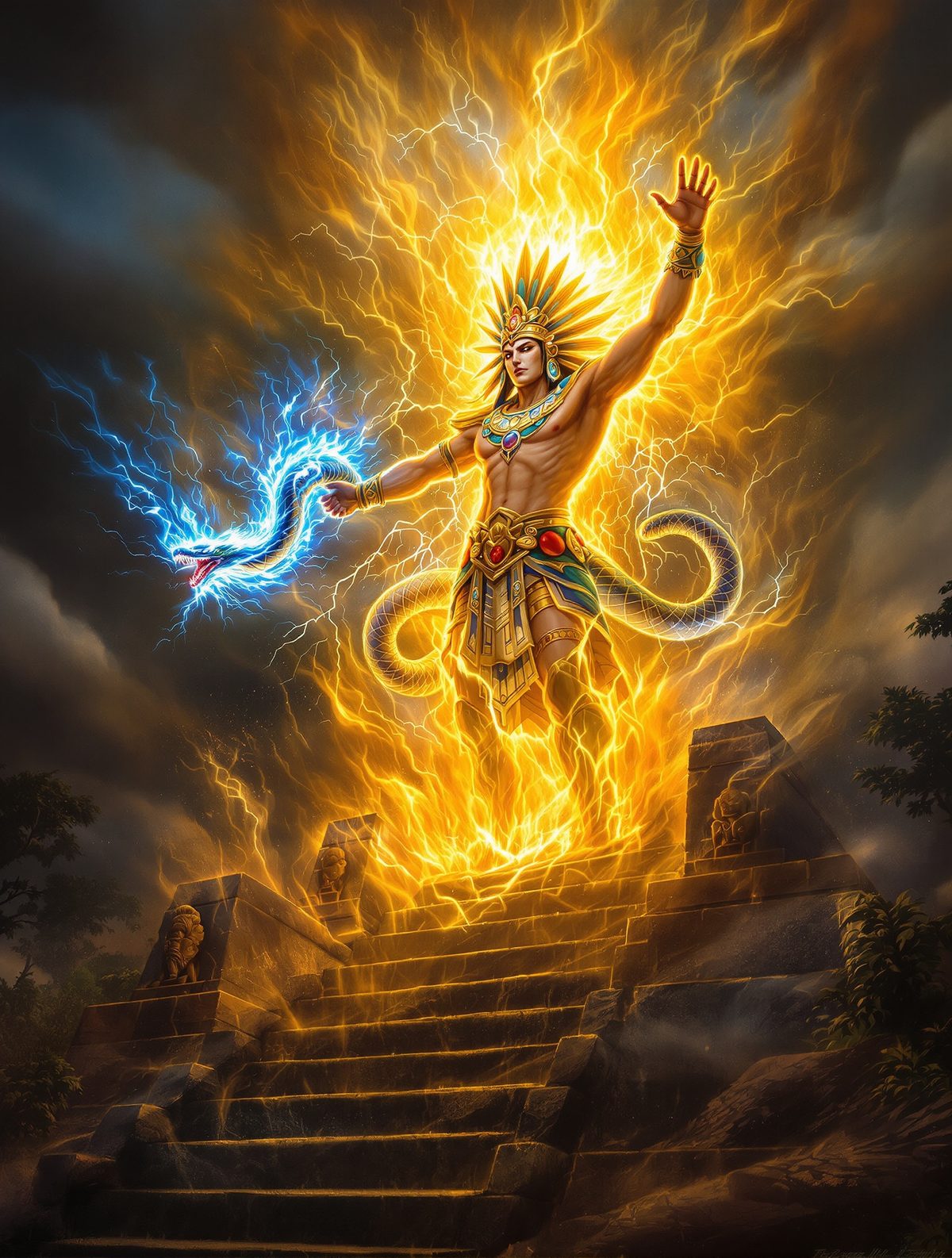
The golden disk of Ra blazed mercilessly over the Nile Delta as humanity's defiance reached its breaking point. In the temples of Memphis and Thebes, priests watched in horror as mortals mocked the gods, abandoned their offerings, and declared themselves masters of their own destiny. The year was roughly 2500 BCE, during Egypt's Old Kingdom period, when the pharaohs still claimed direct descent from Ra himself. But even divine bloodlines couldn't contain the growing rebellion that would soon unleash one of mythology's most terrifying episodes of divine wrath.
What happened next would forever change how ancient Egyptians understood the delicate balance between divine mercy and cosmic justice—a tale so visceral and haunting that it survived in multiple versions across three millennia of Egyptian civilization.
The Sun God's Growing Wrath
Ra, the supreme solar deity whose daily journey across the heavens sustained all life, had ruled from his celestial barque for eons. His golden eye surveyed the fertile lands along the Nile, watching as the civilization he had nurtured grew increasingly bold in their independence. The Destruction of Mankind, preserved in the tomb of Seti I and other royal burial chambers, tells us that humanity's transgression wasn't mere disobedience—it was a fundamental rejection of the cosmic order itself.
Ancient Egyptian texts describe how mortals began plotting against Ra's authority, whispering in secret gatherings that the aging god had grown weak and distant. They questioned why they should prostrate themselves before distant deities when they possessed the wisdom to govern themselves. This wasn't simple religious rebellion; it was an existential threat to Ma'at, the divine principle of truth and cosmic balance that held the universe together.
The gravity of humanity's defiance becomes clear when we consider that Ra didn't act alone. He convened the Ennead, the council of nine primary deities, in the primordial waters of Nun. Here's a fascinating detail often overlooked: the meeting took place in absolute secrecy because Ra feared that if humanity learned of their deliberations, the rebellion would spread even faster. Even the gods, it seems, understood the power of information warfare.
Hathor: The Gentle Mother Transformed
Ra's choice of divine enforcer reveals the calculated cruelty of his plan. He didn't select Set, the god of chaos and violence, or Sobek, the crocodile deity known for his predatory nature. Instead, he chose Hathor—the beloved cow goddess of love, music, fertility, and motherhood. To ancient Egyptians, this would have been like watching a nurturing mother suddenly turn against her children with lethal intent.
Hathor was arguably Egypt's most cherished female deity, often depicted wearing a solar disk between cow horns, her gentle bovine eyes radiating maternal warmth. Temple inscriptions from Dendera, where her primary cult center stood, describe her as "the Golden One" who brought joy to both gods and mortals. She was the divine wet nurse who suckled pharaohs, the patron of miners who blessed Egypt's gold expeditions, and the celestial cow whose milk formed the Milky Way.
But here's where the story takes its first shocking turn: Hathor possessed a terrifying alter ego that most people today have never heard of. Ancient Egyptian theology recognized that deities could manifest in multiple forms, and Hathor's shadow aspect was Sekhmet—a lioness-headed goddess of war, plague, and divine retribution. The transformation wasn't metaphorical; according to Egyptian belief, it was a literal metamorphosis that unleashed one of the most dangerous forces in the cosmic arsenal.
The Birth of the Bloodthirsty Lioness
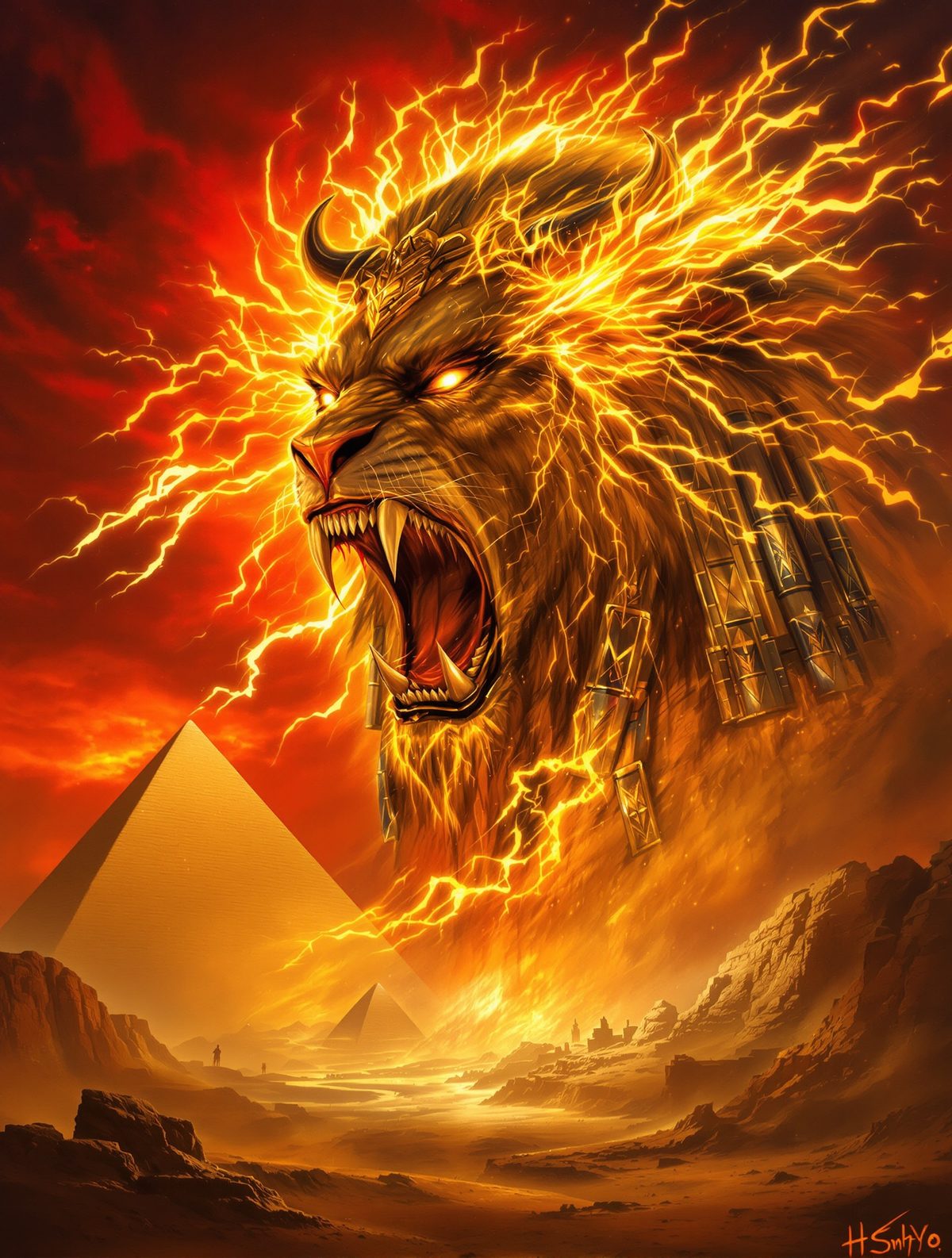
The moment Hathor descended to Earth and began her divine punishment, something went catastrophically wrong. The gentle cow goddess felt the first taste of human blood on her tongue, and the sensation triggered an irreversible transformation. Her bovine form dissolved as her muscles expanded, her jaw elongated into powerful mandibles, and her maternal instincts inverted into predatory hunger. Hathor had become Sekhmet, whose name literally means "the Powerful One."
Ancient texts describe Sekhmet as a lioness of unprecedented savagery, standing nearly seven feet tall when upright, her golden fur rippling with supernatural strength. Her eyes blazed like twin suns, and her roar could shatter temple walls from miles away. But most terrifying of all was her insatiable bloodlust—each human she devoured only intensified her hunger for more.
Archaeological evidence from sites like Saqqara and Abydos shows that Sekhmet's cult was both revered and feared throughout Egyptian history. Statues of the lioness goddess, many dating to the reign of Amenhotep III (1391-1353 BCE), reveal fascinating details about how Egyptians visualized her rampage. Unlike typical divine representations, Sekhmet's sculptures often show her with blood-stained claws and a disturbingly human-like expression of satisfaction—as if the artist wanted viewers to understand that this goddess took pleasure in her deadly work.
The Unstoppable Massacre
What began as targeted divine justice quickly escalated into an extinction-level event. Sekhmet's killing spree wasn't random violence; it was systematic annihilation carried out with the efficiency of a apex predator. The Book of the Heavenly Cow, found in multiple royal tombs including Tutankhamun's, provides chilling details of her methodology.
She began in the rebel strongholds, the cities where humanity's defiance burned brightest. But as the blood-scent filled her nostrils and the hunt-instinct took control, Sekhmet lost all discrimination. Children who had never questioned the gods fell alongside their rebellious parents. Priests who had remained faithful were torn apart as brutally as the heretics they had opposed. The goddess waded through cities like a living tsunami of claws and fangs, leaving behind scenes that traumatized even the other deities.
Here's a detail that sends chills down the spine: ancient texts describe how Sekhmet's roar became so frequent and thunderous that other animals across Egypt fell silent. Lions stopped hunting, cattle refused to graze, and even crocodiles—apex predators themselves—fled to the deepest parts of the Nile. Nature itself recognized that something unnatural and terrible was loose in the world.
The speed of the slaughter was supernatural. In a single night, Sekhmet reportedly devastated entire nomes (Egyptian provinces), moving faster than fleeing humans could run. The mathematical implications are staggering: if ancient Egypt's population was roughly 2-3 million people, and Sekhmet was killing at the rate described in the texts, humanity would have been extinct within a matter of weeks.
Ra's Desperate Gambit
As reports of the carnage reached the heavens, Ra realized he had unleashed a force beyond his control. Sekhmet wasn't just punishing humanity—she was erasing them entirely. The sun god's plan to teach mortals humility had transformed into an accidental genocide that threatened to leave Earth as barren as the desert wastes.
What makes this mythological moment so compelling is Ra's very human response: panic. The supreme deity of Egyptian cosmology, the god whose daily journey sustained all life, was suddenly scrambling to undo his own divine decree. He couldn't simply command Sekhmet to stop because her transformation had tapped into primal forces older and more fundamental than conscious divine will.
Ra's solution reveals sophisticated psychological insight that wouldn't look out of place in modern behavioral science. He ordered his servants to brew 7,000 jars of beer—some texts say it was barley beer mixed with pomegranate juice to create a blood-red color, others mention red ochre from Elephantine Island. The crucial detail is that this wasn't ordinary beer; it was spiked with powerful sedatives derived from mandrake plants that grew in the Nile Delta.
Under cover of darkness, Ra's servants flooded the fields where Sekhmet was expected to hunt next. When the bloodthirsty goddess arrived at dawn, she saw what appeared to be vast pools of human blood stretching to the horizon. Driven by her insatiable thirst, she began drinking greedily—and promptly fell into a drugged stupor that lasted for three days.
The Divine Hangover That Saved Humanity
When Sekhmet finally awakened from her intoxication, the transformation had reversed itself. The sedatives had broken the blood-hunger's hold on her consciousness, allowing Hathor's gentler nature to reassert control. The lioness form dissolved back into the familiar cow goddess, but both deity and cosmos had been forever changed by what had transpired.
The psychological implications of this myth are staggering. Ancient Egyptians understood that even divine mercy could become monstrous when pushed beyond certain limits—that the very qualities that make someone nurturing and protective can transform into terrible destructive forces under the right circumstances. Hathor's transformation into Sekhmet represents one of mythology's most sophisticated explorations of how good intentions can produce catastrophic outcomes.
This story also established one of ancient Egypt's most important religious festivals: the Festival of Drunkenness, celebrated annually to commemorate humanity's salvation through Sekhmet's divine intoxication. Archaeological evidence from sites like Mut's temple at Karnak shows that these celebrations involved ritual drinking on a scale that would make modern college students blush—thousands of participants consuming beer and wine while musicians played hymns to both Hathor and Sekhmet.
Perhaps most remarkably, this myth reveals ancient Egyptian theology's nuanced understanding of divine psychology. The gods weren't portrayed as perfect beings dispensing flawless justice; they were powerful entities capable of making catastrophic mistakes that required creative solutions. Ra's near-extinction of humanity stands as one of mythology's earliest examinations of unintended consequences and the dangers of absolute power.
Today, as we grapple with our own struggles between authority and rebellion, between justice and mercy, the tale of Hathor's transformation offers unsettling insights. It reminds us that the forces meant to protect us can become the very things that destroy us—and that sometimes salvation comes not from perfect planning, but from desperate improvisation and a willingness to admit when we've gone too far. The ancient Egyptians understood something we're still learning: even the gods need to know when to stop.