In the vast tapestry of Greek mythology, where gods danced across the sky and fate intertwined with the whims of deities, one tale stands out both for its heartbreak and its irony. It is a story not of victorious battles or triumphant heroes, but of unfulfilled desire and the wrath of a slighted god. This is the story of the day when Eros, the mischievous god of love, struck down mighty Apollo—leading him to experience not only love but also the hopelessness of eternity.
A Clash of Divine Wills
Our tale begins on a day much like any other upon the divine mountaintop of Olympus. The youthful god Apollo, known far and wide for his golden hair and brilliant intellect, spied young Eros playing with a bow and arrows. Perhaps it was the boundless pride that often accompanies the title of divinity or maybe just a passing whimsy. Whatever the cause, Apollo laughed at Eros, claiming that such a child had no business wielding a weapon of warriors. "What could you know of arrows?" he taunted, his voice as bright and as arrogant as the sun he governed.
This divine laughter, however, would seal Apollo's fate in a twist of tales as cunning as it was cruel. For Eros, son of Aphrodite, bore no ordinary weapon. His arrows were forged not of mere iron, but of gold and lead—each carrying mischievous magic of its own. Apollo's jest had stung Eros, and in retaliation, he drew his bow and released two arrows that would forever alter the lives of gods and mortals alike.
The Arrows of Eros
The first of these arrows, crafted with shimmering gold, struck Apollo with a potent and unquenchable fire of love towards the maiden Daphne, a nymph known for her grace and beauty. This arrow did not merely cause affection; it ignited a fierce yearning that eclipsed the sun itself, transforming Apollo from a god of reason to one tormented by unwieldy passion.
The second arrow, dull in its leaden hue, was destined for Daphne. It instilled in her not love, but an unequivocal aversion to the once illustrious god. From that moment on, she felt nothing but disdain and a desperate urge to escape the object of Apollo's affection. As fate decreed, these opposing forces set the stage for an extraordinary chase that reverberated through time.
The Chase Through Arcadia
The chase unfolded across the verdant hills and woods of Arcadia, a landscape echoing with the sound of Apollo's hurried pursuits and Daphne's panicked, fleeing footsteps. Imagine it—a scene where nature itself held its breath as the god, shining like the crest of dawn, sped over streams and through ancient groves, arms outstretched toward an unattainable dream.
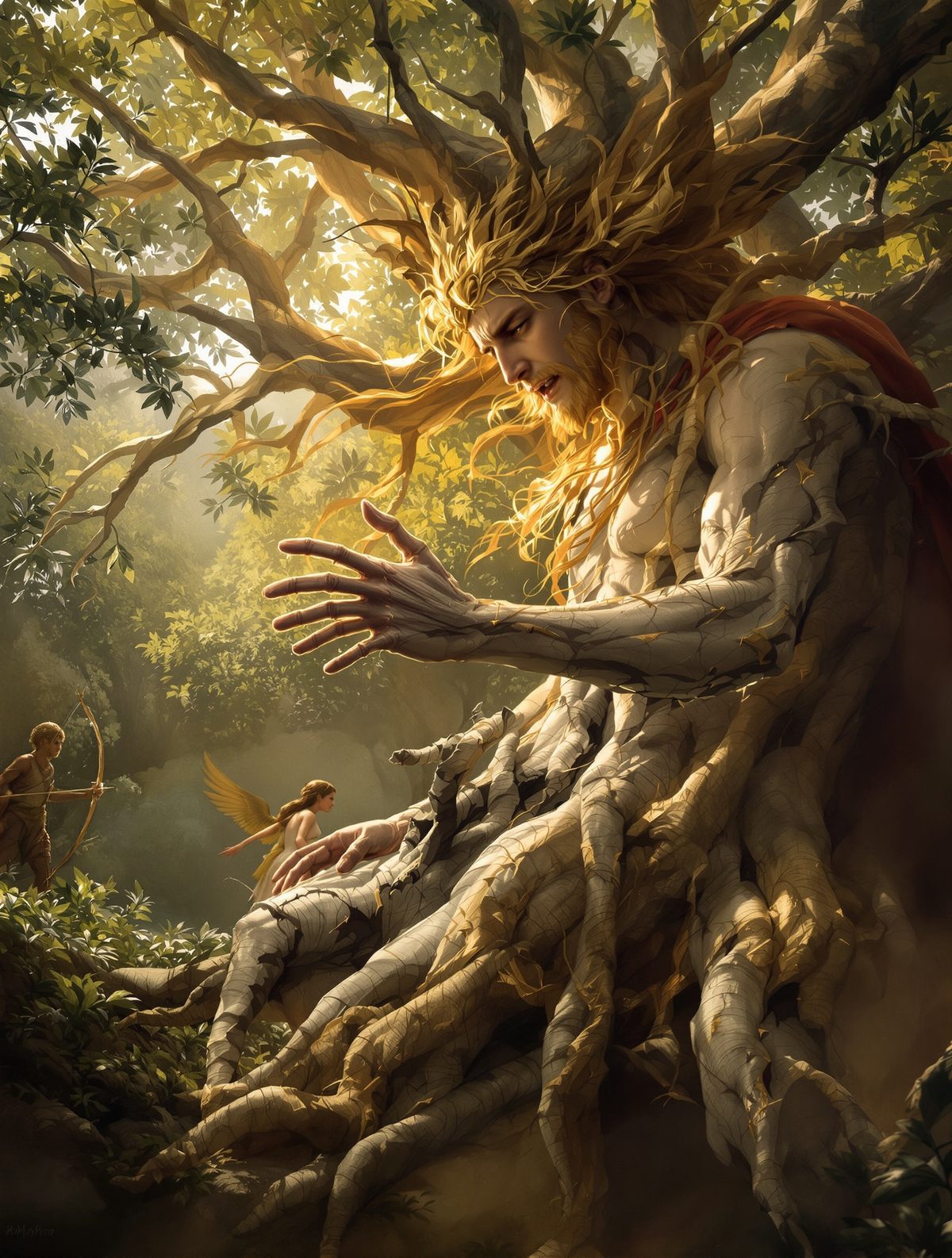
Daphne, lithe and determined, ran with the wind in her hair and terror in her heart. She called out to her father, Peneus, a river god, pleading for deliverance from her relentless suitor. As Apollo pressed close, her prayer was heard, and in a moment of divine intervention, her form began to shift. Her legs rooted into the earth, slender arms became branches, and the laurel leaves whispered in the sudden stillness.
The Birth of the Laurel
The transformation was like a silent explosion of nature's power, witnessed by gods and earth alike. Daphne, now bound forever to the soil as a laurel tree, stood unchanged by time and untouched by Apollo's touch. In profound sorrow, the god embraced the tree, vowing that her beauty would remain immortal in his heart. The laurel would henceforth be his sacred symbol, worn as a wreath and bestowed as a mark of honor and victory.
It is a poignant irony—the god of prophecy did not foresee a future where love was denied, where a simple jest would become the root of such profound loss. In one sense, Apollo's plea to die was answered—his past self, the blameless and untouchable, died with Daphne's transformation.
The Lasting Echo
Why does this story of yearning and transformation matter today? In its poetic depth, it captures the capricious nature of love and the power of words, reminding us that mockery often masks misunderstandings that can have irreparable consequences. Even the mighty Apollo discovered limits through the humility that only unrequited love can enforce.
In modern terms, this story of Eros and Apollo reflects the unpredictable nature of emotions and the unforeseen outcomes when scorn meets with vengeance. It serves as an eternal metaphor for the balance of forces—love and hate, pride and humility. Above all, it speaks to an ancient truth: that even gods are not immune to the whims of fate and whim.
As we ponder this ancient legend left out of textbooks, we are reminded of the beautiful madness love can bring—a madness as captivating now as it was in the ancient stories of the Greeks. Perhaps this tale continues to resonate because, as with Apollo and Daphne, it speaks to the eternal complexities of the heart and the timeless dance of desire and despair.