Picture this: The most powerful being in the universe receives a gift so sacred that merely touching it could grant eternal bliss. What does he do? He tosses it onto his elephant's head like a piece of cheap jewelry. Within moments, that single act of cosmic arrogance would strip him of his throne, rob the gods of their immortality, and plunge the heavens into chaos. This is the story of how Indra, king of the gods, learned that even divine power has its limits.
In the ancient Sanskrit epics, few tales capture the catastrophic consequences of pride quite like the legend of Durvasa's garland. It's a story that makes the fall of empires look like minor inconveniences, where one moment of disrespect triggered a curse so devastating that it required churning an entire ocean to undo. Yet for all its cosmic scope, it begins with something as simple as a flower garland and a short-tempered sage.
The Sage Who Made Gods Tremble
To understand the magnitude of what unfolded, you first need to know about Durvasa—arguably the most feared figure in Hindu mythology. This wasn't your typical hermit meditating peacefully in a cave. Durvasa was considered a partial incarnation of Shiva himself, specifically embodying the destroyer god's wrathful aspect. Ancient texts describe him as a rishi whose anger could literally reshape reality.
The sage's reputation preceded him everywhere he went. Stories tell of Durvasa cursing King Ambarisha to be pursued by the Sudarshana Chakra—a spinning disc of divine fire—simply for breaking a fast incorrectly. He once cursed Shakuntala, causing her lover King Dushyanta to forget her completely, all because she failed to greet him properly while lost in thought. These weren't empty threats or theatrical outbursts; when Durvasa cursed someone, the universe itself seemed to enforce his will.
What made Durvasa particularly dangerous was his unpredictability. Unlike other sages who might warn someone before unleashing divine punishment, Durvasa's temper could flare in an instant. The Puranas describe him as having performed such intense penances that his spiritual power, or tapas, had accumulated to world-shaking levels. This wasn't just religious authority—it was concentrated cosmic force that could challenge even the gods.
The Divine Gift That Started Everything
On the fateful day that would change everything, Durvasa had come into possession of an extraordinary garland. This wasn't just any ceremonial offering, but a sacred vanamala that had been blessed by Lakshmi herself, the goddess of wealth, fortune, and prosperity. According to the Vishnu Purana, such garlands were imbued with divine energy that never wilted, emanated heavenly fragrances, and carried within them the very essence of abundance.
The circumstances of how Durvasa acquired this garland vary in different tellings, but most versions agree it came directly from Lakshmi during one of her earthly manifestations. Some accounts suggest she had worn it while blessing devotees, others that it had adorned her during a divine ceremony. What remained constant across all versions was its incredible sanctity—this garland represented the goddess's direct blessing made manifest.
When Durvasa encountered Indra traveling in his magnificent chariot, pulled by horses swift as thought itself, the sage decided to offer this precious garland as a gift. In the cosmic hierarchy, this was an extraordinary gesture. Durvasa, despite his fearsome reputation, was showing respect to Indra's position as king of the gods. The offering of such a sacred item wasn't mere politeness—it was a recognition of divine authority and a blessing that could enhance Indra's already formidable power.
The Moment Paradise Began to Crumble
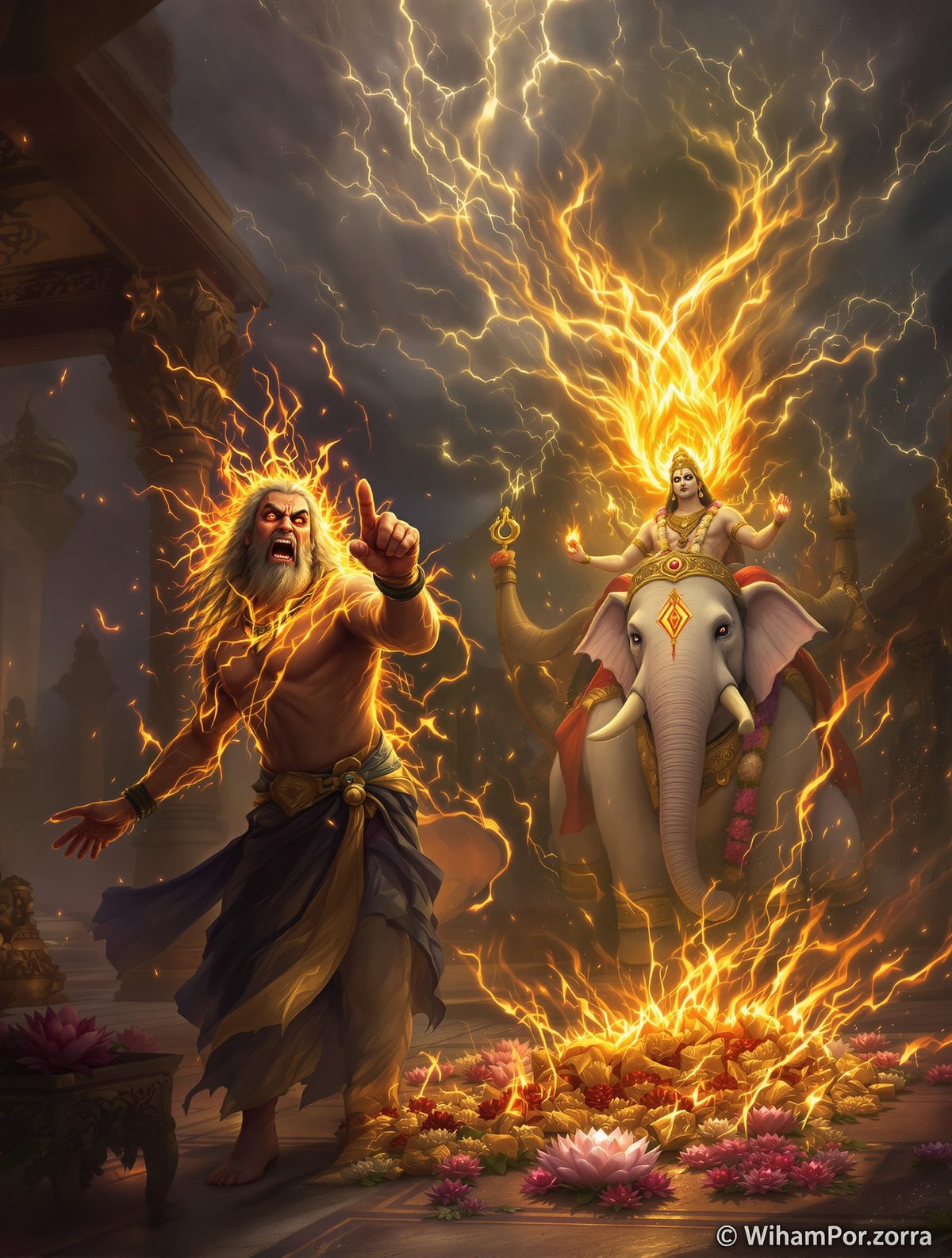
What happened next has been called one of the greatest acts of cosmic foolishness in all of Hindu mythology. Indra, seated majestically on his celestial elephant Airavata, received the garland with what can only be described as casual indifference. Instead of recognizing its sacred nature, instead of receiving it with the reverence due to a gift from Lakshmi herself, Indra simply placed it on Airavata's head as if it were a common decoration.
The mighty elephant, perhaps sensing the garland's otherworldly nature or simply annoyed by the unfamiliar object on its head, promptly shook it off. The sacred garland—blessed by the goddess of prosperity, offered by one of the most powerful sages in existence—fell to the ground and was trampled under Airavata's massive feet. In some versions of the story, the elephant actively tore at the garland with its trunk, reducing the divine offering to scattered petals and broken stems.
Durvasa watched this unfold with mounting horror and rage. To him, this wasn't merely careless handling of a gift—it was a profound insult to the divine feminine principle, a desecration of Lakshmi's blessing, and a display of arrogance so breathtaking that it demanded cosmic correction. The sage's accumulated tapas, already formidable enough to challenge the gods, now focused into a laser of divine fury.
The Curse That Shook Heaven
When Durvasa spoke his curse, the words themselves seemed to ripple through the fabric of reality. "Since you have shown such disrespect to the goddess of prosperity," the sage declared, his voice carrying the weight of universal law, "let prosperity abandon you completely. Let your power drain away like water through broken clay. Let the three worlds see how hollow divine authority becomes without divine grace."
The effects were immediate and catastrophic. Indra felt his strength beginning to ebb like air escaping from a punctured vessel. The gods, whose power was intrinsically connected to their king's authority, began experiencing their own decline. Their immortality—that fundamental characteristic that separated them from mortals—started to weaken. The celestial realm itself, sustained by divine energy, began to lose its luster.
But Durvasa's curse extended far beyond personal punishment. The Bhagavata Purana describes how the entire cosmic order began to destabilize. The asuras, the demons who were perpetual enemies of the gods, sensed this weakness like sharks detecting blood in water. Under the leadership of powerful demon kings like Bali, they began mounting attacks against increasingly vulnerable divine forces.
What made this curse particularly terrifying was its comprehensive nature. This wasn't simply a loss of strength or magical ability—it was a fundamental disconnection from the source of divine power itself. The gods found themselves aging, weakening, and facing the prospect of actual death for the first time in their existence. The cosmic balance that had maintained order between good and evil, light and darkness, began to tip dangerously toward chaos.
Churning the Ocean of Eternity
Faced with impending extinction, the gods did what they had never been forced to do before: they begged for help. Indra, his pride thoroughly crushed, led his fellow deities to Brahma, the creator god, seeking a solution to their dire predicament. Brahma, recognizing the severity of the situation, directed them to Vishnu, the preserver, who alone possessed the wisdom to undo what had been set in motion.
Vishnu's solution was as audacious as it was desperate: the churning of the cosmic ocean, known as the Samudra Manthan. This wasn't merely stirring some celestial waters—it required using Mount Mandara as a churning rod and the cosmic serpent Vasuki as a rope. Most remarkably, it required the gods to cooperate with their mortal enemies, the demons, who were promised a share of the amrita—the nectar of immortality—that would emerge from the churning.
The churning of the ocean became one of the most celebrated events in Hindu mythology, producing not just the life-saving nectar but numerous divine treasures: Kamadhenu the wish-fulfilling cow, Parijata the heavenly tree, Apsaras the celestial dancers, and ultimately Lakshmi herself, who rose from the churned waters in all her glory. When the gods finally obtained and consumed the amrita, their immortality was restored, and divine order was reestablished.
The Lesson That Echoes Through Time
The tale of Durvasa's garland offers a fascinating glimpse into ancient Indian concepts of cosmic justice and divine accountability. In this story, even the king of gods is subject to universal moral law—there is no authority so high that it cannot be held responsible for disrespect toward the sacred.
What makes this legend particularly relevant today is its exploration of how casual disregard for what others hold sacred can have consequences far beyond what we might expect. Indra's mistake wasn't malicious—he didn't deliberately insult Durvasa or consciously desecrate Lakshmi's blessing. His error was simpler and perhaps more relatable: he was so comfortable in his power that he stopped paying attention to what really mattered.
In our modern world, where cultural sensitivity and religious respect are increasingly important topics of discussion, the story of Durvasa's garland serves as a powerful reminder that what seems trivial to one person may be profoundly sacred to another. It suggests that true leadership—whether divine or earthly—requires not just power, but wisdom, humility, and constant awareness of the deeper significance behind seemingly simple gestures.
Perhaps most importantly, this ancient tale reminds us that in the cosmic accounting system, respect for the sacred isn't optional—even for gods.