
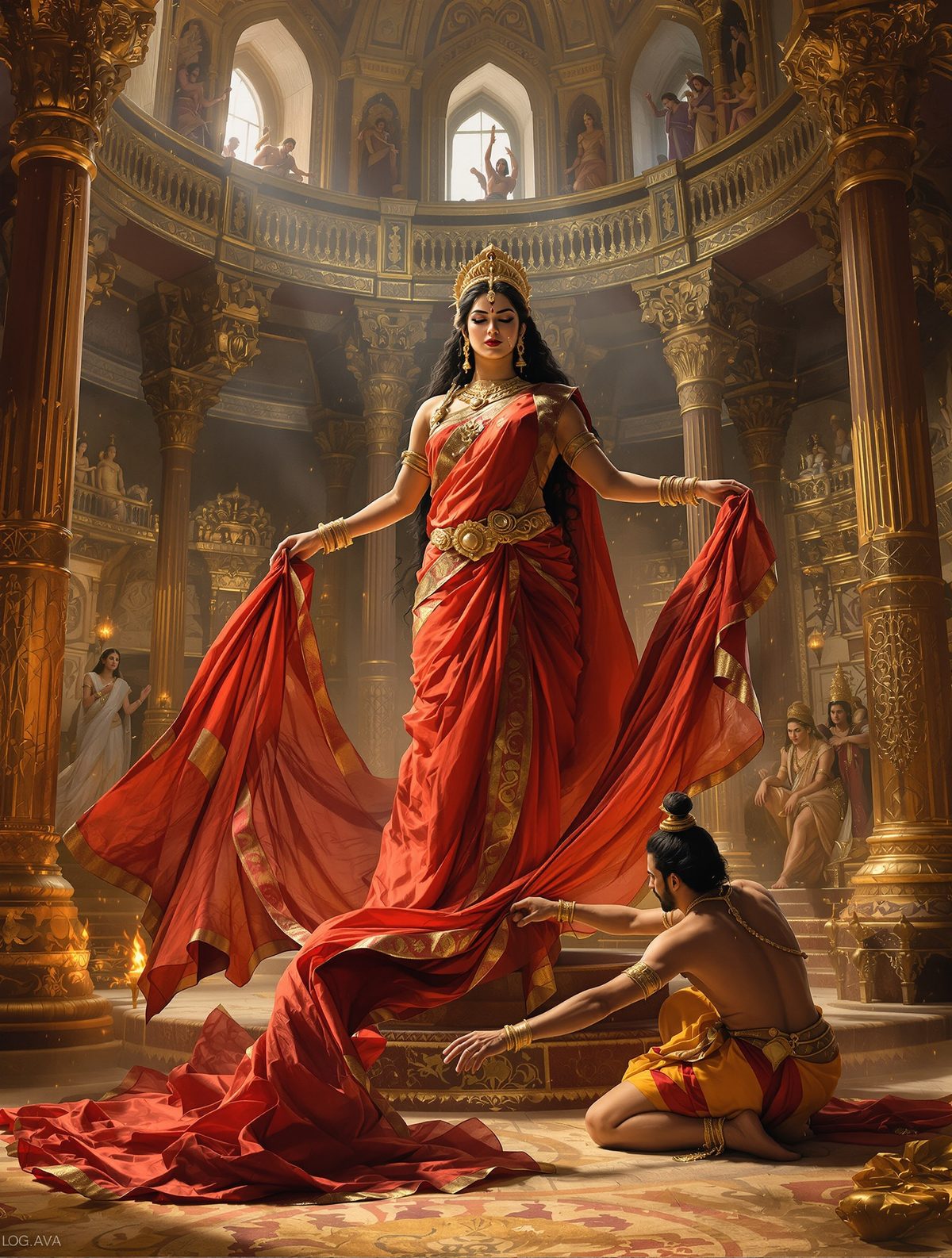
In the marble halls of Hastinapura's royal court, surrounded by the greatest warriors and wisest sages of ancient India, a scene was about to unfold that would echo through millennia as one of history's most powerful demonstrations of divine justice. The year was approximately 3102 BCE, according to traditional Hindu chronology, and what began as a gambling match was about to become something far more sinister—and ultimately, far more miraculous.
Picture this: a woman dragged into a court of a hundred princes, her hair disheveled, wearing only a single piece of cloth. Her five husbands—legendary warriors who had conquered kingdoms—sat helpless, bound by the cruel laws of a rigged game. And as Prince Dushasana reached for her sari with a malicious grin, none of the assembled nobles could have imagined they were about to witness an intervention that would redefine their understanding of divine power.
The Stage is Set: A Kingdom's Honor on Display
The great court of Hastinapura was no ordinary throne room. Designed by the celestial architect Maya, it was a marvel that had already confused visiting kings with its crystal floors that looked like water and pools that appeared solid as glass. On this fateful day, the court was packed with the who's who of ancient India: the blind king Dhritarashtra on his throne, the wise grandfather Bhishma, the teacher Dronacharya, and dozens of princes, ministers, and courtiers.
At the center of this gathering sat Duryodhana, the Kaurava prince whose jealousy had orchestrated this entire spectacle. His uncle Shakuni, master manipulator and expert with loaded dice, had just helped him win the impossible: in a rigged gambling match, they had claimed not just the kingdom of the Pandavas, but the Pandavas themselves, and finally, their shared wife, Draupadi.
What many don't realize is that Draupadi wasn't just any princess—she was Panchali, daughter of King Drupada, born from the sacred fire itself during a complex ritual. Ancient texts describe her as krishnaa—dark and beautiful, with lotus-petal eyes and hair that carried the fragrance of blue lotus even from two miles away. More importantly, she was under the protection of Krishna, her sakha (friend), though he was miles away in Dwarka.
The Moment of Ultimate Disgrace
When Duryodhana's messenger Pratikami was sent to fetch Draupadi, she initially refused, questioning the legality of her being wagered when Yudhishthira had already lost himself first. But her defiance only enraged the Kauravas further. Dushasana, Duryodhana's brother and the most hot-headed of the 99 Kaurava princes, was dispatched with clear instructions: bring her by force.
The scene that followed was unprecedented in royal courts. Dushasana grabbed Draupadi by her long, unbraided hair—a violation so severe that in ancient Indian culture, it was equivalent to attempted rape. He dragged her through the palace corridors, past shocked servants and guards, into the packed assembly hall where her five husbands sat in stunned silence, bound by their word to accept the consequences of the game they had lost.
Here's a detail most people miss: According to the Mahabharata, Draupadi was in her rajasawala period (menstruation) at the time, wearing only a single piece of cloth as was customary. This made Dushasana's actions not just politically humiliating, but a violation of the most sacred taboos surrounding feminine purity in ancient Indian society.
The Impossible Unfolds: When Fabric Defies Physics
What happened next has been painted, sculpted, dramatized, and retold countless times, yet it never loses its power to astound. As Dushasana began pulling at Draupadi's sari, confident he could strip her naked before the entire court, the impossible occurred: the fabric simply wouldn't end.
Ancient texts describe the scene with vivid detail—Dushasana pulled with all his strength, his muscles straining, sweat beading on his forehead. The sari came off in his hands, yard after yard of silk, but Draupadi remained modestly covered. He pulled harder, enlisting the help of other Kaurava princes, but still the fabric flowed endlessly. Soon, the center of the great court was filled with mounds of beautiful silk, rising like small hills around the exhausted princes.
The truly remarkable aspect? Krishna was performing this miracle from over 500 miles away in Dwarka. According to the epic, he had been in the middle of a bath when he sensed Draupadi's desperate prayer for help. Without hesitation, he extended his divine power across the vast distance, multiplying her garments through his cosmic energy.
Traditional calculations suggest that Dushasana pulled at the sari for nearly an hour, generating enough cloth to fill a significant portion of the massive court hall. Some regional versions of the story claim the fabric was enough to clothe a thousand women—a detail that emphasizes not just the miracle, but Krishna's abundant generosity in protecting his devotee.
The Court Watches Divine Justice in Real Time
The reactions in the court were as varied as they were telling. The Mahabharata records that some nobles began to sweat profusely despite the cool marble halls, recognizing they were witnessing something far beyond mortal power. Others, like the wise Vidura, openly wept at the injustice being perpetrated. A few, including some lesser Kaurava princes, actually tried to protest, but were silenced by Duryodhana's glares.
Most fascinating is the reaction of the great warriors. Bhishma, the grandsire who had taken vows that prevented him from acting against the throne, sat with his head bowed, tears streaming down his ancient face. Dronacharya, the teacher of both the Pandavas and Kauravas, was reportedly seen muttering prayers under his breath. These weren't men easily moved or frightened—they had seen decades of warfare and royal intrigue—yet they recognized they were witnessing a cosmic intervention.
Here's what's rarely discussed: Several courtiers actually tried to leave during the incident, but found the doors mysteriously heavy, as if some invisible force wanted them to witness the complete event. This detail, preserved in some regional Mahabharata traditions, suggests that Krishna's intervention wasn't just about protecting Draupadi—it was about ensuring that the court's collective sin was witnessed by all, making them complicit in what was to come.
The Collapse of Mortal Arrogance
After what felt like an eternity, Dushasana finally collapsed, exhausted and defeated. His hands were raw from pulling at the endless fabric, his royal garments soaked with perspiration, his princely dignity in tatters. Around him lay mountains of silk, testimony to the futility of fighting divine will with mortal strength.
But the miracle wasn't over. As Dushasana fell, gasping for breath, Draupadi stood untouched and perfectly draped, her modesty completely intact. More than that, she appeared radiant, almost glowing, as if the divine intervention had left her charged with cosmic energy. The contrast was stark: the prince who had sought to humiliate her lay crumpled and defeated, while she stood with the dignity of the divine feminine protected.
At this moment, Draupadi spoke words that would prove prophetic. She declared that she would not tie her hair until it was washed with Dushasana's blood—a vow that would be fulfilled eighteen years later on the battlefield of Kurukshetra when Bhima would tear open Dushasana's chest and Draupadi would indeed wash her hair in his blood.
When the Gods Intervene: Why This Story Refuses to Die
In our modern world of scientific rationalism and digital connectivity, why does a 5,000-year-old story about endlessly multiplying fabric continue to captivate millions? Perhaps because it addresses something eternal in the human experience: the desperate hope that when mortal systems fail to protect the innocent, some higher power will intervene.
The miracle in Hastinapura's court wasn't just about supernatural cloth production—it was about the cosmic principle that dharma (righteousness) ultimately prevails, even when all earthly protections fail. Draupadi's five warrior husbands couldn't help her due to the laws of the game. The wise elders couldn't act due to their political obligations. The court system itself had been corrupted by Shakuni's loaded dice. Yet divine justice found a way.
Today, as we grapple with our own failures of justice—from courtrooms to boardrooms to international tribunals—the story of Draupadi's protection reminds us that there are moral laws that transcend human institutions. Her story continues to inspire women facing harassment and abuse, suggesting that even when earthly support systems fail, the universe itself stands with those who call upon righteousness with a pure heart.
The ultimate lesson? Sometimes the most powerful protection comes not from the strength of our defenders, but from the purity of our own call for justice. In that marble court of ancient India, as divine cloth piled higher and higher around a defeated prince, the cosmos itself declared that some lines should never be crossed—and that those who cross them do so at their own peril.