Imagine standing on a cliff, the wind howling like a banshee, glaring defiantly as the waves of the East Sea crash angrily against the rocks. In the heart of this furious storm strides a figure no taller than a young tree, with eyes lit by the fiery determination of a thousand suns. This was Nezha, the boy-god who once shook the pillars of heaven and made the fearsome Dragon King kneel.
A Child Born Among Gods
In the vast tapestry of Chinese mythology, few figures are as captivating as Nezha. Emerging into ancient stories around the 12th to 13th centuries AD, particularly in texts like the "Fengshen Yanyi" or "Creation of the Gods," Nezha's legacy is cemented as a symbol of rebellious spirit and youthful zeal. Born to Li Jing, a high-ranking military officer, and destined to be a divine protector, Nezha's birth was anything but ordinary. After a peculiar gestation of three-and-a-half years, his emergence into the world caused both dread and fascination.
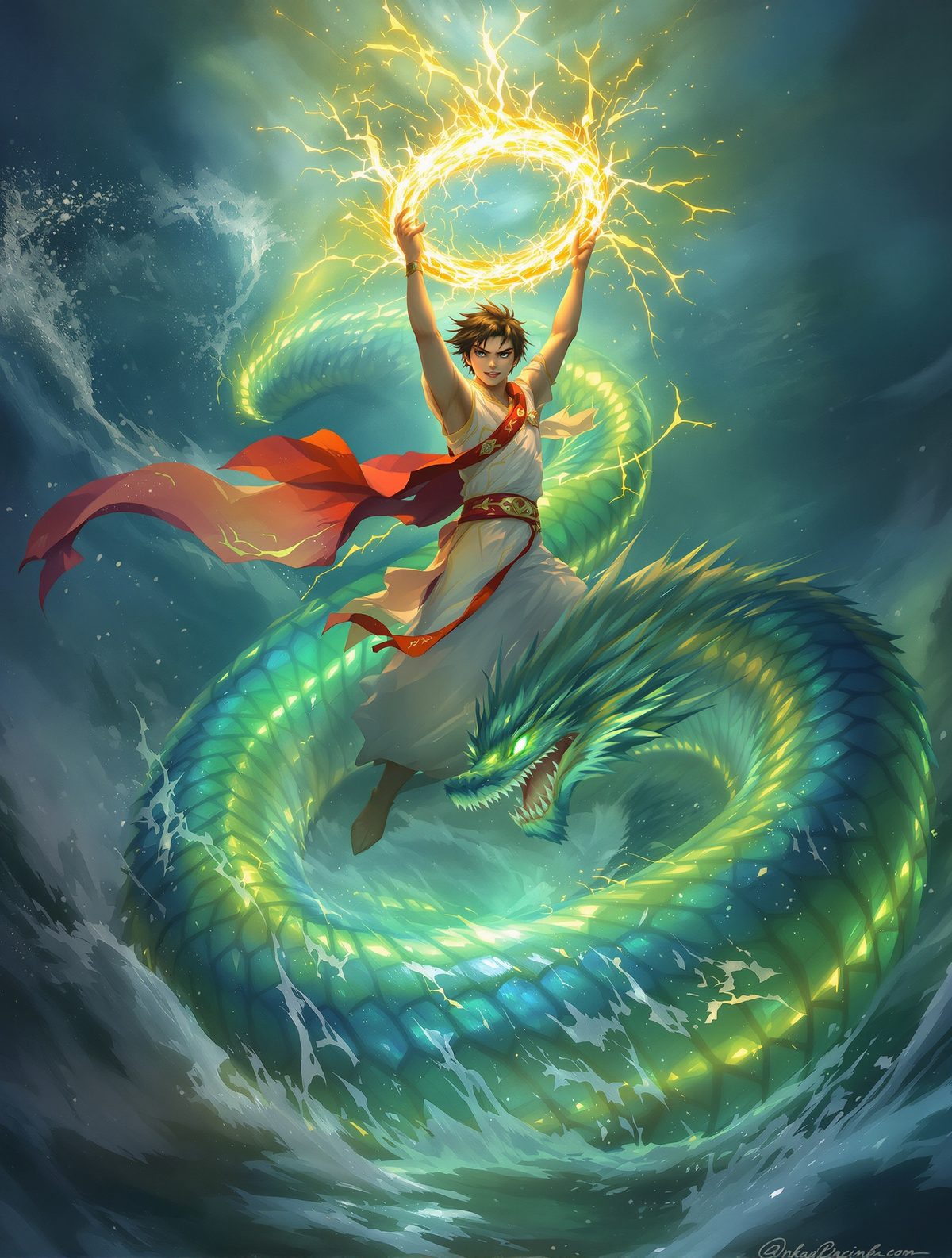
From the moment he drew breath, it was evident that he was unlike any other child. Gifted with celestial powers and bearing a Fire Wheels and Universe Ring, Nezha defied conventions and challenged the rigidity of divine hierarchies. But little did the celestial realms know, Nezha's most breathtaking feat was yet to come, and it would take place deep beneath the angry waters of the East Sea.
The Clash of Titans
It was in this boiling cauldron of eastward waters where the infamous encounter unfolded. The East Sea, ruled by the Dragon King Ao Guang, was no ordinary expanse. To its depths were entrusted the secrets of the ocean and the treasures of the Earth. The Dragon King's might was unrivaled, his authority unquestioned among the ruling deities of water. Yet, all it took was one audacious child to shatter this serenity.
Fueled by tenacity and a youthful yearning to prove himself, Nezha marched into the sea and demanded a weapon fit for a god. His request, met with haughty amusement, was not taken seriously by Ao Guang. But when the refusal came down, it wasn't Nezha's heart that faltered—it was the sea's calm.
Unwilling to be belittled, Nezha ripped through the waters, seizing the Dragon King’s third son, Ao Bing, as leverage. The act was not mere defiance; it was a declaration that echoed across the realms — the wrath of a child was not to be trifled with. As Nezha laid waste to the underwater palace with godly fury, the once-mighty Dragon King was forced into a humiliating submission.
From Wrath to Reverence
The aftermath of Nezha's rebellion resonated far beyond the East Sea. The boy who wore the pelt of a dragon and snapped its sinew like twine was rapidly transforming into a legend. Nezha’s iconography took on potent symbols of both heroism and accountability. His exploits against the Dragon King were not just youthful defiance but a divine balancing of the scales.
Chinese culture, rich in symbolism and lessons, began to see Nezha as a figure of resilience and moral uprightness. Notably, this story became a resonant reminder of standing against oppressive powers, transcending time to inspire countless generations.
Lesser-Known Dimensions: The Human Element
Nezha's tale didn't end at his victory over the Dragon King. Despite his larger-than-life exploits, the young deity experienced trials and tribulations with very human facets. As his actions brought devastation, ultimately resulting in his own father's anger, Nezha took extreme measures. His eventual self-sacrifice to repay his karmic debts added depth to his legend, displaying a vulnerability that resonated with the people.
Nezha is often remembered wearing a red sash across his shoulders and a bandeau of blazing gold across his forehead—a reminder of both his fiery spirit and his commitments. Perhaps the greatest lesson from Nezha's saga was that power, however mighty, must be checked by compassion and responsibility.
The Legacy of Defiance
Why, then, should the tale of Nezha matter in today's world? In a time where resilience in the face of authority remains vital, Nezha stands as a beacon of hope and courage. His story is not merely an ancient record of a child's whimsy taken to godly heights; rather, it is an enduring metaphor for questioning the status quo.
In an era characterized by unrest and a thirst for justice, the fervor of a young bleeding-heart god echoes down the corridors of time. By recounting the Dragon King's humiliation, we are reminded that within each of us lies the power to challenge the greatest fears and injustices, however monumental they might seem. Nezha teaches that courage can come in small forms, yet possess the weight to topple empires.
As you close this chapter of wondrous myth, let it remind you: the stories that echo in the heart are those that compel us to live courageously and to challenge what must change. Whether they roared once upon ethereal tides or whispered tales on ancient winds, some legends, like that of Nezha, never fade.