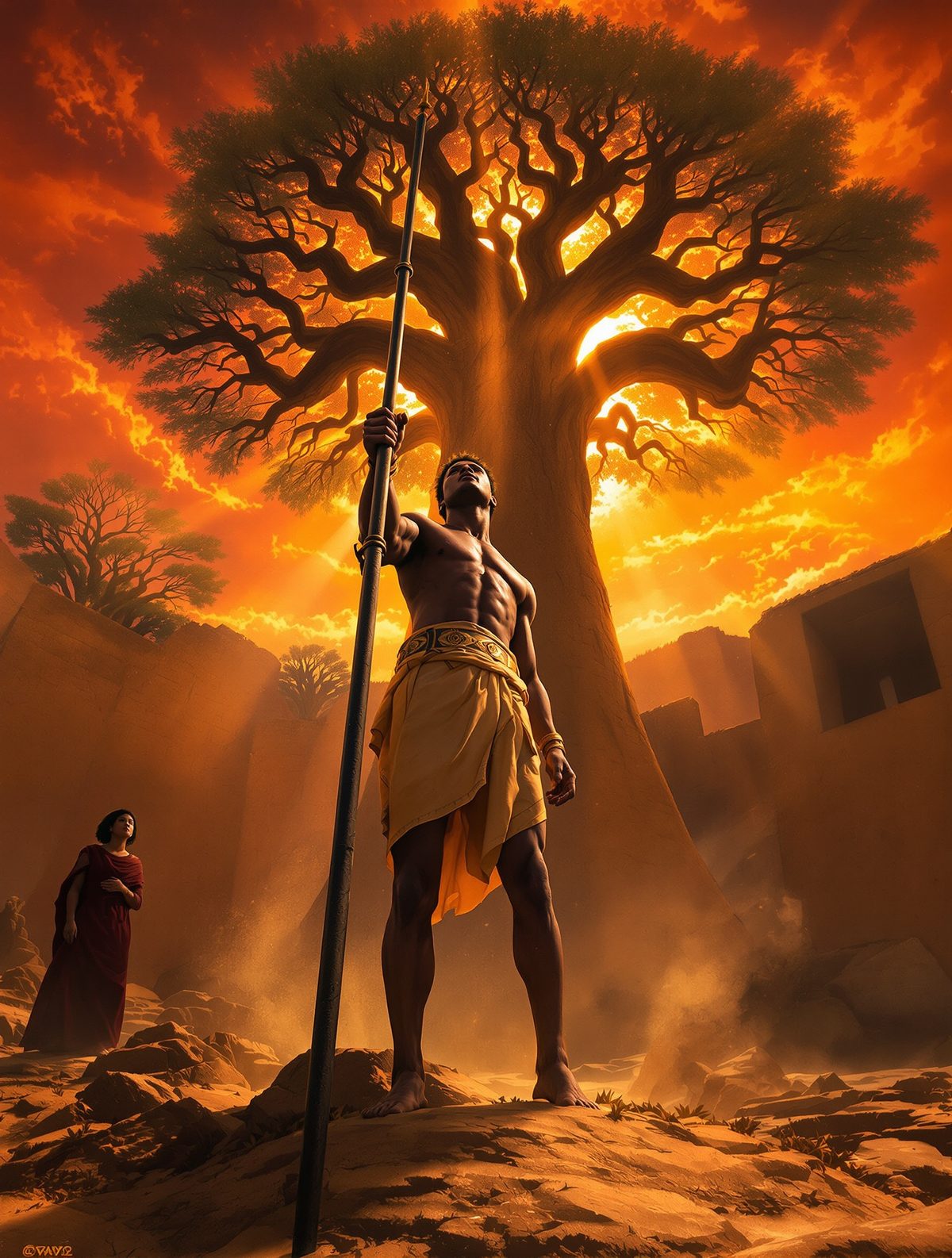
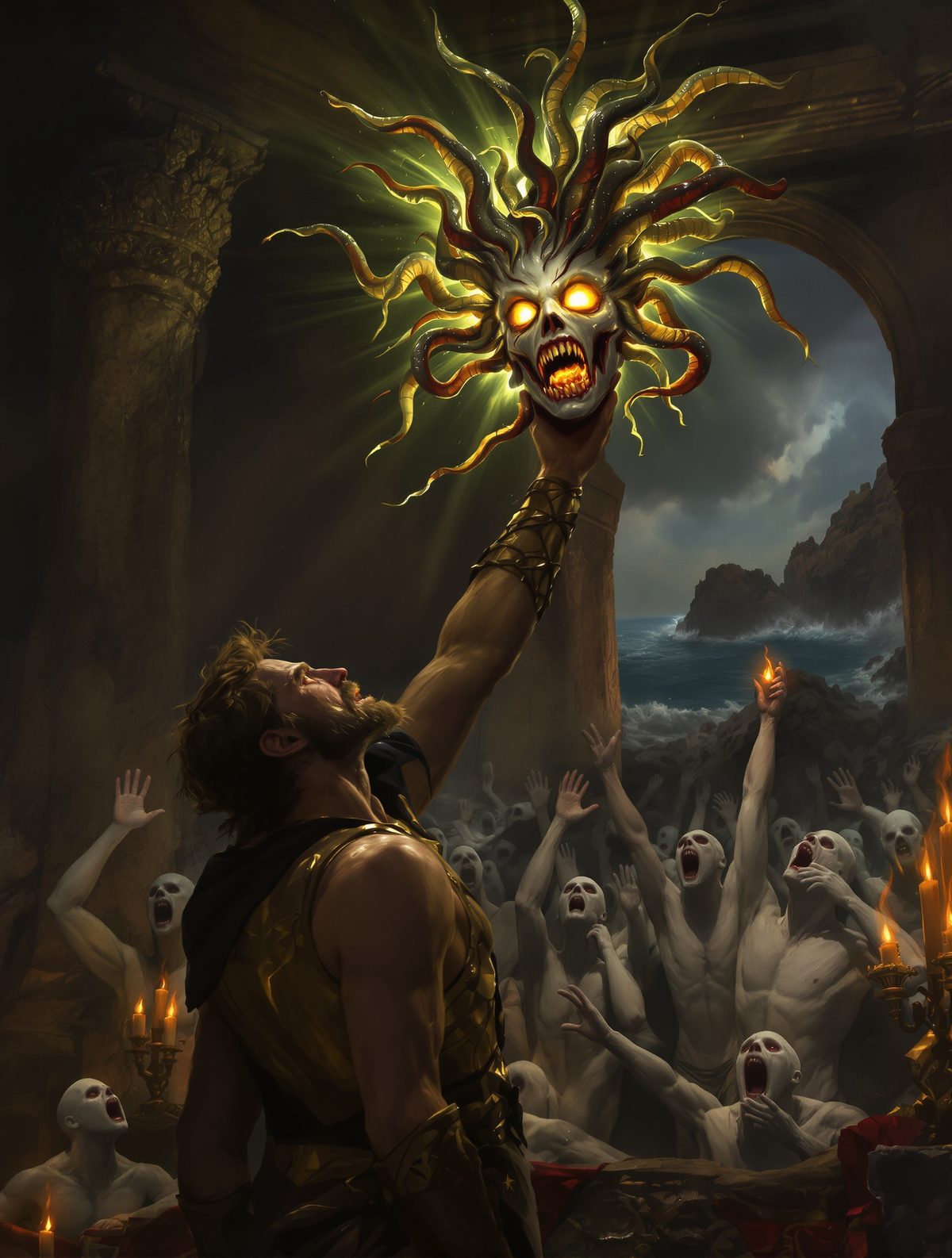
Amid the whispering winds of the ancient Aegean, where myths were born in the embroidered fabric of starlight and the sea, a hero stood at destiny's edge. Perseus, the son of Zeus and Danaë, possessed a weapon unlike any other, a resting head fragile and calm, yet brimming with dormant fury. It was the deadly visage of Medusa, the Gorgon whose gaze could petrify the fiercest of warriors. Here, upon the golden sands of Seriphos, Perseus would reveal the true power of Medusa's gaze, transforming history in a matter of heartbeats.
A Journey to the World's Edge
To understand the power of Medusa's gaze in Perseus's hands, we must journey far from the tranquil shores of Seriphos to the grey expanse of the Gorgons' lair. This was no ordinary endeavor. Medusa, one of the three fearsome Gorgons, once roamed with her sisters, Stheno and Euryale, whose territory lay at the periphery of the known world. Among the trio, Medusa was the only mortal, cursed by the goddess Athena, her once beautiful features transformed into something monstrous—a visage that spelled doom for all who dared look upon it.
Equipped with divine gifts—the mirrored shield of Athena, Hades' helm of invisibility, Hermes' winged sandals, and the adamantine sickle—Perseus embarked upon his quest. With daring agility and ingenious tactics, he closed the distance between life and legend, severing the dreaded head of Medusa while using Athena's shield to avoid her direct stare. The journey back to Seriphos, however, was fraught with its own peril—a fact unknown to those who only remember the sculptural aftermath.
Unveiling the Stone Gaze
Having eluded the surviving Gorgons and a myriad of other dangers, Perseus returned to Seriphos not as a humble hunter, but as a harbinger of ancient might. Upon this island kingdom, ruled by the tyrannical King Polydectes, Perseus's valiant tales were met with skepticism and disdain. King Polydectes, who sought Perseus's life as he sought to court Danaë, met defiance with a sneer and a cadre of loyal soldiers ready to ensure the hero's demise.
In the king's court, surrounded by a wall of flesh and steel, Perseus's options were few. Yet, with the unveiling of Medusa's head, he commanded a legion of ungazed guardians in an instant. Witnesses describe a moment stretched into eternity, where time slowed to the rhythm of heartbeats, and foes found themselves encased in their stone cocoons forever. The aftermath was a landscape of statues, eerily lifelike amidst the blooming myrtle and olive trees.
A Double-Edged Legacy
The legend of Medusa's gaze, so deeply entwined with Perseus's own legend, reveals a curious duality. On one hand, Medusa herself was a victim, punished for desecrating Athena's temple through no fault of her own. Her transformation into a monster reflects the ancient world's blend of divine retribution and tragedy. But in Perseus's hands, Medusa becomes the tool of liberation, a savior as much as she was a villain, her powers turned against those who oppress and suppress.
The ambiguity of Medusa's legacy resonates through history—her image adopted by feminists and artists as a symbol of protection and reflection. Beyond the myths' inherent drama, these stories hold a mirror to humanity's eternal struggle with the fearsome and the unknown, urging heroes to wield compassion as skillfully as they wield power.
Beyond Stone and Myth
The story of Medusa's gaze, as demonstrated by Perseus on the shores of Seriphos, resonates through time. Myth begets myth, and the parables they weave cast long shadows over the corridors of history, art, and culture. In a modern context, the narrative explores the potential of hidden strength and the courage to confront and overcome our personal monsters.
Even now, scientists have found material inspiration in the myth—the concept of “Medusa effect” in biology, where enzymatic reactions are paused as if frozen in stone, echoing the stories of old. Literature and art, too, have drawn upon these ancient roots, reaffirming that the power held within stories is unyielding, ageless.
Myth's Mirror: Reflections for Today
Perseus's triumph carved in stone a story that traverses the bounds of mythology and reality. In today's world, where society often questions the nature of power and justice, Medusa's tale inspires inquiry and reflection. It challenges us to consider the consequences of our attitudes toward the “other” and to embrace compassion alongside strength.
The Gorgon's tale—and the hero who wielded it—reminds us that the line between salvation and destruction is thin. How we wield our metaphorical gazes, how we confront obstacles and adversaries, and how we adapt unyielding power into constructive strength speaks to our collective capacity to learn from the past and sculpt a future of understanding, not merely of stone.