In the embrace of mist-shrouded mountains and beside the flowing serenade of the Yangtze River lies Hangzhou, a city steeped in folklore that intertwines with the very fabric of China’s cultural tapestry. Among its many legends, one tale of profound love and celestial uproar stands out for its ability to whisk readers away to a world where the line between human and spirit blurs — the story of the White Snake.
The Serpent’s Awakening
Over a thousand years ago, amidst the tangled roots of the sacred Emei Mountain, a remarkable transformation began. Within the hushed whispers of ancient trees, a white snake spirit, gifted with intelligence and spiritual potency, embarked on a millennia-long journey of cultivation. Her journey was one of perseverance, dedication, and an unrelenting desire for enlightenment. Over centuries, the snake learned the art of shape-shifting, aligning herself with the ebb and flow of the cosmic energies.
This divine metamorphosis was more than a physical change; it was a spiritual evolution. The White Snake, whose true name has faded into the annals of mythology, attained the ability to adopt a human form, emerging as a woman of ethereal beauty named Bai Suzhen. Driven by an inexplicable yearning, she descended from her mountain sanctuary, guided by the threads of fate woven through time and space.
Love in Mortal Form
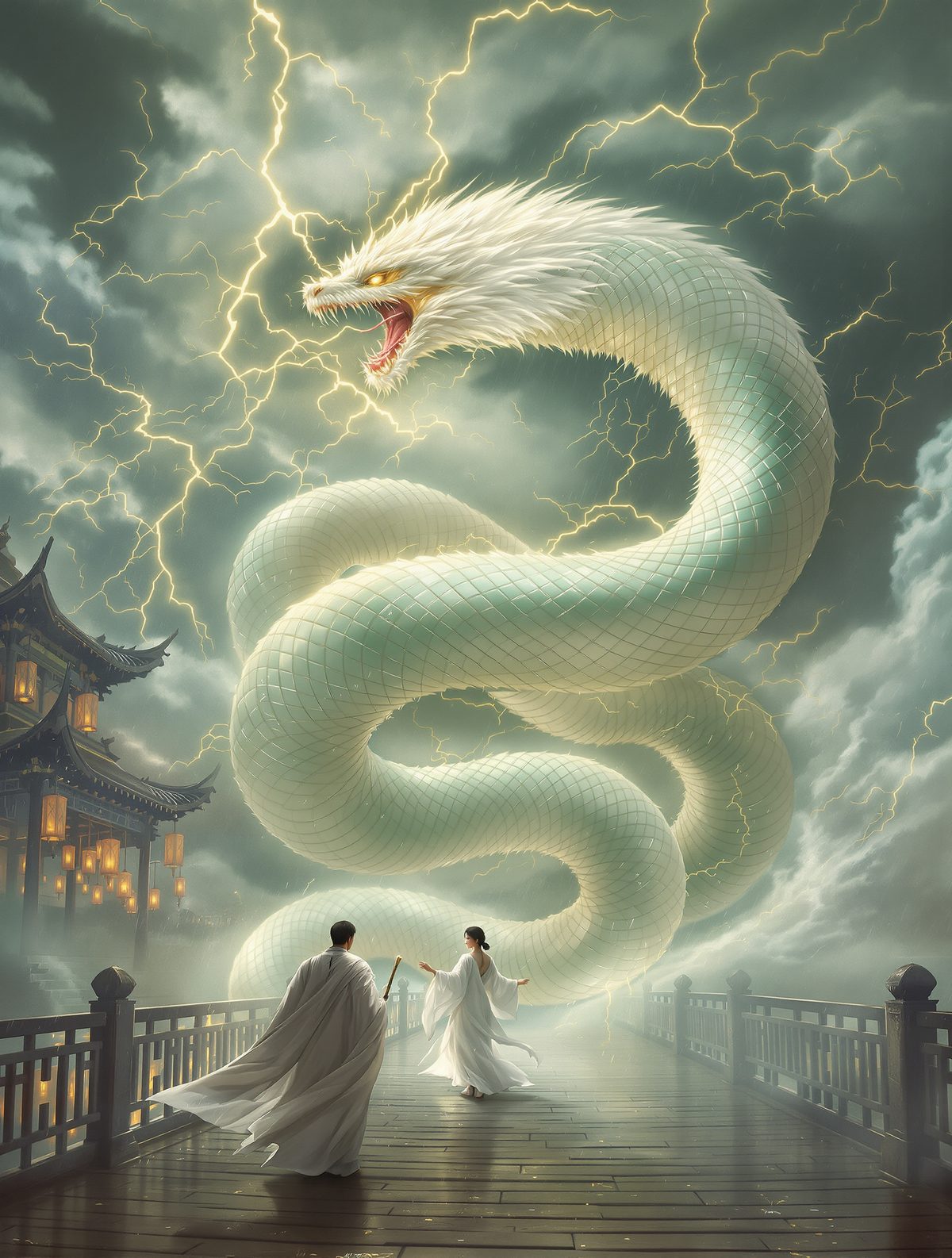
In 1127, during the Southern Song Dynasty, Bai Suzhen's steps led her to the bustling streets of Hangzhou, where the scent of blossoming lotus flowers mingled with the laughter of traders. It was here that an unexpected encounter would alter the course of destiny. Bai Suzhen crossed paths with Xu Xian, a humble and kind-hearted herbalist, at the picturesque Broken Bridge on the West Lake.
Their meeting was serendipitous — one might even say it was orchestrated by the very heavens. Drawn to each other by a profound and mysterious connection, their love blossomed swiftly in the gentle glow of springtime. Bai Suzhen, fully embracing her role as a mortal woman, found joy and fulfillment as Xu Xian's wife, exploring love's depths with a purity and strength that only the divine could offer.
The Monk's Intervention
Yet, as with many legends, darkness lurked at the edges of this romantic idyll. Enter Fahai, an austere monk at the nearby Jinshan Temple, whose unwavering commitment to maintaining cosmic order bordered on zealotry. Known for his spiritual prowess, Fahai sensed the supernatural aura surrounding Bai Suzhen, and it vexed his sense of duty.
The monk's belief in the rigidity of mortal-divine boundaries fueled his resolve. He set a plan in motion that would reveal Bai Suzhen's true form and shatter the illusion she had so carefully crafted. During the Dragon Boat Festival, a cup of realgar wine — a traditional concoction believed to weaken spirits — became his weapon of choice. Unbeknownst to Bai Suzhen, she consumed the wine at a festive gathering, and the inevitable occurred. In a heart-stopping moment, she transformed into her serpent form before Xu Xian's eyes.
A Battle Beyond Mortal Ken
Stricken by the revelation yet still deeply in love, Xu Xian found himself ensnared in turmoil. But the cosmos had already decreed that a greater confrontation loomed. Fahai saw Bai Suzhen's existence as a blasphemy against the natural order, and he sought her imprisonment beneath the pagoda at Leifeng Tower, believing it would restore balance.
The battle that ensued was not just of swords and magic, but of ideals and love against duty. Bai Suzhen's powers, tempered by centuries of cultivation, clashed with the monk's spiritual might. The struggle shook the heavens, echoing the clash between eternal love and rigid order across the spiritual realms.
The Eternal Reverberance
Tinged with the bittersweetness of enduring passion, Bai Suzhen's ultimate sacrifice was a testament to the transcendental power of love. Though imprisoned, her spirit remained indomitable, and her story sparked a multitude of interpretations and adaptations across Chinese literature and opera.
Historically speaking, this tale’s longevity underscores the cultural value placed on love and loyalty in China. It's a narrative that invites reflection on the rigidity of societal norms and the spiritual dimensions of love that transcend the mortal coil. At its heart, the legend of the White Snake unearths a profound question: Can love, in its truest form, defy the edicts of heaven?
The Legacy Continues
Even in today’s fast-paced world, the legend of Bai Suzhen and Xu Xian reverberates through the walls of Leifeng Pagoda, now a popular tourist attraction, as well as in the hearts of those who have heard their story. It compels us to ponder the nature of true love amidst barriers, both seen and unseen, societal and spiritual.
Bai Suzhen's story reminds us that while the heavens may dictate laws and boundaries, the heart is resilient, seeking unity and transcendence against all odds. Perhaps, in an age where divisions seem ever-stronger, we might draw inspiration from a love that shook heaven itself — a love that, maybe, is not as mythical as it seems.