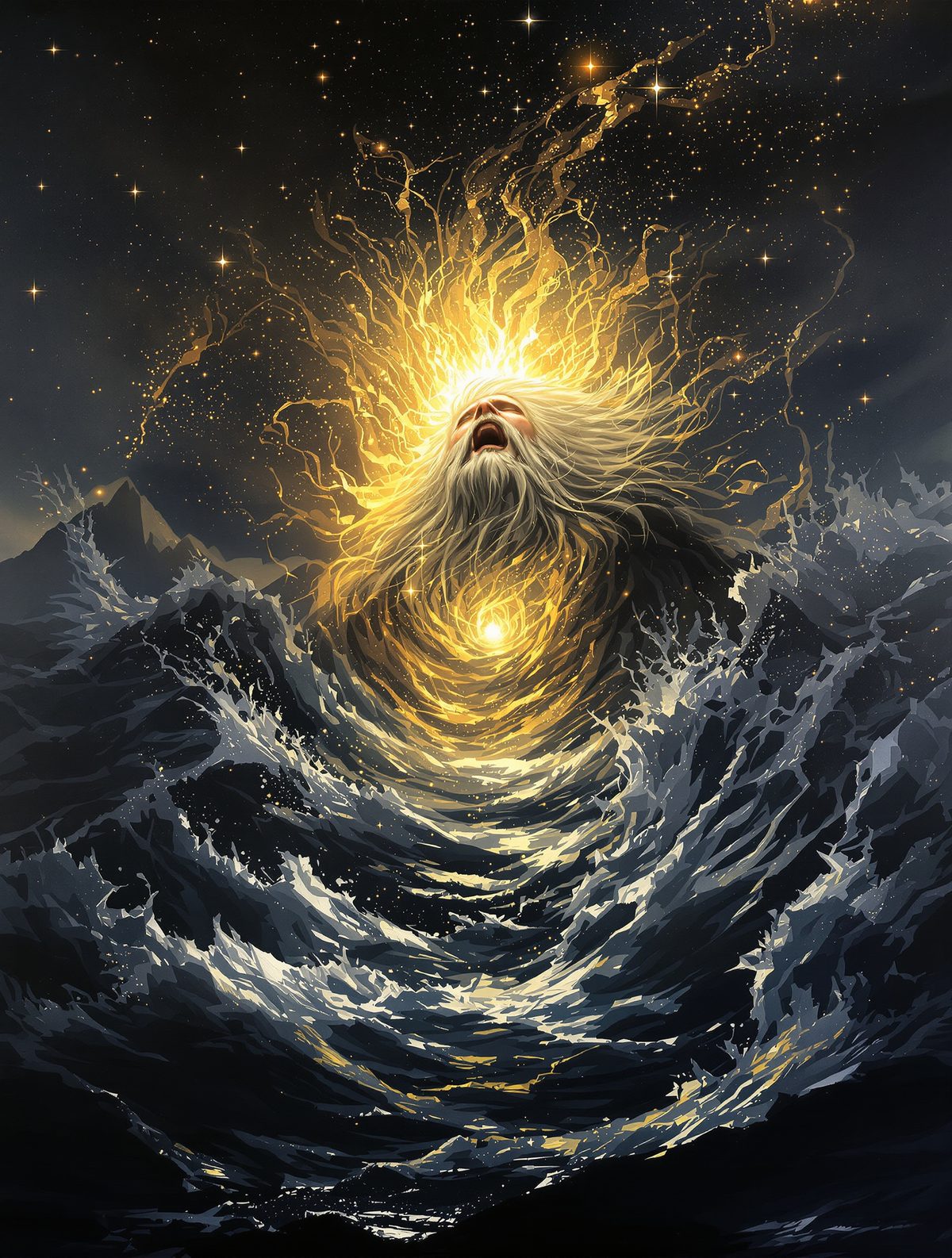
The world in silence, unshaped and void, awaited creation. Before the very fabric of reality was woven, before gods wielded hammers or sculpted landscapes, there was a power unlike any other. A song. Sung by Väinämöinen, the mythical shaman-god of Finland. In an era shadowed in mystery, before the written word, it was Väinämöinen's voice that awakened the world.
The Birth of a Universe
Long before history crystallized in the tomes of human knowledge, Finnish creation lore echoed through the lush landscapes of the north, whispered by the winds across untamed forests and icy lakes. In the grand epic of the Kalevala, Väinämöinen emerges as more than a mere mortal. It's said before anything else existed, he sang the world into shape. His song was not composed of lyrics or melodies we know, but a pure, unbridled essence of creation itself.
Within the void, Väinämöinen's song resonated and rippled through the cosmos, splitting the ocean's vast expanse, giving form to the sky and contours to the land. At his voice's command, mountains soared from the depths, and rivers began their eternal journey. The world, born from song rather than violence, became a testament to the power of creativity over destruction.
Väinämöinen: A God Before Gods
In the pantheon of Finnish mythology, Väinämöinen stands apart. While many mythologies delve deep into tales of titanic conflicts or divine wrath shaping existence, the Kalevala presents a different genesis. Väinämöinen, according to these ancient songs, carries the essence of both worlds shaman and God—a deity who doesn't rule with an iron hand or fiery wrath but with song and wisdom.
Historical analysis dates the oral traditions of the Kalevala back thousands of years before the text was compiled by Elias Lönnrot in the 19th century. Venerations of Väinämöinen reveal a figure whose importance was rooted in his connection to nature and ability to harness elemental forces not with tools, but with his voice. This marked a profound understanding among early Finns of the intimate relationship between the word and the world.
Creation's Orchestra: Elemental Harmony
Imagine standing on the precipice of existence, the world hums with untapped potential. Väinämöinen's voice rises, weaving through the chaotic frequencies of the nascent universe. In his song, one finds the calling of winds, the patient growth of trees, the gentle carving of rivers through earth and stone. Each note is a whisper of elements, emerging not from conflict, but from harmony.
As creatures sprang to life, their symbiotic dance with the ecosystem underscored the harmonious roots of creation. Väinämöinen's role wasn't just as a creator, but as the conductor of a grand symphony, where each element played its part, adhering to a master plan orchestrated by song. This vision presents a universe not bound by the physical chains we perceive today but by an ethereal resonance of unity.
Legacy of the Creator Shaman
Throughout centuries, Väinämöinen's legacy would ripple through Finnish culture and beyond. His story wasn’t just a creation myth— it infused the lives of people with teachings on balance, wisdom, and resilience. The concept of singing things into being wasn’t merely a tale of old, but a testament to the enduring power of words and ideas to shape reality.
Personal accounts from Finnish folklore reveal tales of everyday heroes invoking Väinämöinen's power in various aspects of life, from agricultural rites to healing practices—turning to song and spoken word as an echo of their mythic progenitor.
Väinämöinen Today: The Power of Creative Voice
Why does this ancient tale of creation through song resonate today? In a world teeming with noise and conflict, Väinämöinen reminds us of the power inherent in creativity and harmony. Before the clashing of swords or the ushering of storms, it is a song—a voice—that wields the profound ability to change the course of existence.
Modern scientists, artists, and philosophers unknowingly echo this sentiment, striving to break new ground not through destruction but through innovation and inspiration. Väinämöinen’s ancient wisdom offers a timeless lesson: Creation and harmony are not mere relics of myth, but potent forces capable of crafting new realities.
As we stand at the forefront of our own creations—whether it be stories, music, or technological advancements—let us remember Väinämöinen. In his ethos, we discover the timeless truth that our world need not be shaped by brute force or conflict. Instead, like the master shaman of old, we hold the power to sing new worlds into existence with our own triumphant voices.