
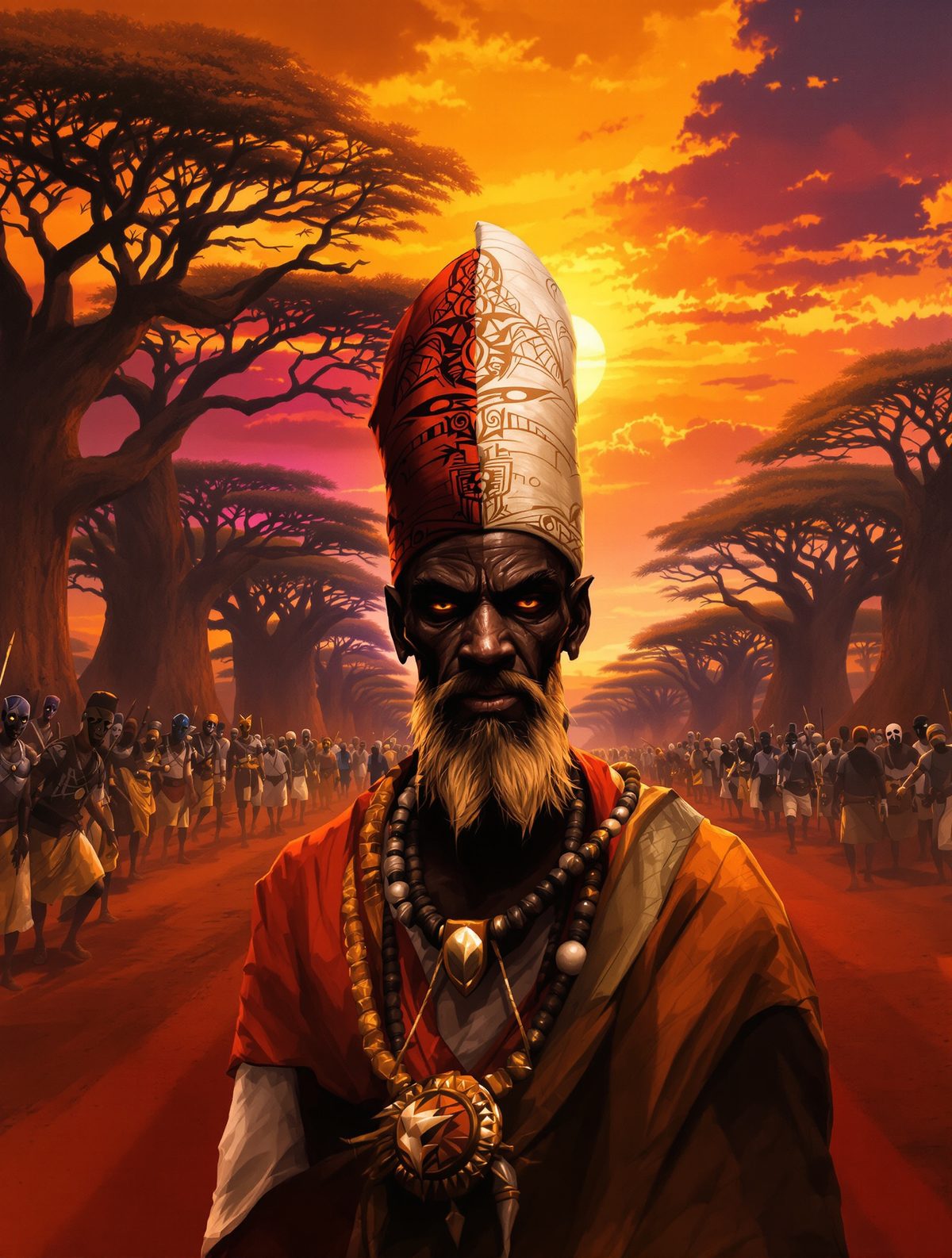
In the vibrant tapestry of Yoruba mythology, we find tales that wink at us mischievously while imparting profound lessons. Among these, none is quite as compelling as the story of Eshu's two-faced hat. This tale, from the time before time, reveals the whimsy and wisdom of the divine trickster Eshu, a god whose actions ripple through history like the wake of an ancient canoe on the River Niger. Gather round, as we traverse the dusty roads of Yoruba land and uncover the truth behind one of mythology's most intriguing legends.
The Road to Discord
Picture a sunlit path winding through a verdant landscape in old Yoruba land, where the world's beauty was crafted by the hands of the Orisha. Here, amidst rustling palms and the distant call of an African pied crow, two friends, Alabi and Odion, set out to journey towards a bustling market town. They were bonded by years of camaraderie and shared stories, trusting each other like brothers. Little did they know, their friendship would soon be caught in the web woven by Eshu, the ultimate trickster.
As they walked, Eshu strode the road ahead of them, donning a hat that was red on one side and white on the other. To Alabi, walking on his left, Eshu appeared with a vibrant red crown. Meanwhile, Odion, on Eshu's right, saw a hat of purest white. Eshu walked with a nonchalant grace, humming a tune only the mischievous know.
The Fracture of Perception
The friends arrived at the market, chirping with the chaos of traders and buyers. Alabi and Odion, still unraveling the sight of the strange wanderer, began to argue. Alabi was adamant about seeing Eshu's red hat, while Odion swore it was white. In a blink, their debate escalated from words to blows, a symphony of misunderstanding playing out in front of a bewildered crowd. The colors of Eshu's hat danced in their minds with such certainty, each convinced their version was the unquestionable truth.
This simple disagreement soon spiraled into a conflict that enveloped their families, dividing their community. The air, once filled with laughter and warm fellowship, grew thick with tension and anger. Eshu, meanwhile, chuckled in the shadows, for his role was never one of malevolence but of revealing deep-seated truths about the human condition.
The Trickster Unveiled
Who was this enigmatic Eshu, and why sow such chaos among steadfast friends? As the god of crossroads and duality, Eshu embodies paradox and challenges the limits of perception. He thrives in the spaces between certainty and doubt, often forcing mortals to confront uncomfortable truths about themselves. In Yoruba tradition, he is both the divine messenger and the keeper of Ayo, the game of destiny.
Understanding Eshu's role necessitates looking beyond his tricks to the heart of the lessons he imparts. His red-and-white hat is a potent symbol of duality, reminding us that truth is multifaceted, shaped by perspective and context. It is this dance between realities that Eshu enjoys orchestrating, leaving humans to untangle his riddles and grow wiser in the process.
The Ripples of Realization
In the aftermath of the conflict, a respected elder intervened, invoking the tales of Eshu to context the turmoil. The young and old gathered, listening as he unraveled the intricacies of the trickster's hat. As understanding dawned upon Alabi and Odion, so too did regret and remorse. Their eyes, once blurred by anger, now saw the truth in Eshu's capricious lesson — that what we see depends greatly on where we stand.
The reconciliation was a quiet affair, marked by the hug of old friends and the gentle hum of renewed harmony. The tale of Eshu’s hat, once sown into discourse and conflict, now bore fruit in the form of wisdom. The lesson spread like wildfire, becoming a beacon of insight for generations — a reminder that every road walked has two sides and that every truth has its shades.
The Legacy of Eshu's Wisdom
Why, then, does Eshu's tale matter in our contemporary world? As we navigate a world colored by ever-diverging perspectives and truths, Eshu’s benevolent chicanery offers a timeless lesson. In the modern landscape, where certainties are often questioned and diverse viewpoints clash, embracing Eshu’s philosophy prompts us to approach disagreements with empathy and understanding.
The tale of Eshu's hat challenges us to step into another's shoes, to glimpse the hues that shape their reality. It reminds us that life's most profound lessons are nestled within the cracks of duality, urging us to bridge divides with laughter rather than strife. In a world that can all too quickly ignite into conflict, Eshu’s wisdom calls us back to curiosity and compassion.
So next time you find yourself caught in a debate, remember the red and white hat of Eshu. Consider the dance of perception and the unseen trickster guiding you toward enlightenment. For in the end, it is not about choosing sides, but about walking the road with eyes wide open to all the truths it holds.