In the shadowed depths of ancient Egypt, where myths flowed like the Nile River, there exists a tale of cosmic intrigue and celestial gambles — a story of divine cunning that reshaped the heavens and the pantheon of Egyptian deities. This is the saga of how Thoth, the enigmatic god revered for his wisdom, dared challenge the boundaries of time itself to ensure the birth of gods, defying an edict from Ra, the mighty sun god. Prepare to be drawn into a world where deities played games with the fabric of time and fate itself hung in the balance.
The Curse of the Sky: A Mother's Burden
The sky goddess Nut found herself at the center of heavenly drama, her story anchored in a divine decree meant to quell her future. Ra, the all-powerful sun god, set forth a curse forbidding Nut from giving birth on any day of the year — a move designed to prevent her progeny from threatening his sovereignty. Historians speculate this myth symbolizes the struggle to maintain cosmic balance amidst the chaotic powers of creation.
To comprehend the gravity of this curse, it is essential to recognize Nut's celestial role. Nut, often depicted as a star-studded woman arching protectively over the earth, was the sky itself. Her union with Geb, the earth god, represented a powerful alliance of creation and fertility. Yet, Ra’s decree was absolute — no child of Nut's would see the light of day or the cover of night.
A Game of Cosmic Chance: Thoth's Divine Gamble
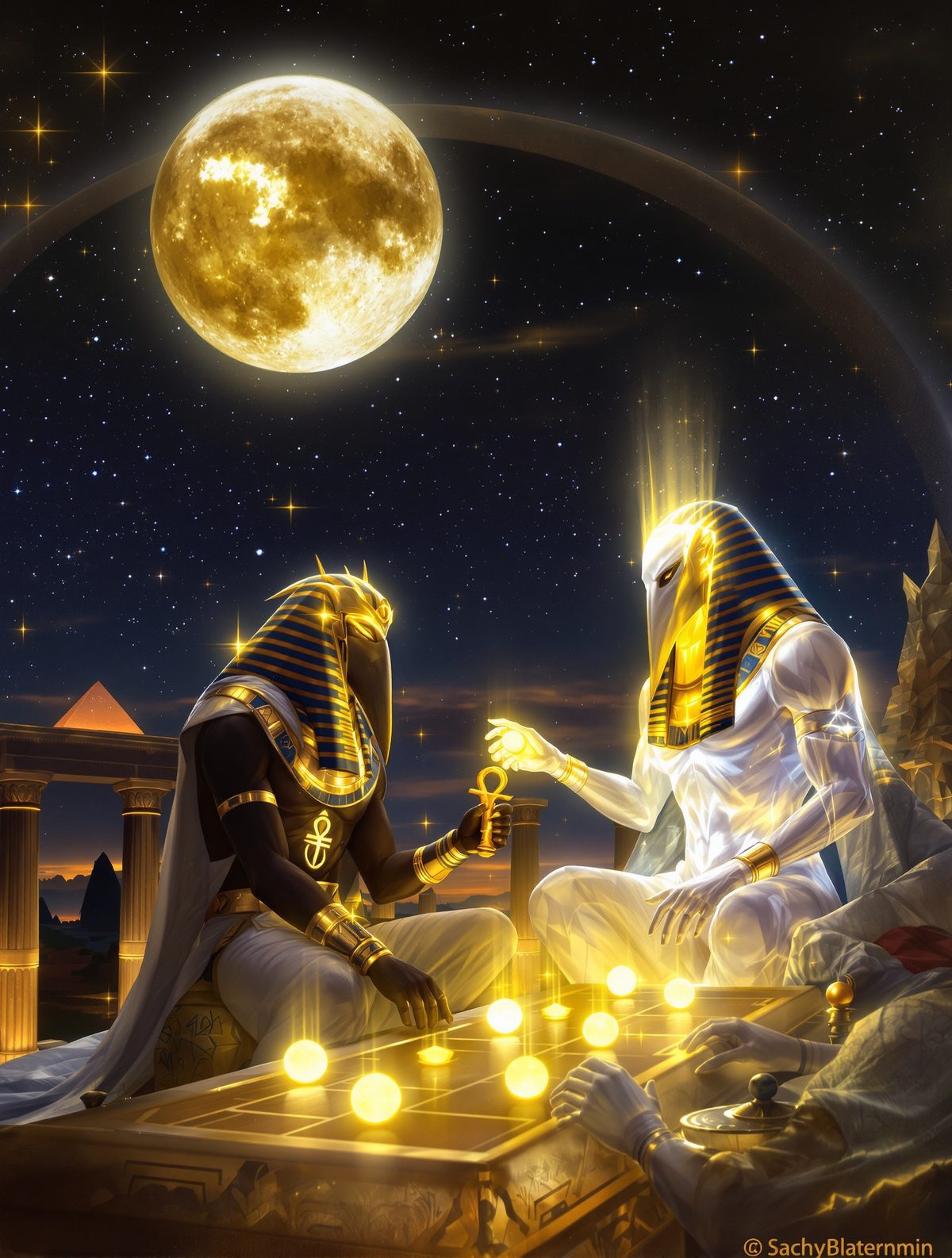
Enter Thoth, the clever and articulate god of wisdom, writing, and magic, characterized in hieroglyphs by an ibis or baboon. In a clever twist of mythology, Thoth devised a plan to outwit the very cycle of time. But who was his opponent? None other than Khonsu, the lunar god, a celestial body and an embodiment of the moon's phases.
The game was cosmic in nature, a high-stakes wager involving senet, an ancient Egyptian board game. Its specifics lost to antiquity, but the stakes were monumental. Thoth, with his boundless intellect, wagered for light — slivers of moonlight, fractions of time — against Khonsu's luminescent essence. He won, of course, garnering one-seventy-second of moonlight from each lunar cycle, the result being five extra days tacked onto the existing 360-day calendar.
These five intercalary days did not belong to any month or year, thus circumventing Ra's decree. Thoth's clever resolution gifts the story its enduring wonder; a loophole rendered by ingenuity that became embedded in the Egyptian continuum of time.
Births Among the Stars: The New Gods Arrive
With the celestial loophole secured, Nut bore her children during these five extratemporal days. Each day saw the emergence of titanic beings who would leave an indelible impact on Egyptian culture and theology.
The first was Osiris, destined to become the god of the afterlife and resurrection, a symbol of eternal renewal. His birth marked a pivotal point in Egyptian belief, offering hope of life beyond death to Pharaohs and commoners alike.
On the second day, Horus the Elder was born — a sky god often conflated with the better-known Horus, son of Isis and Osiris. The convolutions of Egyptian myth highlight a complex legendary lineage that predates the divine kinship so familiar in religious texts.
Day three heralded the arrival of Set, a god with a tumultuous legacy, often associated with chaos and deserts, yet also a necessary adversary balancing the benevolent forces of the world. His presence speaks of the Egyptian recognition of duality in creation.
Isis emerged on the fourth day, destined to be the most venerated and beloved goddess in Egyptian mythology. Her attributes of motherhood, magic, and a protective nature went on to inspire religions beyond Egypt's borders.
Finally, on the fifth day, Nepthys appeared, often overshadowed by her siblings but quietly influential in the realms of magic and protecting the dead. Her inclusion underscores the complex and often esoteric nature of Egyptian divine relationships.
The Legacy of Stolen Days: A Calendar and Cosmology Transformed
What might seem a narrowly-solved celestial quandary became a major influence on Egyptian society. The adoption of a solar calendar incorporating these five "epagomenal" days forged Egypt's link to the stars, demonstrating a cosmological and agricultural precision that supported its dynasties for millennia.
The tale also illustrates a philosophical narrative — the triumph of intelligence and determination over seemingly insurmountable obstacles, a timeless theme that resonates in modern audiences. The Egyptian pantheon owes its continued presence to Thoth’s wit, a subtle reminder of how beings of light and shadow coexist through divine diplomacy.
The Eternal Echo: Why This Matters Today
As we unravel these ancient stories, immersed in their vibrant tapestry of symbols and stars, we must ask why a millennia-old fable remains so compelling. Perhaps because, at its heart, this legend captures the human spirit's relentless quest for balance, justice, and understanding. Just as Thoth carved out time for life to flourish where it was forbidden, so too do we strive to invent, solve, and create amidst the chaos of modern existence.
In an age ever more reliant on technology and scientific discovery, let us not forget the wisdom conveyed through these cosmic narratives. They remind us of the ongoing dance between reason and fate, and humanity's indomitable spirit to comprehend the arcane rhythms of the universe in which we find ourselves.