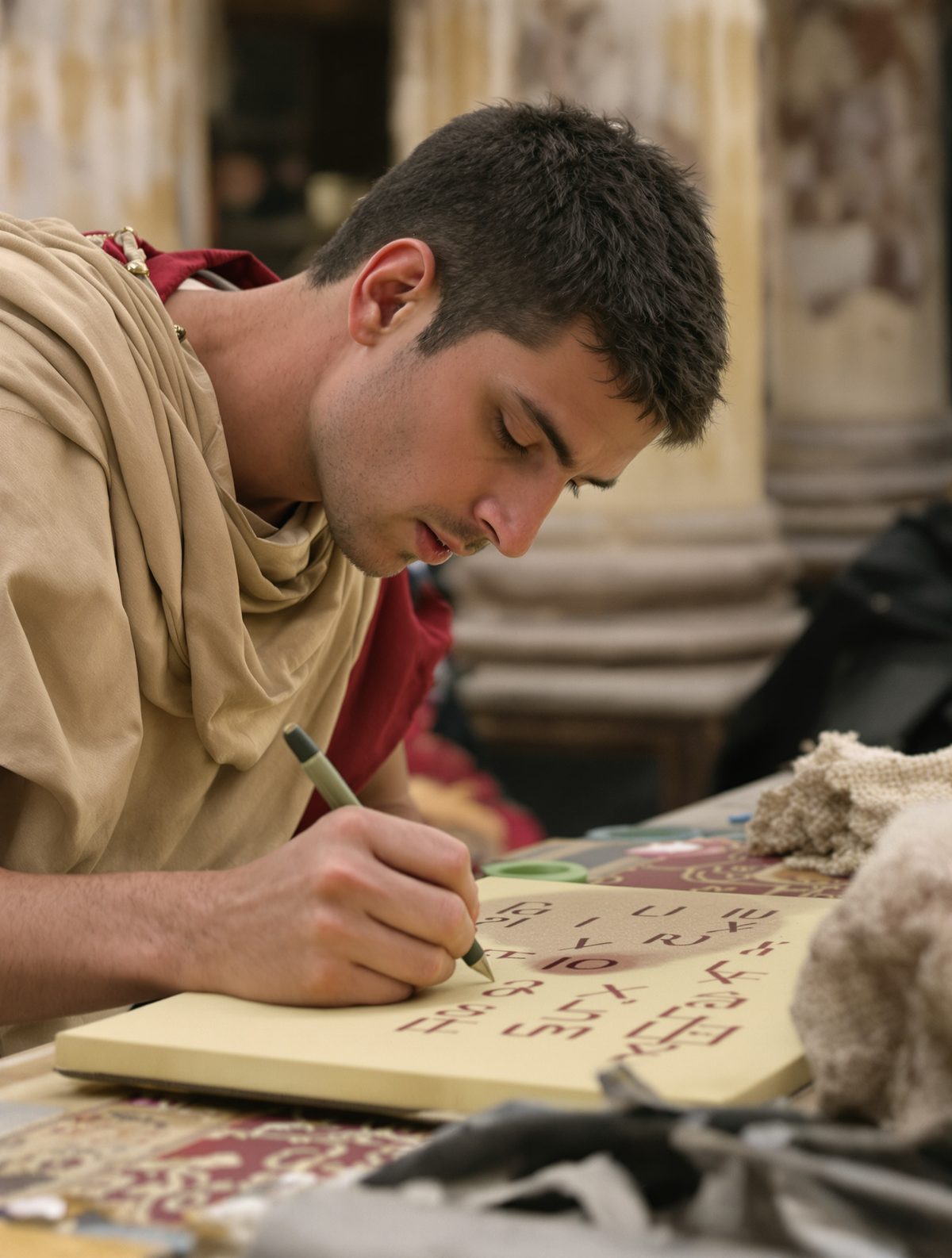
The marble floors of the Roman Senate echoed with the thunderous voices of senators locked in heated debate. It was 63 BC, and Marcus Tullius Cicero was delivering one of his legendary speeches against the conspirator Catiline. In the shadows of the great columns, a young slave named Marcus Tullius Tiro frantically scratched symbols across his wax tablet, sweat beading on his forehead as he struggled to capture every precious word. Traditional Latin letters were simply too slow for the rapid-fire oratory of Rome's greatest speaker. In that moment of desperation, Tiro made a decision that would revolutionize written communication for the next millennium—he abandoned letters entirely and began creating his own system of symbols and abbreviations.
What Tiro invented that day wasn't just a personal note-taking method. He had just created the world's first systematic shorthand writing system, one so effective that it would spread throughout the Roman Empire and survive long after Rome itself had fallen.
The Slave Who Became History's First Stenographer
Marcus Tullius Tiro occupied a unique position in Roman society. As Cicero's personal secretary and freedman, he had been granted his freedom in 53 BC, but even as a slave, he enjoyed privileges that most Romans could only dream of. He was literate, educated, and trusted with his master's most sensitive correspondence. Born around 103 BC, Tiro had likely been part of the Cicero household since childhood, growing up alongside the future consul and developing an intimate understanding of his patron's speaking patterns and intellectual habits.
The relationship between Cicero and Tiro transcended the typical master-slave dynamic of ancient Rome. Cicero's letters reveal genuine affection for his secretary, whom he described as "most dear to me" and praised for his exceptional intelligence. This wasn't mere sentiment—Tiro's intellectual contributions to Cicero's work were substantial enough that some scholars believe he may have helped compose portions of his master's speeches and writings.
But it was Tiro's practical problem-solving skills that would leave the most lasting mark on history. As Cicero's career reached its zenith, the volume and complexity of his correspondence, speeches, and legal work had grown overwhelming. Traditional Roman scribes, writing in formal Latin script, simply couldn't keep pace with one of history's most prolific orators.
When Letters Failed: The Birth of Tironian Notes
The system Tiro developed, later known as "Tironian Notes" or "Tironian Shorthand," was revolutionary in its simplicity and effectiveness. Rather than writing out complete words in traditional Latin letters, Tiro created a library of symbols, abbreviations, and marks that could capture the essence of speech at the speed it was delivered. His system included over 4,000 different symbols by some accounts, each representing common words, syllables, or even entire phrases.
What made Tironian Notes truly ingenious was how they reflected the actual patterns of Latin speech and rhetoric. Tiro didn't just create random symbols—he developed a logical system that could be learned and standardized. Common words like "et" (and) became simple curves that could be written with a single stroke. Frequent political and legal terms received their own dedicated symbols, allowing a skilled practitioner to record senatorial debates or court proceedings in real-time.
The system was so advanced that it included methods for indicating inflection, emphasis, and even speaker changes during multi-person conversations. Imagine being able to capture not just what Cicero said, but how he said it, and when Cato the Younger interrupted with a pointed objection—all while the debate raged at full speed.
From the Senate to the Empire: A System Spreads
Word of Tiro's remarkable innovation spread quickly through Rome's elite circles. By the time Augustus became emperor, Tironian shorthand had evolved from one slave's clever solution into an essential tool of imperial administration. The emperor himself reportedly learned the system, and it became standard practice for recording official proceedings, taking dictation, and managing the vast correspondence required to govern an empire stretching from Britain to Egypt.
Professional schools for teaching Tironian Notes emerged throughout the empire. These weren't casual workshops—they were rigorous training programs that could take years to complete. Master stenographers became highly valued professionals, earning salaries that rivaled those of skilled craftsmen and minor officials. Some could write at speeds approaching 120 words per minute, a pace that wouldn't seem out of place in a modern office.
The system's adoption wasn't limited to government work. Wealthy Romans employed Tironian-trained scribes to record everything from dinner party conversations to philosophical discussions. Early Christian communities used it to preserve sermons and theological debates, creating some of the earliest rapid transcriptions of religious discourse in Western history.
Beyond Rome: A Thousand-Year Legacy
Here's where Tiro's story becomes even more remarkable: his shorthand system didn't die with the Roman Empire. As Roman civilization transformed and evolved, Tironian Notes adapted and survived. Medieval monasteries became centers for preserving and teaching the system, with monks using it to copy manuscripts and record scholarly discussions. Irish monks, in particular, became masters of Tironian shorthand, using it to preserve both classical texts and contemporary writings during the Dark Ages.
By the 9th century, Charlemagne's court was using an expanded version of Tironian Notes for official correspondence. The system had evolved to include symbols for Christian concepts and medieval legal terms that Tiro could never have imagined. Some manuscripts from this period contain over 13,000 distinct Tironian symbols—a testament to how thoroughly the system had been developed and refined over the centuries.
The longevity of Tironian Notes is staggering when you consider that most ancient technologies were eventually superseded and forgotten. Yet Tiro's basic approach to shorthand—using simplified symbols to represent common words and sounds—remained in use across Europe until well into the medieval period. Even when new shorthand systems emerged during the Renaissance, they often borrowed principles that Tiro had established over a millennium earlier.
The Forgotten Genius Who Changed Communication Forever
Perhaps the most fascinating aspect of Tiro's story is how thoroughly his personal contribution was overshadowed by his famous master. While every educated person knows Cicero's name, Marcus Tullius Tiro remains largely unknown despite creating something that may have had a more lasting impact on daily life than any of Cicero's speeches. The irony is profound: the slave's innovation preserved and transmitted the master's words, but history remembered only the speaker, not the recorder.
Tiro lived to be remarkably old for his era, reportedly reaching his 99th birthday in 4 BC. He spent his final decades as a free man, probably wealthy from his innovations and continuing relationship with the Cicero family. Some sources suggest he may have written a biography of Cicero, though no copies survive. If true, it would mean that Tiro not only recorded history but tried to write it as well—perhaps using his own shorthand system to capture memories and observations that no one else could have provided.
The technical sophistication of Tironian Notes wasn't matched again until the development of modern stenography in the 19th century. Sir Isaac Pitman's famous shorthand system, developed in 1837, employed many of the same principles that Tiro had pioneered nearly two millennia earlier: phonetic representation, standardized symbols for common words, and methods for rapid transcription of spoken language.
Why Tiro's Story Matters in the Digital Age
In our age of voice recognition software and digital transcription, Marcus Tullius Tiro's story might seem like an antiquarian curiosity. But his innovation represents something timeless and profoundly human: the drive to capture and preserve the spoken word, to bridge the gap between thought and permanent record, between fleeting conversation and lasting knowledge.
Tiro's shorthand wasn't just about writing faster—it was about democratizing access to information. Before his system, detailed records of speeches, debates, and discussions were limited by the physical constraints of traditional writing. His innovation meant that more voices could be preserved, more ideas could be captured, and more perspectives could survive for future generations.
Every time we take rapid notes on our phones during a meeting, every time voice-to-text software captures our dictation, every time a court reporter creates a real-time transcript of legal proceedings, we're using technology that traces its conceptual lineage back to a young slave in the Roman Senate. Marcus Tullius Tiro didn't just invent shorthand—he invented the idea that human speech could be captured at the speed of thought, an innovation that continues to shape how we communicate, learn, and preserve knowledge today.
The next time you see someone typing rapidly on their laptop during a lecture, or watch closed captions appear in real-time on a live broadcast, remember the slave who started it all with nothing more than a wax tablet, a stylus, and the determination to keep up with one of history's greatest speakers.