In the sweltering heat of a Theban summer in 1550 BC, two palace guards froze in terror as they made their rounds through the Valley of the Kings. From deep within the sealed tomb of Princess Ankhesenamun came a sound that chilled their blood—the unmistakable scratch of fingernails against stone. The princess had been dead and buried for seventy days. What they were about to discover would shake the very foundations of Egyptian beliefs about death, the afterlife, and the thin line between the two.
A Death That Fooled the Gods
Princess Ankhesenamun was barely seventeen when the fever took hold. In the scorching month of Akhet, when the Nile's waters rose to bless the land, a mysterious illness swept through the royal palace like wildfire. The princess, daughter of a minor pharaoh whose name has been lost to history, fell victim to what palace physicians described as a "burning sickness" that left her body rigid and her breathing so shallow it was barely perceptible.
For three days, she lay motionless on her golden bed, attended by the finest healers in all of Egypt. They burned incense to Sekhmet, goddess of healing, and pressed their ears to her chest, listening for the whisper of life. On the third dawn, her body grew cold. Her skin took on the waxy pallor of death. Even the most experienced physician, a man who had served three pharaohs, declared what seemed obvious: Princess Ankhesenamun had journeyed to the realm of Osiris.
What no one realized was that the princess had fallen victim to a condition we now know as cataleptic shock—a rare neurological response to severe illness that can slow bodily functions to such an extent that even trained medical professionals mistake it for death. In an age when a mirror held to the lips was the most sophisticated method of detecting breath, the mistake was tragically easy to make.
The Seventy-Day Journey to Eternity
Ancient Egyptian burial customs were as elaborate as they were irreversible. The moment Princess Ankhesenamun was declared dead, a precisely choreographed ritual began that would consume the next seventy days—the traditional period required for proper mummification of royalty.
Her body was immediately transported to the per nefer, the "house of mummification," located on the west bank of the Nile where the sun died each day. Here, master embalmers began their sacred work. They removed her internal organs—all except the heart, which Egyptians believed was needed for judgment in the afterlife. Her body cavity was packed with natron, a naturally occurring salt that would desiccate the flesh over the next forty days.
But here's where this story takes its most chilling turn: somewhere during this process, perhaps due to the preservative effects of the natron or the cool, dry conditions of the embalming chamber, Princess Ankhesenamun's body began to recover from its cataleptic state. Imagine the horror of awakening, blind in the darkness, your body wrapped in linen, surrounded by the sharp smell of preservative salts.
The embalmers, working in shifts and following sacred protocols that had remained unchanged for centuries, never noticed. They completed their work with meticulous care: wrapping the princess in over 400 square yards of the finest linen, placing protective amulets between the layers, and finally sealing her in a series of nested sarcophagi made from cedar wood and overlaid with gold.
Sounds from the Underworld
The tomb of Princess Ankhesenamun was located in a lesser-known section of the royal necropolis, carved into the limestone cliffs that overlooked the Nile. Unlike the grand sepulchers of the pharaohs, her burial chamber was modest—a series of three rooms connected by narrow corridors, with walls painted in the traditional scenes of her journey through the Duat, the Egyptian underworld.
Palace guards Khaemwaset and Amenhotep had been making their nightly rounds for over two months when they first heard the sounds. Initially, they dismissed the faint scratching as perhaps a desert fox or grave robbers attempting to tunnel into the tomb from above. Tomb robbery was so common that pharaohs employed entire battalions of guards to protect their eternal resting places.
But as the nights passed, the sounds grew more distinct and more disturbing. The scratching followed patterns—frantic bursts of activity followed by periods of silence, as if someone inside was conserving their strength. More unsettling still, the sounds seemed to come not from the outer chambers where grave robbers would first enter, but from the deepest part of the tomb where the sarcophagus lay.
The guards faced an impossible choice. Egyptian religious law was absolute: the seal of a royal tomb could not be broken except by direct order of the pharaoh himself. To do so meant not only death for the offender but the damnation of their soul for all eternity. Yet the alternative—ignoring what might be a divine miracle or a supernatural crisis—seemed equally perilous.
The Impossible Discovery
After consulting with the high priest of Amun, the guards received grudging permission to investigate. On a moonless night seventy days after the princess's burial, a small party of priests, guards, and palace officials descended into the tomb with flickering oil lamps and hearts full of dread.
The outer seals were intact. The burial chambers showed no signs of disturbance. But as they approached the sarcophagus, the scratching sounds intensified, echoing off the painted walls like some nightmarish percussion. The golden lid of the outermost coffin bore fresh scratches—deep gouges that could only have been made from the inside.
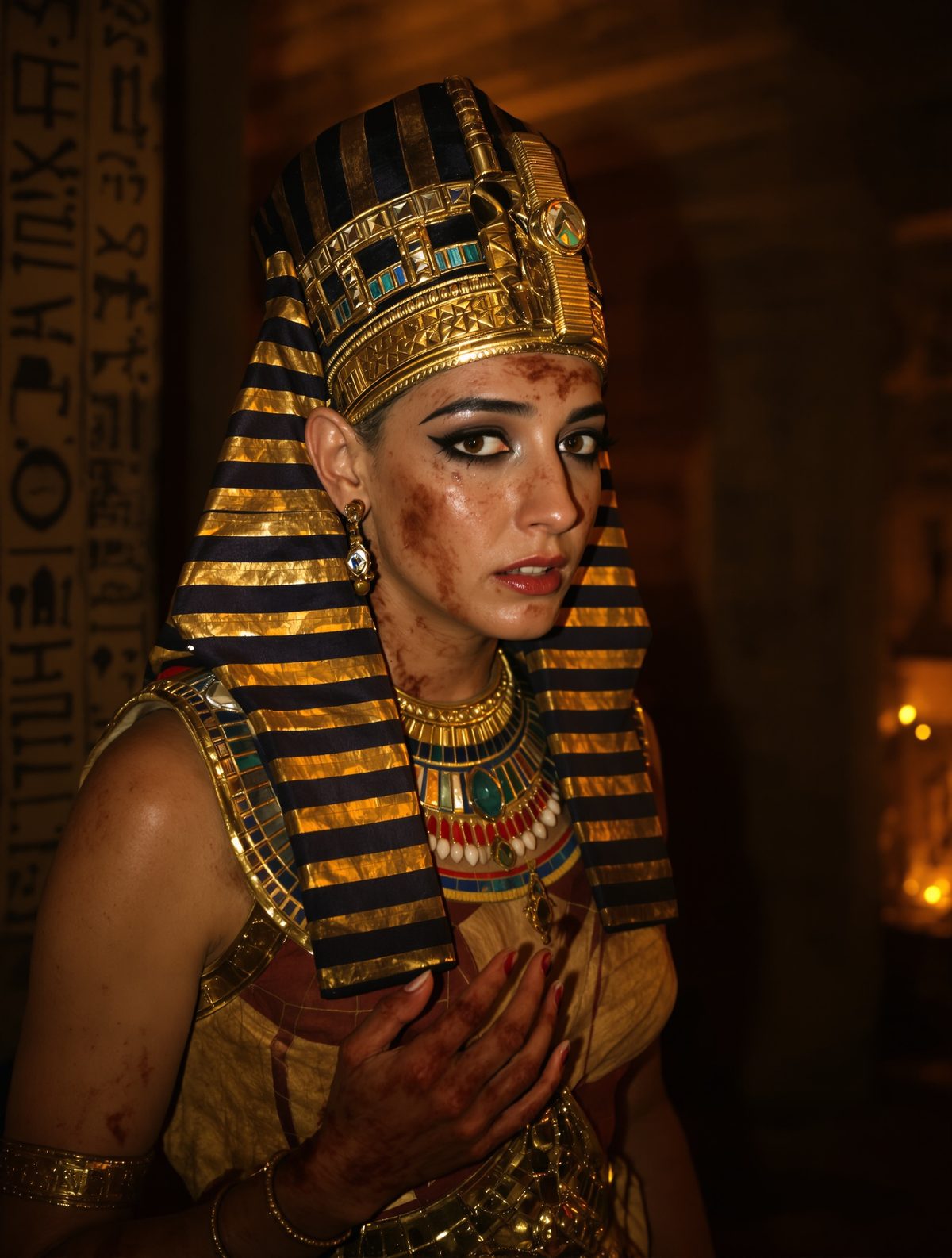
What they found when they finally opened the sarcophagus defied every law of death the Egyptians knew. Princess Ankhesenamun was alive, though barely. Her fingernails were completely gone, worn away to bloody nubs from clawing at the stone and gold that entombed her. The fine linen wrappings around her hands and arms were shredded. Her throat was raw from screaming in a tomb designed to muffle all sound.
But perhaps most remarkably, she was conscious and coherent. The princess spoke of dreams—vivid visions of the underworld where she claimed to have walked alongside Anubis, the jackal-headed god of the dead. She described golden fields of reeds and rivers of starlight, places that matched exactly the descriptions in the Book of the Dead that she, as a princess, would never have been taught to read.
A Life Between Worlds
Princess Ankhesenamun's rescue created a theological crisis that rippled through every temple in Egypt. If she had truly died and returned, what did this mean for their understanding of the afterlife? If she had never died at all, how had she survived seventy days without food or water in a sealed tomb?
The priests' solution was as politically expedient as it was spiritually creative. They declared that the princess had been chosen by the gods for a special mission—to return from the dead and share divine knowledge with the living. She was given the new title ankh-ef-en-Sekhmet, meaning "she who lives for Sekhmet," and became the first recorded person in Egyptian history to hold the position of Oracle of the Returned.
Modern medical analysis of similar cases suggests that Princess Ankhesenamun's survival, while miraculous, wasn't supernatural. The cool, dry conditions of the tomb, combined with the preservative effects of natron, may have slowed her metabolism dramatically. The princess likely slipped in and out of consciousness, conserving energy and moisture. The gold leaf that decorated Egyptian sarcophagi could also have condensed small amounts of humidity from her breath, providing just enough moisture to sustain life.
Echoes Across Eternity
The story of Princess Ankhesenamun forces us to confront uncomfortable truths about the nature of death and our certainty about it. In an age of advanced medical technology, we assume that such mistakes are impossible. Yet cases of people waking up in morgues, or showing signs of life just before cremation, still make headlines today.
The princess lived another forty-three years after her resurrection, becoming one of the most influential religious figures of her time. Pilgrims traveled from across the known world to hear her speak about the afterlife. Her tomb, when she finally died for the second and final time, became a place of pilgrimage that lasted well into the Roman period.
But perhaps the most haunting aspect of her story isn't the miracle of her survival—it's the question of how many others throughout history weren't so fortunate. How many people have we buried alive, their final moments spent in darkness, clawing at coffin lids that would never open? Princess Ankhesenamun's fingernails, worn to nothing against stone and gold, stand as a testament not just to the will to live, but to the thin line between the medical certainty we trust and the mysteries that still surround the moment when life becomes death.
Her story reminds us that even in our age of scientific precision, the ancient Egyptian prayer rings as true today as it did 3,500 years ago: "May your eyes open in the light, may your voice be heard among the living." Sometimes, against all odds, they do.