Amidst swirling chaos and formless mists, a vast cosmic egg drifted in the primordial silence. Within this enigmatic capsule slumbered Pangu — a lone giant, unknown yet destined to become the architect of the world. For eighteen thousand years, he slept, dreaming of life, order, and the potential that lay beyond his imaginary prison. As millennia passed in steady rhythm, the time for genesis approached, culminating in a dreamer's stirring that would echo through the annals of myth.
The Awakening of Pangu
The distant sound of axes cleaving through air may symbolize progress, yet in the absolute void before time, it marked a beginning. When Pangu awoke, his eyes first met darkness — an all-consuming blackness pressing upon him as he lay cramped and confined within the colossal egg. A weighty silence surrounded him, hushing chaos into a deceptively serene lull. It was then that Pangu grasped the axe formed in deep slumber — an instrument born of dreams and strength yet untapped.
Pangu's might surged as he swung, and with a resounding crack, the axe cleaved the egg open. Lo! The yolk separated into distinct halves, casting the lighter elements as the heavens and the heavier matter as the earth. Thus, light and darkness, Yin and Yang, burst forth, spinning a new tapestry of existence. The world had found its breath — a symphony initiated by an awakened dream.
From Axis to Atlas
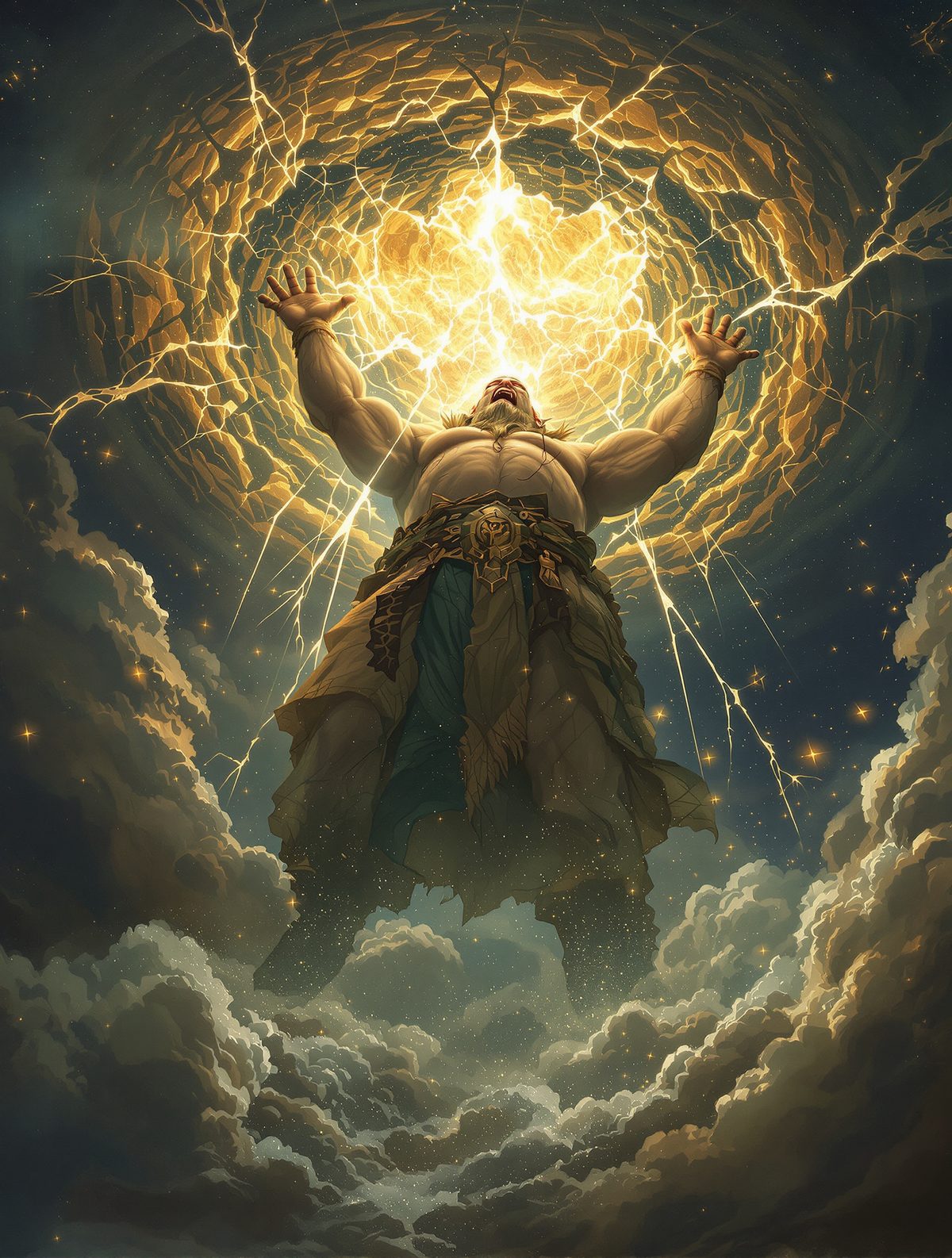
Newly liberated, Pangu recognized a fragility in this nascent world. The sky and earth, now divided, threatened to collapse back into chaos. In an act of profound sacrifice, Pangu wedged himself between them, lifting the skies with his mighty hands while grounding his feet firmly on the burgeoning earth. With each day, he grew taller. As legend tells, he gained ten feet daily, keeping this fragile balance for yet another set of eighteen thousand years.
Pangu bore the universe's weight in this primal gesture as he stood, an Atlas-like figure lending form and function to the chaos. It is said that he listened to the heartbeat of the world as it synchronized with his own, a constant reminder of his purpose and the natural order he maintained.
The Boundless Transformation
Time, it is said, respects no entity, not even giants. As Pangu reached the end of his life, he prepared for his final transformation—a metamorphosis that myth intricately weaves into the very fabric of reality. Upon his passing, his colossal form did not vanish into the ether. Instead, it scattered across creation, each part serving a newfound purpose. Pangu's body could be seen in the topography of the world itself.
His breath became the mighty winds that sweep across the lands. His voice transformed into the orchestrated thunder that rumbles through heavens. From his eyes came the sun and moon, casting light and shadow across the terrestrial tapestry. Pangu's limbs unfolded into the majestic mountains, his blood flowed as rivers, and his flesh enriched the soil—each element of him remains imbued with life and promise. Even his hair whispered ancient secrets, turning into forested canopies and plant life brimming with vitality.
Echoes of the Ancients
Pangu's legacy is as rich as the terrains he formed. The Pangu myth is not just a tale of cosmic division; it's a cultural axis around which chinese cosmology spun for generations. While Chinese mythology claims no singular foundational myth equivalent to Genesis or Ragnarok, Pangu remains a unique and pivotal figure in the tapestry of world creation tales.
Those who have sought to understand the world through the lens of mythology have often unearthed correlations with modern science. In an unexpected parallel, Pangu's emergence from the cosmic egg intriguingly mirrors the Big Bang theory — a universe spawned from a singular point of origin. Nationally, Pangu's narrative acts as a testament to ancient Chinese ingenuity and imagination — a cultural touchstone that resounds through centuries.
Why Pangu Remains Relevant
The tale of Pangu, while embedded in ancient lore, offers contemplative value to modern audiences. It challenges individuals to consider the power of dreams, the potential held within states of reflection and slumber. It underscores the notion of sacrifice for the greater good, a vivid reminder that greatness often requires the transcendence of self.
As myth myth persists through time, individuals and cultures interpret the archetype of Pangu in ways that resonate with both history and personal experience. In a world grappling with environmental concerns, Pangu's metamorphosis into nature's elements elegantly emphasizes the interdependence of life and environment.
Pangu's legacy is a rich soil from which modern reflections can grow. His colossal form, dispersed among the stars and earth, calls us to recognize the myths around us, informing our histories, our cultures, and the stories yet to be written.