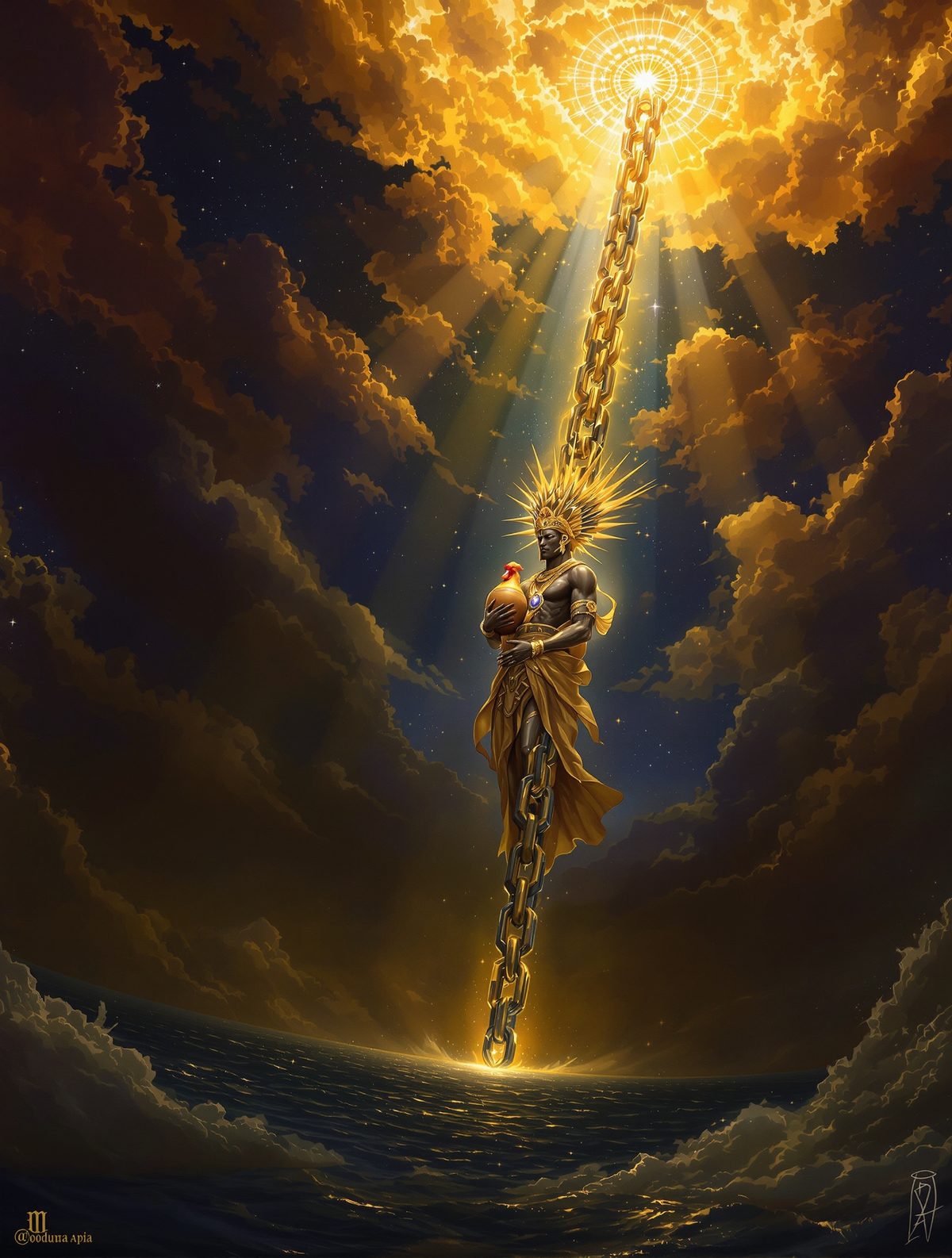
The waters stretched endlessly under a canopy of sky, a world still formless and void. Yet, amidst this vast expanse of nothingness, a cosmic event was about to alter the universe forever. A divine figure began his descent from the heavens, suspended by a magnificent iron chain, clutched in his grasp the tools of creation—a calabash of sand and a five-toed hen. This is the tale of Oduduwa, the god who planted the first earth.
Heavenly Dispatch
In the pantheon of Yoruba mythology, perched at the zenith of divine hierarchy, sat Olodumare, the Supreme Being. Olodumare envisioned a world of land and life in the primordial chaos of water and sky but sought the perfect emissary to bring this vision to life. Oduduwa, known for his wisdom and power, was chosen for this celestial commission. It was a compelling year of creation—eons ago, and yet the seed he planted continues to grow.
To this day, the role of Oduduwa in the ancient Yoruba mythos is regarded with deep reverence. Yet, for many outside West Africa's heartlands, his name and legacy have often drifted under the mainstream radar. As Oduduwa stood poised on the edge of heaven, every detail, from the chain forged from ethereal iron to the humble five-toed hen nestling in his arm, was chosen with precision.
Descending the Iron Chain
The descent began—a cascade of metal links lowering Oduduwa over the chaotic surface below. The chain, more than just a tool, symbolized the divine link between heaven and earth, between the celestial and the terrestrial. An unbroken connection represented faith and destiny itself—a line that some Yoruba believe holds the world together even now.
As Oduduwa made his journey from the heavens, time paused. Such was the significance of his mission that the very fabric of existence seemed to acknowledge it. As his feet touched the churning waters, a low hum, resonant with the promise of life, pulsed through the abyss.
The Birth of Earth
Oduduwa found himself standing upon a world yearning to be born. With steadfast purpose, he unsealed his calabash and scattered its sand into the abyss. Wherever the grains fell, they proclaimed solidity, burgeoning islands rising from the depths. This was no random act; it was creation orchestrated with divine intent.
Next, the five-toed hen was set upon these nascent mounds. It scratched fervently at the sand, scattering it further, gradually expanding the landmass. Fascinatingly, some variants of this legend, collected meticulously over time, suggest that different breeds of earth emerged from each scratch, showing how the Yoruba myth reflects a cultural understanding of biodiversity as part of divine craftsmanship.
The Very Air Begins to Breathe
What transpired thereafter is etched into the very essence of our continents, coastlines, and the earth beneath our feet today. With each clawful of soil flung by the hen, valleys formed their depths and hills their crests. Oduduwa’s calabash gave birth to land, instigating a symphony of geological and ecological development that would ripple through millennia.
Once the land was birthed, vegetation swiftly followed. Myriad plants emerged as if painted by Oduduwa’s will, each symbolizing the boundless potential of life. Grass, trees, and flowers unfurled, coaxed by the sun’s warm caress, all orchestrated under the watchful eye of the god who had granted them form.
Ripples Across Time and Space
Oduduwa’s tale extends beyond myth; it is a narrative deeply embedded in Yoruba culture and society and offers a fascinating insight into the human psyche’s yearning to rationalize the world around us. New archaeological evidence suggests that this myth might have influenced territorial demarcations and agricultural practices within ancient Yoruba civilization.
Even the significance of the five-toed hen remains relevant today, often seen in ceremonial contexts ranging from divination to symbols of prosperity. According to oral traditions, this very legend delineated the Yoruba understanding of the earth and its treasure, a story preserved in the fabric of their language and customs.
Indeed, the interplay between divine myth and human practice continues to intrigue scholars. The spiritual heritage left by Oduduwa’s descent has been passed down through generations, manifesting in the vibrant practices we find among the Yoruba people today. From exploring the cosmos to instilling ethical values, Oduduwa's influence is omnipresent.
Sands of Time, A Reflection
In reflecting on this tale, we find a primordial resonance that transcends continents, echoing in creation myths worldwide. What does Oduduwa's descent teach us today? Namely, that the foundations of our world stretch beyond what is visible, into realms of culture, belief, and deep, shared human wonder.
In a world driven by modernity, technology, and rapid advancement, Oduduwa’s legend presents a grounding narrative—a reminder of our roots, the invisible chains that hold us together, and the ingenuity we share in answer to the question, "How did we come to be?"
As we ponder Oduduwa's legacy, we too might feel compelled to anchor our experiences in the sanctity of creation myths, showing us that the stories of yesterday hold profound relevance for the world of tomorrow.