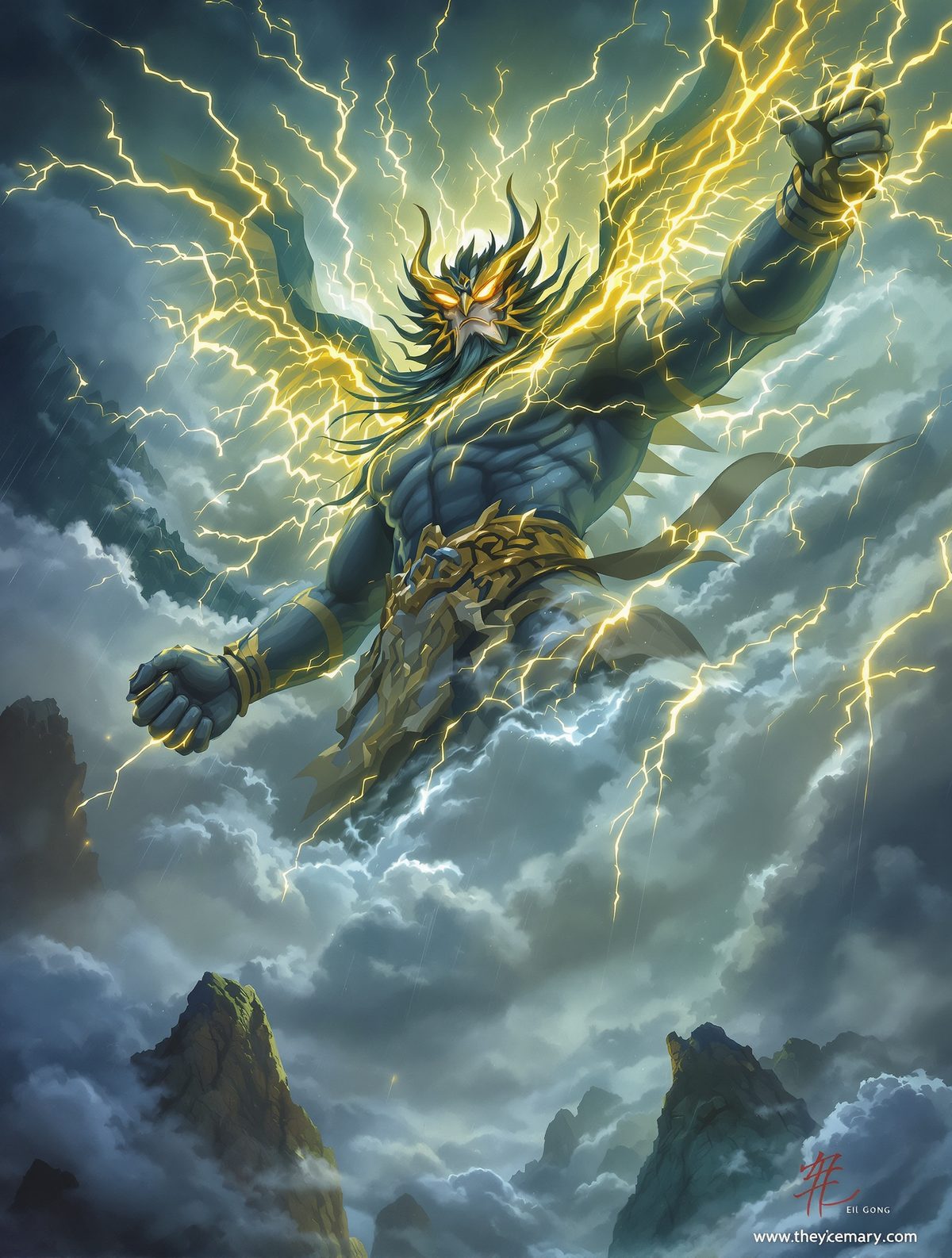
In the darkened sky, the echo of a drum rolls as if challenging the serene order of the heavens. Clouds gather in tumultuous whispers, and a flash illuminates the horizon. It is not simply a storm that approaches, but the righteous wrath of Lei Gong — the duke of thunder, on his ceaseless quest against wickedness. With the beak of an eagle and wings of a bat, his silhouette is that of fear carved against the rain-soaked skies. This is the timeless tale of justice that does not wait for the afterlife but crashes into the present with celestial judgment, rendering the guilty breathless beneath the weight of their own misdeeds.
The Birth of a Divine Enforcer
Lei Gong's origins, wrapped in the rich tapestry of Chinese mythology, are as electrifying as the stormy skies he commands. Ancient texts tell us that Lei Gong was first a human, whose unrelenting pursuit of justice earned the favor of the Jade Emperor himself. As the story goes, he was transformed into a god to serve as the celestial enforcer, a literal strike against evil, with a mission: to seek out those who disrupt the divine order and punish their misdeeds with uncompromising swiftness.
Crafted by the divine smiths of the celestial chambers, Lei Gong's drum resonated with the fervor of a thousand gales, while his chisel gleamed with the striking clarity of a judgment unclouded by mortal dilemmas. Empowered by the Jade Emperor, he descended from the heavens, moving as effortlessly as a shadow between worlds, judging mortals with the keen perception of one who has seen all that unfolds under heaven's gaze.
Instruments of Divine Retribution
Staring up at Lei Gong's storm, one would likely focus on the fearsome drum abutting the sky, a forgotten instrument turned weapon of consequence. According to ancient scholars, this was no ordinary drum. Its skin was stretched from the hide of celestial beasts, its framing forged from the branches of cosmic trees ritually pruned by deities themselves. When struck with his mallet, crafted from purest thunderous ore, it sent shockwaves of divine justice through the ether, splitting skies and rattling the very souls of wrongdoers.
But Lei Gong's arsenal was not complete without his sharp, all-seeing chisel. A tool crafted from star shards, it carved truth into the hearts of sinners, leaving no place for their evils to hide. This weapon of heavenly craft was not merely symbolic; it was said to be able to cleave even the most fortified consciences, ensuring that no wicked deed went unpunished.
The Myths, the Legends, the Lessons
In the annals of Chinese lore, Lei Gong plays a pivotal role, tasked with maintaining cosmic balance. The story of Wei Gu, a man who dared exploit his cunning for deceitful gain, is recounted often. As Wei Gu swindled the innocent, legend holds that Lei Gong's fury cascaded across the heavens, manifesting in a storm so violent that his truth could no longer be concealed. Lei Gong struck Wei Gu with the force of a thousand storms, obliterating his ill-gotten fortune, ensuring that divine justice never wavered, even amidst mortal chaos.
However, surprising tales of sympathy also circulate among scholars. In one particular narrative, an accused individual, who had been unjustly targeted by his peers, encountered Lei Gong. Yet, due to the purity of his spirit, Lei Gong paused, realizing the man's path was sincere. This unlikely kindness underscored the belief that Lei Gong's judgments were not only fierce but fundamentally fair.
Echoes of Thunder: Lei Gong in the Qing and Beyond
Lei Gong's significance thrived in society beyond fragile myths. Throughout the Qing dynasty, imagery and stories of Lei Gong were prevalent, a stern reminder to the populace of cosmic justice's watchful presence. Rituals invoked Lei Gong's might during trials, pleading for his insight against corruption and injustice, a practice that emphasized the enduring influence of Lei Gong's narrative throughout Chinese culture.
The arrival of modernization did not diminish Lei Gong's message. Instead, he morphed, finding a place within Chinese philosophy and moral discourse. Depictions in opera and art immortalize Leitian's relentless pursuit of justice, a bridge to discussions of social morality that continue to resonate in contemporary Chinese society.
Striking the Balance: The Legacy of Lei Gong
Why does Lei Gong's story endure? Perhaps not because we fear a thunderous judgment, but because his tale speaks deeply to humanity's innate longing for justice. In an era where morality seems subjective, Lei Gong teaches that there is an immutable force poised, like a lightning bolt, against the darkness.
Today, our understanding of right and wrong may shape-shift, yet the metaphorical essence of Lei Gong scrutinizes the wicked and champions those unjustly accused. As an embodiment of retribution and fairness, Lei Gong reminds us that true balance is less about the final judgment and more about the journey toward an equitable existence. In remembering Lei Gong's luminous mythos, we are called repeatedly to audit our own world, ensuring silence never reigns where thunderous justice is due.