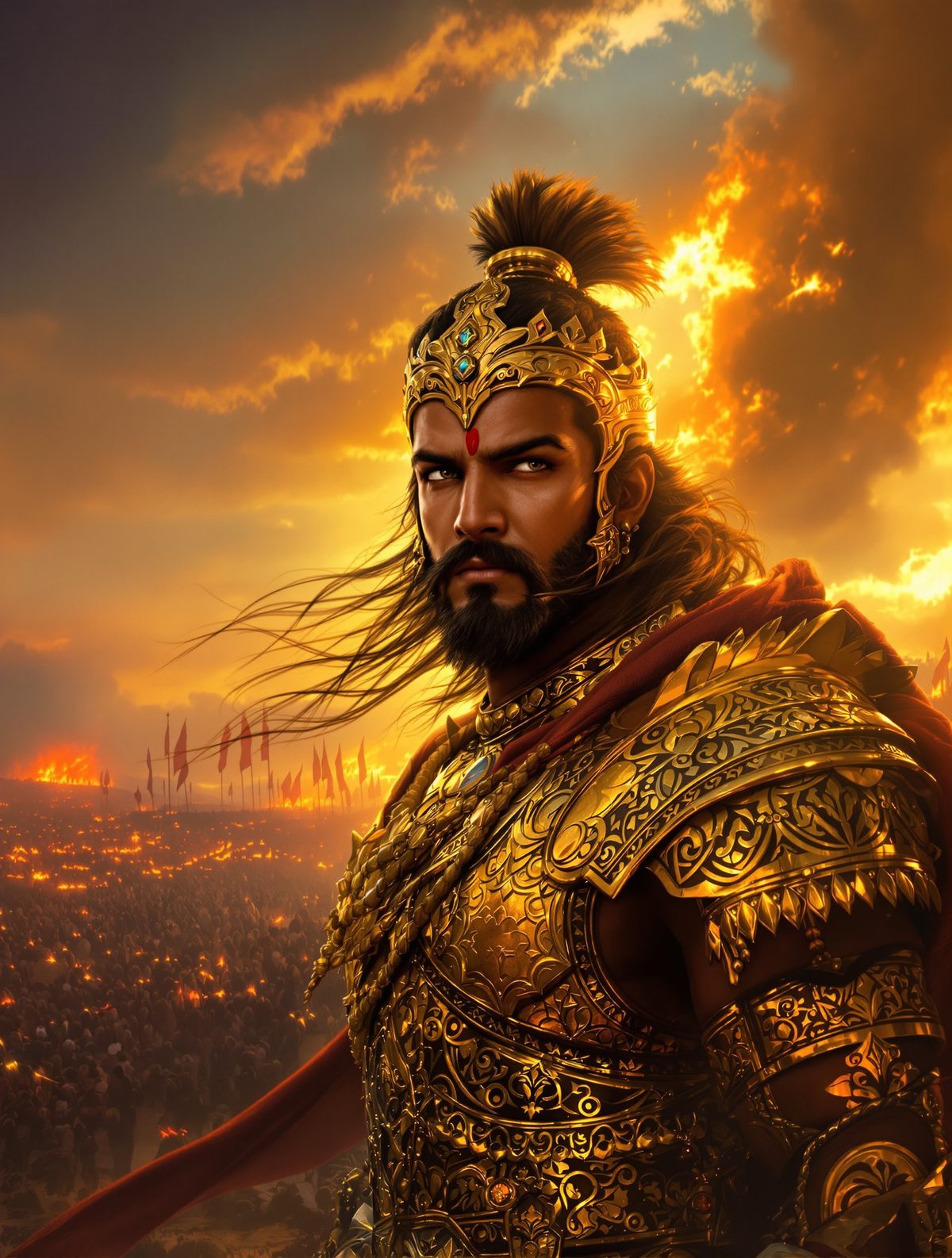
On a dusty battlefield beneath the gaze of an unforgiving sun, a lone warrior stands; his armor gleaming, his chariot ready to charge. He is Karna, the tragic hero of the Mahabharata, whose legend is whispered through the corridors of time but seldom given the glory it deserves. His story is one of greatness shadowed by secrecy and betrayal, unveiling the human virtues and vices that continue to resonate today.
The Hidden Birthright
Karna’s journey begins with a concealed birthright. Born as the eldest son of Kunti, a queen, and the sun god Surya, Karna’s sheer existence was a scandal cloaked in divine mystery. To preserve her honor, Kunti cast the infant afloat on the river in a basket—a theme reminiscent of baby Moses but played out in the rich, vibrant tapestry of ancient India. This decision set the course of Karna’s life, a journey veiled in deception and irony.
Raised by the humble charioteer Adhiratha and his wife Radha, Karna grew up yearning for a sense of belonging denied to him by the stars. The destiny written for kings was far from reach, yet his embedded kinship with warriors was uncompromising, like the pounding rhythm of the war drums he would later command. From childhood, Karna displayed an unparalleled mastery of archery, a skill that would etch his name among the greatest. Yet, his caste, a social shackle he couldn’t shake off, became the thorn in his side.
Denied a Kingdom
At Hastinapur, the city echoing with lore of heroism and bravery, young Karna made his first mark at a prestigious archery tournament. Like an eagle among sparrows, his skill was unmatched. But the jubilation of his deeds quickly soured. Dronacharya, the formidable teacher of the Pandavas and Kauravas, refused Karna the fruit of recognition, stripping him of the coveted title he so rightfully earned. In just a glance, he was cast aside by society as suta putra, the son of a charioteer, unfit to compete with noble blood.
This misjudgment didn’t wane Karna’s spirit; rather, it forged his resolve. Duryodhana, the ambitious Kuru prince, saw in Karna both an ally and a means to offset the Pandavas' supremacy. He seized the opportunity, anointing Karna as the King of Anga. With this allegiance, Karna found a brotherhood that accepted him, not for his birth, but for the blade of strength he wielded.
An Oath of Fealty
The interplay of loyalty and destiny would lead Karna to the battlefield of Kurukshetra. His allegiance to Duryodhana was absolute; he pledged his bow to the Kauravas, not knowing the faces across the field bore the likeness of his own blood. In vivid colors, the battlefield of Kurukshetra sprawled—a tapestry of chaos and valor that would decide the fate of Bharat.
Karna stood tall, wielding the celestial bow Vijaya, a gift from Lord Indra. The very ground trembled beneath the hoofs of his chariot, and the air sang with arrows streaking into the azure firmament. Yet, as karma interplayed with dharma, fate had woven an intricate trap. In an act of gods and men, Karna’s own armor and earrings, imbued with divine blessings, were relinquished to Indra, the father of Arjuna, Karna’s greatest rival.
Revelation and Regret
As the great war loomed, Queen Kunti sought out Karna, unveiling the truth of his birthright. With each word, she unburdened a secret that could crumble allegiances and shatter destinies. Karna, overwhelmed by profound revelation, was offered his rightful place among the Pandavas, his half-brothers.
Yet, Karna was bound by honor and friendship—an intriguing conflict of ethics that tugs at the heartstrings of righteousness and personal duty. Despite knowing the truth, Karna’s loyalty to Duryodhana was unyielding. It was too late for love and kinship to sway his path, leaving Kunti stranded in a web spun by her own choices.
The Final Stand
On the seventeenth day of battle, Karna met his ultimate fate. The earth, in vengeful mockery, swallowed his chariot wheel, and his mind, usually as sharp as the edge of his arrows, faltered between honor and victory. As he struggled to free himself, Arjuna—his brother and foe—struck him down under Krishna’s counsel, the lord whose cryptic wisdom often tread the fine lines of morality.
Karna died dishonored, his last breath escaping amidst dust and betrayal. Yet his story transcends mere heroics, casting him as a symbol of a complex era where glory was tangled with flaws. The moral fabric of the Mahabharata is woven with such tales, where dharma is seldom straightforward, and the hearts of men are etched with human imperfections.
The Legacy of Karna
The story of Karna resonates because it mirrors the conflicts faced by humanity across ages. It challenges our perceptions of right and wrong, urging us to look beyond the veneer of social markers and choices ordained by fate. Karna’s continuous struggle for acceptance speaks to a persistent reality where merit often grapples with prejudice.
His loyal sacrifice in the face of personal tragedy invites reflections on the complexities of identity and honor. These are not just ancient dilemmas; they echo in present times where individual potential and societal structures can be at odds. Understanding Karna compels us to reconsider the stories left out of our textbooks, to acknowledge the unsung heroes who, like Karna, stood steadfast amid the rolling tides of destiny.