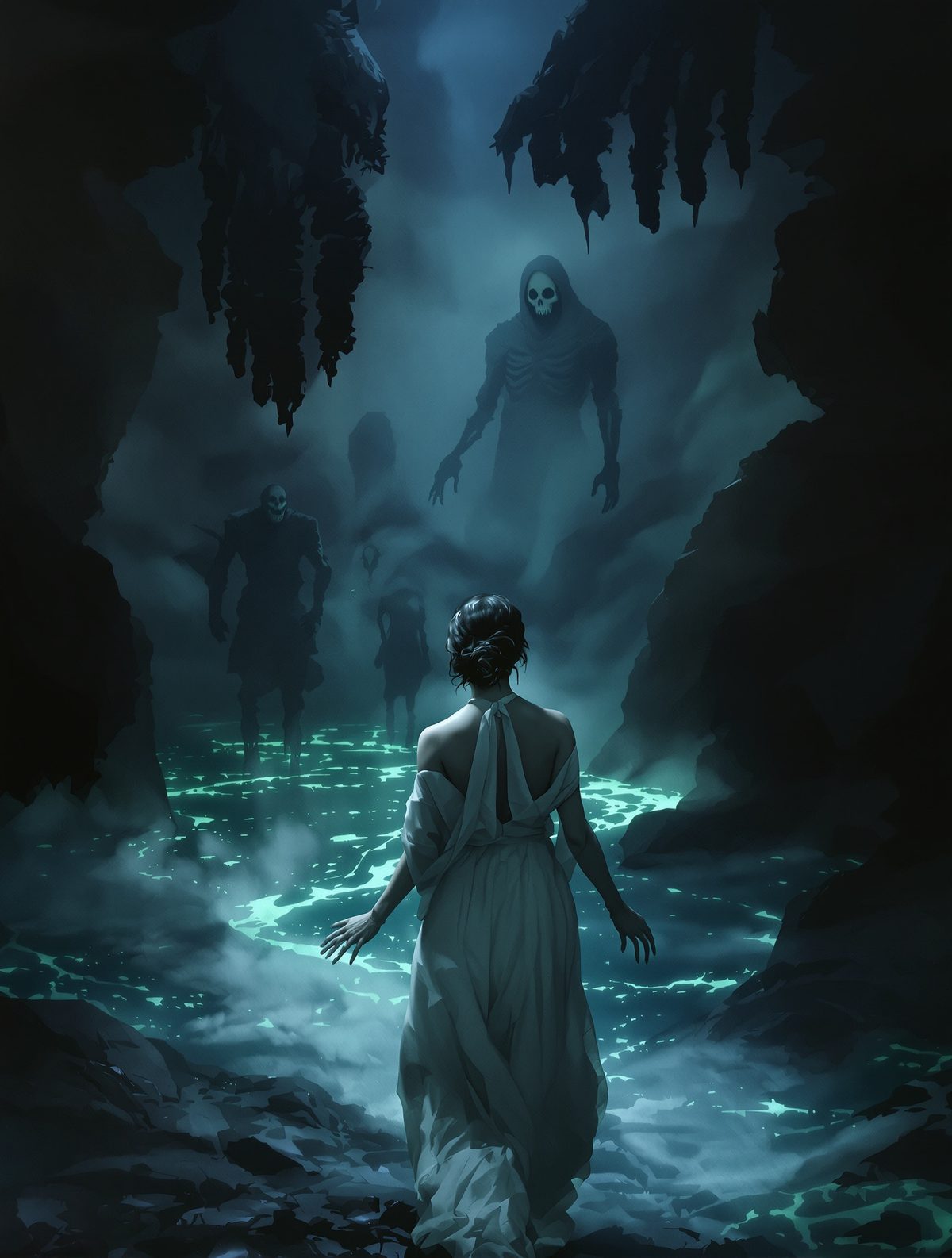
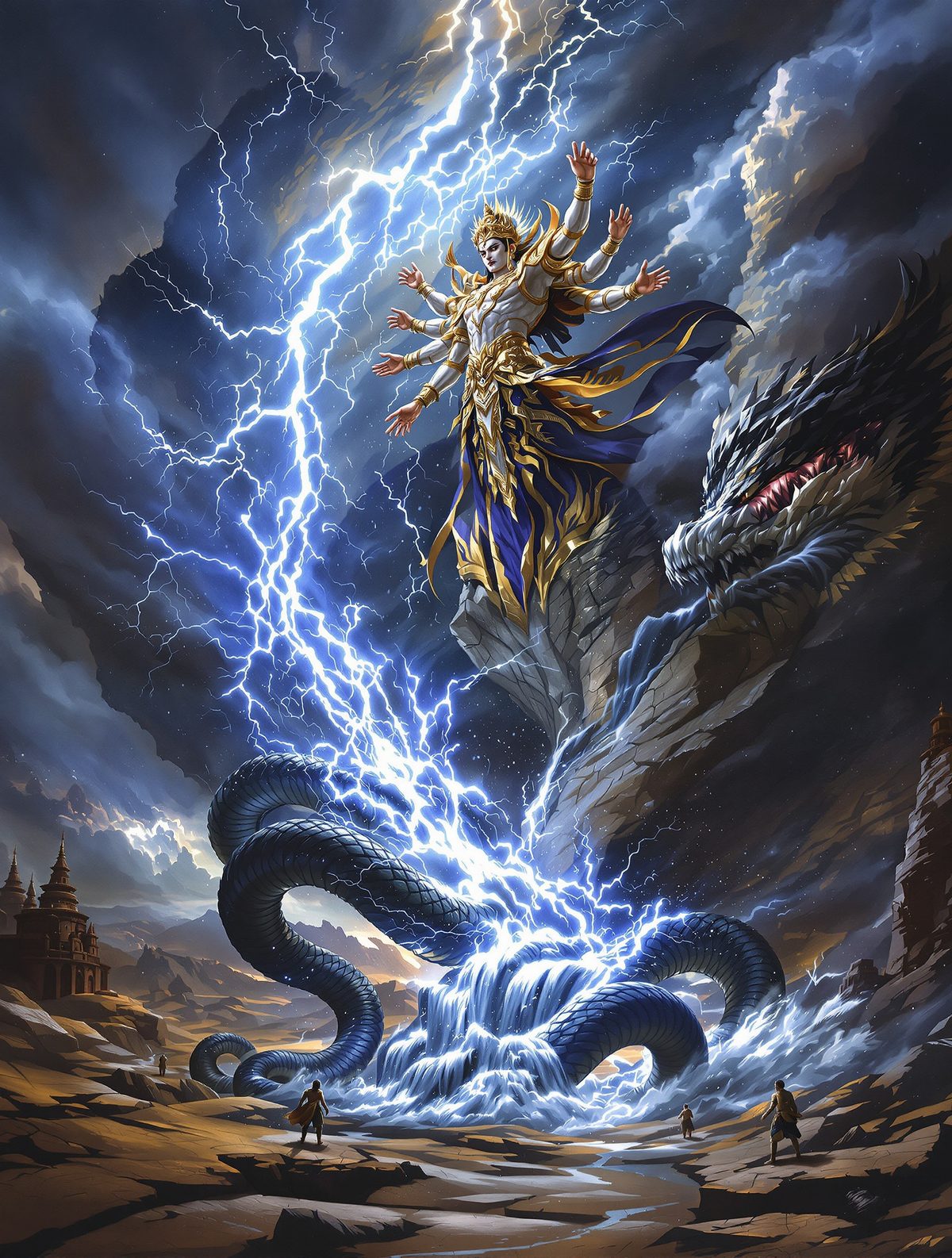
Imagine a world where the rivers and oceans have vanished. There's only an unending wave of cracked earth, a world gasping for rain. This was the dire reality in the ancient mythic realm of Hindu mythology, where the dreaded demon Vritra had devoured every drop of water, casting life into a desperate scramble for survival. But within this chaos walked Indra, the king of gods, wielding a weapon of unimaginable power — the bones of a sage forged into a thunderbolt. This is the legend they left out of the textbooks, where a battle of gods and demons determined the fate of our world’s life-giving waters.
The Rise of Vritra: A World Enveloped by Darkness
The epic saga of Vritra begins in the misty epochs of ancient India, within the mystical narratives of the Rigveda, the oldest of the sacred Vedic scriptures dating back to around 1500–1200 BCE. Vritra, the embodiment of drought and chaos, was a monstrous dragon with a body as endless as the night. He slithered into the world’s heart and coiled himself around every source of water. With a single, monstrous gulp, rivers vanished, leaving dry riverbeds in his wake, and oceans became ghostly valleys of dust.
This act of utter consumption was not merely physical. The absence of water threw the cosmos into disorder. The exuberant voices of the gods were silenced. Humanity stumbled into an age of thirst. Yet behind Vritra's fearsome power lay an origin as compelling as his destruction. It is said that Vritra was constantly at odds with the gods, a bane crafted from the depths of Brahman's creative faculty to test and balance divine power.
Indra's Divine Purpose: The Making of the Thunderbolt
As the ruler of the heavens, Indra's magnificence was embodied in the elements. He was the god of rain and thunderstorms, quintessentially linked to the fertility and prosperity of the Earth. But Vritra's conquest was a blight on his domain. Emboldened by desperation and the looming shadow of chaos, Indra embarked on a quest for a weapon formidable enough to conquer Vritra.
In his search, Indra approached the sage Dadhichi, revered for his meditative wisdom and ascetic strength. The sage selflessly agreed to give his own bones, understanding the chilling necessity for such a sacrifice. From these bones, Vishwakarma, the celestial architect, shaped the thunderbolt, Vajra. This was no ordinary armament; imbued with cosmic potency, it was an entity imbibed with the will of the divine.
The Cosmic Battle: Clash Between Light and Dark
The confrontation between Indra and Vritra was nothing short of cataclysmic. As they prepared for battle on the rocky plane of the heavens, the air crackled with electricity, and the firmament seemed to hold its breath. Indra, armored in luminous gold, advanced with the Vajra glimmering in his grasp — a lightning forged from sacrifice and determination.
The battle raged, a cacophony of thunder and roars that set the universe aflame. Indra charged, hurling the thunderbolt straight at Vritra. The clash between the weapon and the demon produced a cleaving sound so monumental that even time seemed to falter. In that instant of impact, Vritra split open, and the stranglehold on the waters released. Rivers burst forth with their ancient vigor, and the oceans roared back into existence, reclaiming the world they had once nurtured.
The Resurrection of Life: Water Returns to the Earth
The world inhaled as the waters cascaded and splashed against its surface. The rivers, like jubilant messengers, meandered across valleys and plains, nourishing the parched lands. Humanity rejoiced amid this rebirth, dancing in torrents of rejuvenating rain. Indra's triumph was not only a victory for the gods but a reaffirmation of life itself.
Interestingly, this myth not only illustrates the significance of balance in nature but hints at a deep recognition of how life is inherently cyclic, a perpetual dance of destruction and creation. The saga remains a template of resilience, illustrating that through sacrifice and courage, even the mightiest of oppressions can be overthrown.
The Legacy of Indra and Vritra: Why Myths Matter Today
In today's world, where environmental concerns and the sustainability of resources are pressing topics, the story of Indra and Vritra transcends its mythic origins. It becomes a parable of the battles we face with climate change, drought, and the sustainability of our natural resources. Just as in the days of ancient India, we are reminded that the power to alter our world lies within us — sometimes requiring sacrifice, collaboration, and the formidable bravery to defend our planet’s precious resources.
These legends, while steeped in divine and mystical realms, often offer us timeless lessons on the complexities of our human existence. The battle of Indra and Vritra, a vivid tapestry embroidered with thunder and dragons, serves us well beyond its mythic core — as a stark reminder of the preciousness of life-giving water and the eternal interplay between light and darkness.