
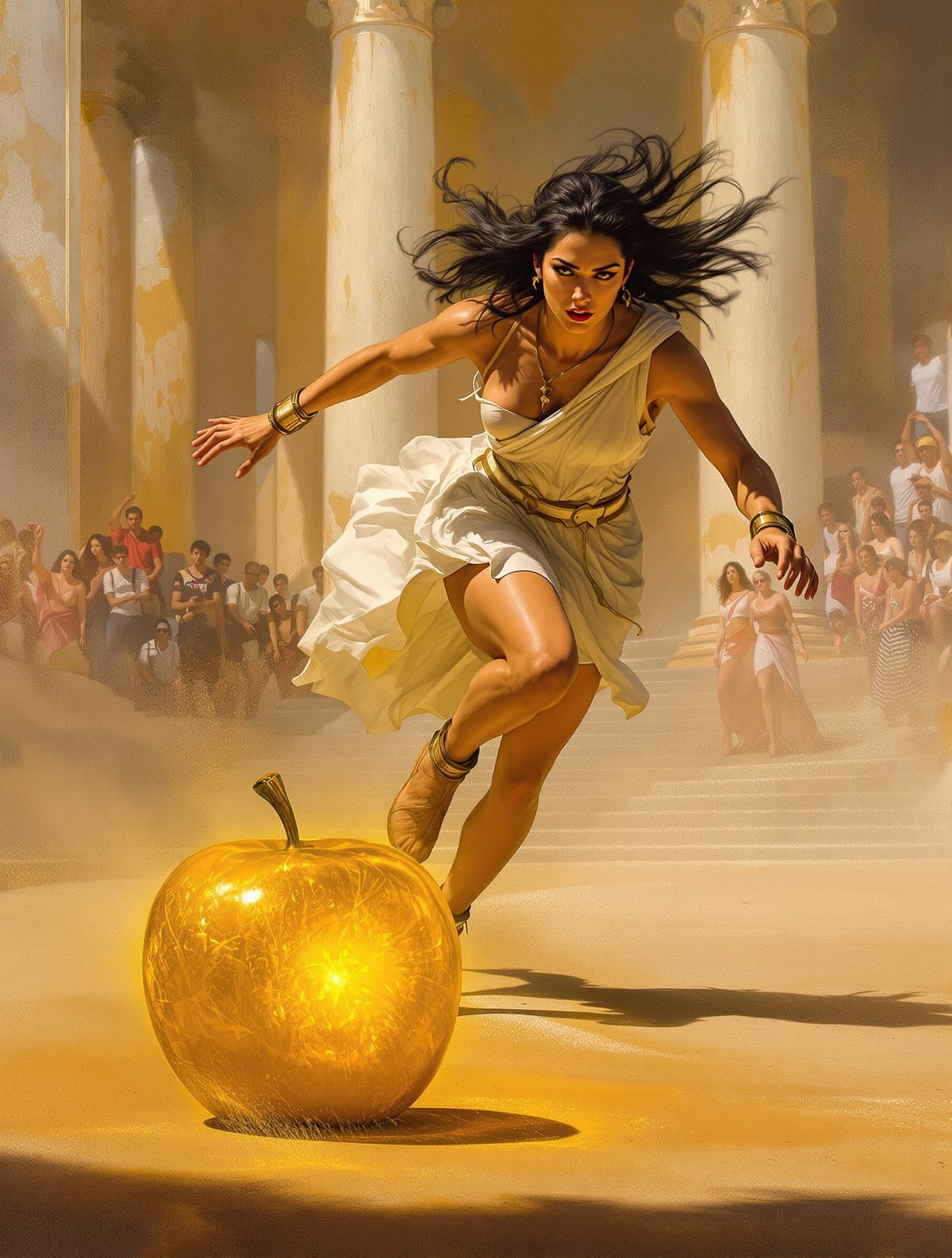
Among the myths and tales woven into the tapestry of ancient Greece, few stories capture the imagination quite like that of Atalanta's race with Hippomenes. This is a tale of speed, skill, love, and fate — a legend that has intrigued storytellers and historians for millennia, involving a deft mix of divine intervention and human ingenuity. Let's delve into the staggering journey of Atalanta, the swift-footed maiden who chose to lose to win something greater.
The Speed of a Huntress
In the burgeoning realms of myth, Atalanta emerged as one of the most extraordinary figures. Born to Iasus and Clymene of Arcadia, she was left exposed on a mountainside — a cruel custom of those times to dispose of unwanted daughters. Yet, Atalanta's destiny was unlike any other. A she-bear, meant to be her executioner, became her guardian instead, raising her with its young. As a result, Atalanta grew up in the wilderness, developing unparalleled strength and the speed of a coursing wind.
Renowned across the lands, she soon outpaced any mortal who dared challenge her. Her prowess wasn't reserved for the race tracks alone. She was also a famed huntress, noted for being the first to draw blood from the fearsome Calydonian Boar. Her fame spread wide and with it, the declaration — any man wishing her hand had to defeat her in a foot race. Fail, as many did, and face execution. It was a grim decree, befitting the wild spirit of Atalanta.
Enter Hippomenes: Love as a Competitive Sport
The legend introduced Hippomenes, known for his cleverness and, now, determination. Desperate not for Atalanta’s speed but for her heart, he devised a cunning plan. However, he knew his prowess was but a candle to her blazing comet. And so, he sought the favor of Aphrodite, the goddess of love, who sometimes took an unexpected interest in mortal affairs.
Aphrodite, amused, bestowed upon Hippomenes three golden apples from the sacred garden of the Hesperides — the domain said to hold the spice of eternity. Armed with these celestial gifts, Hippomenes set foot on the racing track. The spectators held their breath, fully aware that he was but a feather against Atalanta's storm.
The Race of Fate and Apples
The air was thick with anticipation. Onlookers gathered, whispers intermingling with the heartbeat of the earth. The starting signal cracked, and Atalanta bolted ahead like a released arrow. An observer might have thought the race over before it began. But Hippomenes had a strategy as unprecedented as it was ingenious.
At the midpoint, as Atalanta began to surpass him, Hippomenes tossed the first golden apple. Its shining allure caught Atalanta’s eye, and though hesitation was foreign to her nature, she paused. Intrigue? A momentary lapse? Whatever the reason, she stooped to retrieve it, allowing Hippomenes to regain some ground.
The second apple followed suit, casting a bright distraction against her path. Once more, Atalanta found herself in a rare dance of hesitation, her human desire momentarily overshadowing divine speed. Audience members gasped as she stopped yet again. Finally, nearing the race’s inevitable conclusion, the third apple skittered across the track. Atalanta, by now as intrigued as she was intent, reached for it — and in doing so, altered her fate.
Goddesses, Pawns, and Choices
Win or lose, from mountaintops to divine intercessions, Atalanta's life was a chess game played by gods. Yet was her loss orchestrated solely through divine trickery? Some myths argue otherwise — that, perhaps, Atalanta allowed herself these delays. Was it a game of the heart, recognizing in Hippomenes a kindred spirit, something more divine than victory? Such queries linger through ages untold.
There's a particular resonance in how Greek mythology blends fate with personal choice. This tale suggests that even the speediest feet might pause when faced with a challenge not of distance, but of destiny. Atalanta's choices, mirroring those faced by countless figures within Greek lore, reflect the push-pull of controlling one's fate against the whims of divine entities.
The Legacy of Legend
Ultimately, Atalanta's race with Hippomenes was about more than speed. It underscored themes of love, divine influence, and the power of choice. Whether she truly lost or chose to let go, Atalanta's legend invites contemplation about humanity's complex dance with fate and free will. In losing, she gained Hippomenes's love, marking a victory rooted not in the tangible but the emotional.
Today, the story of Atalanta and the golden apples continues to resonate as a symbol of human nature, challenging us to reflect on what we deem truly significant. Facing our own "golden apples," we might ask ourselves: What races do we win, and which ones do we choose to lose, for the sake of something greater than a trophy?