Before the gods, before the sun-kissed vistas of Midgard or the shimmering bridges of Asgard, there was nothing but the void—Ginnungagap, the daunting, primordial chasm. A realm of contrasts, the yawning abyss was flanked by Niflheim, the realm of ice and fog, to the north, and by Muspelheim, the land of fire and lava, to the south. In this stark and desolate universe, an unexpected tale began—one that would eventually lead to the birth of the Norse pantheon itself. This is the story of the cosmic cow and the emergence of Buri, Odin's grandfather, from a block of ice. Let's dive into this captivating myth that they left out of your textbooks.
The Silent World Between
In the haze of prehistory, a time existed when the ominous whispers of Ginnungagap held sway over existence. Though its name might sound foreboding, Ginnungagap played a far more crucial role than mere emptiness. It was the cauldron of creation, the threshold between the fiery south and the icy north, where drastic contrast brought about a dynamic equilibrium. Nestled within this void, the first seeds of life were sown, driven by ancient forces beyond the comprehension of mere mortals.
From the smoldering embers cast by Muspelheim came sparks that met the frigid air of Niflheim. This combination led to the birth of Ymir, the first giant—a colossal figure of ice and flame whose own body became a landscape from which later life would arise. But another occupant sprang forth from the elemental forces—a much humbler creature with a vital purpose.
Audhumla: The Cosmic Cow
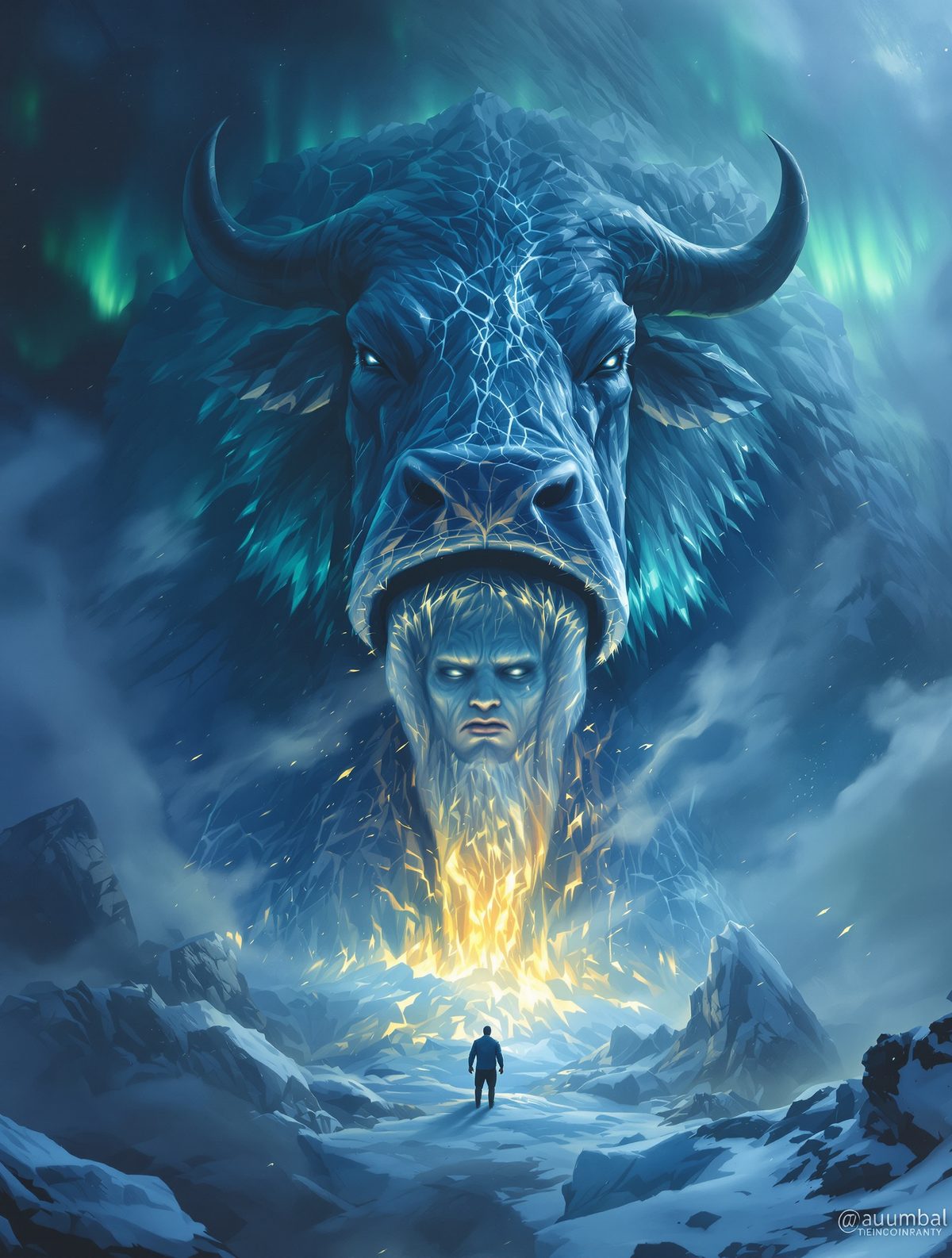
Enter Audhumla, the great primordial cow, whose origins are as mysterious as her appearance was unexpected. From the thawing ice of Niflheim, she emerged, the elements having crafted her form as if in defiance of Ginnungagap's silence. Oddly serene, this cosmic bovine was essential in sustaining the life that had begun to stir. Her udders produced four rivers of milk, offering sustenance to Ymir and ensuring his continued existence.
However, Audhumla’s role extended beyond mere nourishment. Drawn to the salt that crystallized within the frozen landscape, she began to lick at the blocks of ice around her. Never could she have known that with each languid stroke of her tongue, she was uncovering destiny itself.
The Emergence of Buri
In a process that spanned three days, a most extraordinary transformation began to unfold. On the first day, Audhumla's diligent licking revealed a man's hair. By the second, his head and facial features had become discernible, a visage of fortitude etched in ice. And on the third day, the ice shattered to fully unveil a man—Buri, the first being born from the salt-laden blocks nourished by her touch.
Buri's emergence marked a new chapter in the cosmos. Unlike Ymir, who was infamous for his voracious and chaotic nature, Buri seemed to exude a different kind of energy, one that would become synonymous with civilization, structure, and the future lineage of gods. In contrast to Ymir’s tendencies, Buri was harbored a wisdom and a tranquility that was as ancient as the void itself.
A Lesser-Known Lineage
Many might be familiar with Odin, Thor, and Loki—the grand heroic figures central to Norse sagas—but relatively few consider the tale of Buri, the distant patriarch of this mighty line. Buri beget Borr, who in turn became the father of Odin, Vili, and Ve. Buri's initial appearance could almost be overlooked as an incidental detail, yet his role as the progenitor of gods is paramount, setting the stage for the monumental sagas to come.
Buri's existence was indeed crucial, providing the genetic and symbolic continuity required to birth the Norse cosmos' pantheon of deities. While his time may seem shrouded in the frost of ancient memory, the foundations he laid would ripple through the mighty tapestry of creation.
Why This Matters Today
As curious creatures roaming this vast planet, our relentless quest for origins speaks volumes about who we are. The tale of Audhumla and Buri offers a glimpse into the rich narrative tapestry woven by peoples of old—a tapestry that captures their understanding of the world and the mythical etiology of existence.
In today's era of technology and progress, as we delve into the genetic codes and cosmic origins of our own universe, we ironically find myriad parallels in these ancient myths. Whether seen as metaphor or mythic lore, such narratives hold power as they grant meaning, order, and connection to our shared human experience across millennia.
As we ponder the cosmic cow tirelessly carving destiny with each lick of her tongue, perhaps we recognize a mirror to our own endeavors—endlessly chipping away at the ice-carven challenges of our own Ginnungagap, seeking to reveal the greater possibilities for humanity's path forward.
Thus, the awe-inspiring narrative of Ginnungagap’s first fire and the cow who licked Odin's ancestor free resonates beyond its ancient origins, as an enduring emblem of the potential lying frozen within the void, awaiting the patient hand of creation.