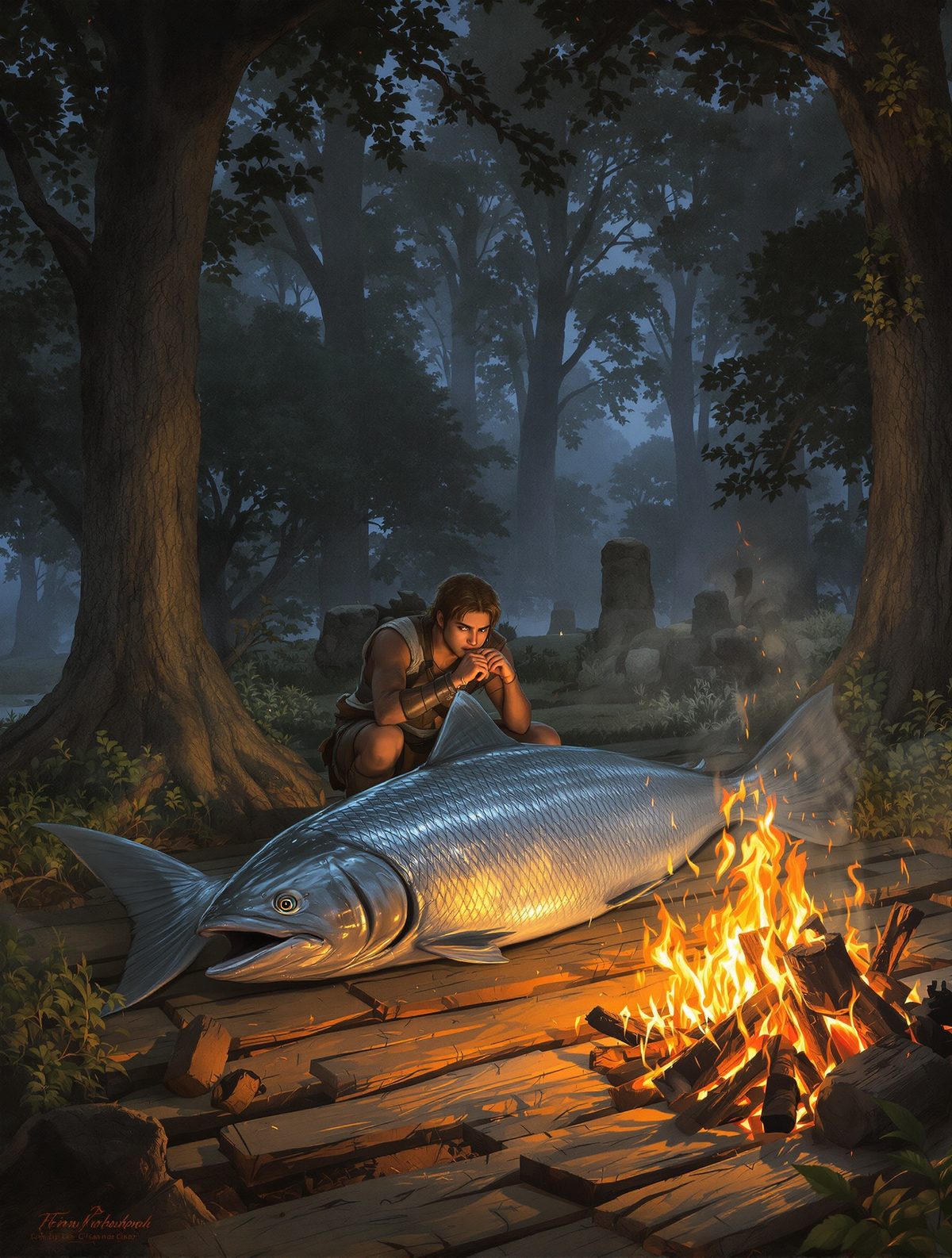
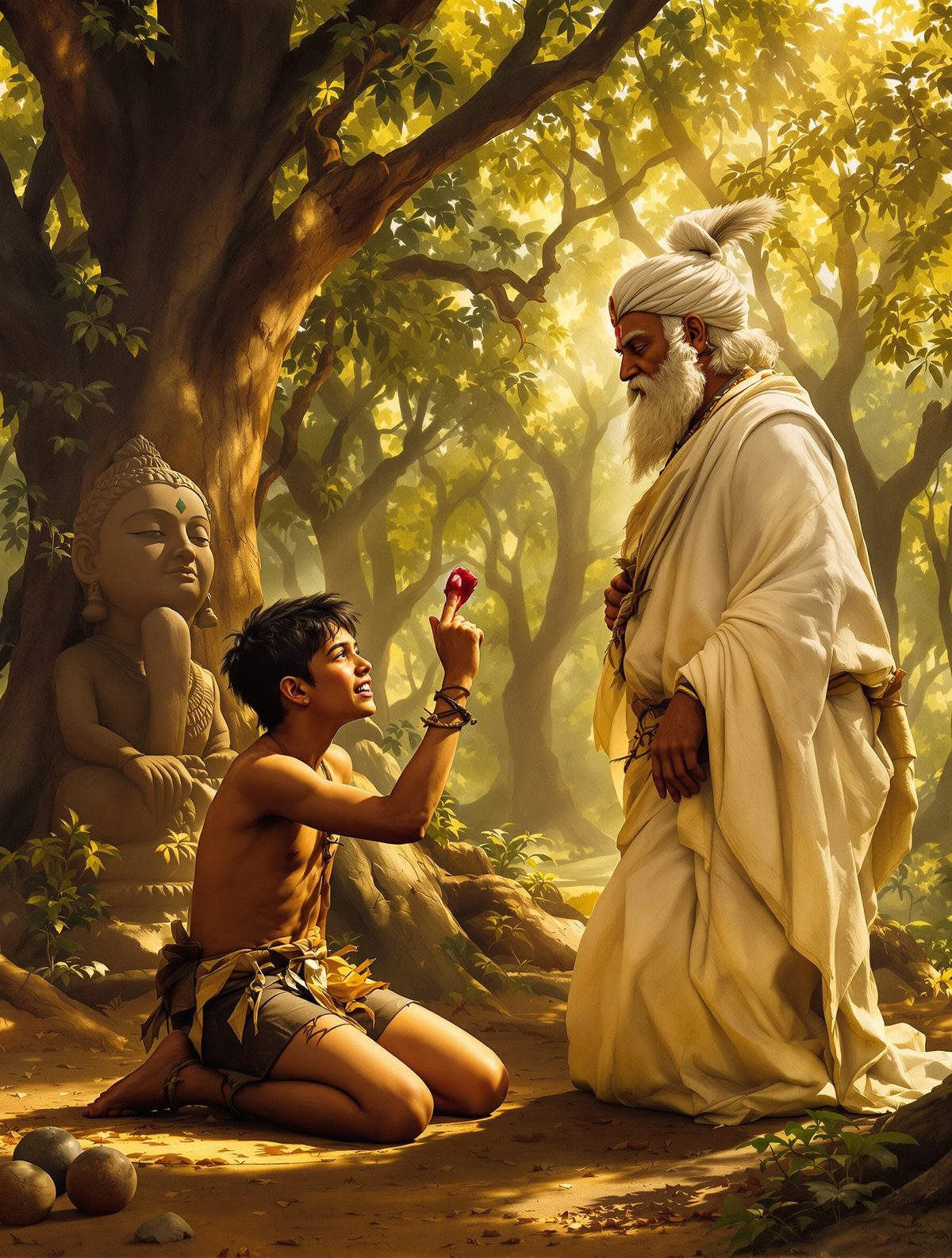
In the dense forests of ancient Hastinapura, where the morning mist clung to sal trees and the sound of bowstrings echoed through silent groves, a young tribal boy knelt before a clay statue with tears streaming down his face. In his right hand gleamed a sharp knife. In seconds, he would perform an act of devotion so extreme that it would echo through millennia—cutting off his own thumb to honor a teacher who had never spoken a single word to him.
This is the story of Eklavya, the archer whose love for his craft was matched only by his tragic loyalty. It's a tale that reveals uncomfortable truths about ancient India's social hierarchies, the price of unauthorized knowledge, and what happens when talent threatens to upset the established order.
The Forbidden Student
Eklavya was no ordinary boy. Born into the Nishadha tribe—forest dwellers who lived on the margins of Vedic society—he possessed an almost supernatural fascination with archery. While other children his age learned to track deer and gather forest herbs, Eklavya dreamed of something greater: mastering the divine art of dhanurveda, the sacred science of archery.
When word reached his village that the great Dronacharya had established a military academy in Hastinapura, young Eklavya saw his chance. Dronacharya wasn't just any teacher—he was the acharya (master instructor) to the Kuru princes, including the legendary Arjuna. His reputation stretched across the subcontinent as the greatest archery instructor alive, a man who could split arrows mid-flight and thread needles from impossible distances.
With hope burning in his chest, Eklavya made the long journey from his forest home to Drona's ashram. But when he approached the master and humbly requested to become his student, Drona's response was swift and brutal: no. The reason was simple yet devastating—Eklavya belonged to a tribal community considered outside the traditional varna system. In the rigid social hierarchy of ancient India, military arts were reserved for kshatriyas, the warrior caste. A forest dweller, no matter how eager or talented, had no place learning alongside princes.
The Clay Guru
Most young men would have returned home defeated, but Eklavya possessed something rarer than royal blood—an unbreakable will. If Drona wouldn't teach him directly, he would find another way. Returning to the forest, Eklavya did something extraordinary: he created a life-sized clay statue of Dronacharya and installed it in a small forest shrine.
What happened next defied every conventional understanding of learning. Each dawn, Eklavya would bow before his clay guru, offer prayers, and then practice archery with a devotion that bordered on the mystical. Hour after hour, day after day, season after season, he shot arrows at targets while visualizing Drona's teachings. He studied the flight of birds, the movement of leaves in wind, the way light filtered through branches at different times of day.
But here's what makes Eklavya's story truly remarkable: he developed techniques that even Drona had never taught. Through pure observation and intuition, he mastered shabdabhedi archery—shooting targets based solely on sound. He could fire multiple arrows in rapid succession with such speed that they seemed to leave his bow simultaneously. Most incredibly, he learned to shoot accurately while blindfolded, using only his other senses to guide his aim.
Ancient texts suggest that Eklavya's self-taught regimen was more rigorous than anything practiced at Drona's formal academy. While the princes had rest days, festivals, and courtly duties, Eklavya practiced from sunrise to sunset, every single day, for over seven years.
The Prince and the Dog
The collision between these two worlds came through pure chance—and a hunting dog. One day, while the Pandava princes were on a hunting expedition in the forest, their dog wandered away from the group. The animal stumbled into Eklavya's practice area and began barking, disrupting the archer's concentration.
What Eklavya did next would have been impossible for any ordinary archer. Without harming the dog, he fired seven arrows in rapid succession, filling the animal's mouth and effectively muzzling it. The arrows were placed so precisely that they sealed the dog's mouth shut without drawing a single drop of blood or causing any pain.
When the princes found their dog in this condition, they were thunderstruck. Arjuna, who had been assured by Drona that he would become the greatest archer in the world, stared at the arrows in disbelief. The precision required for such a shot was beyond anything he had witnessed—even from his beloved teacher.
The princes immediately began searching the forest for this mysterious archer, and when they discovered Eklavya practicing before his clay statue of Drona, their amazement turned to something more complex. Here was a forest dweller who had somehow surpassed the finest royal training without any formal instruction.
The Guru's Impossible Demand
When Drona learned about his unauthorized student, his reaction was swift and calculating. Accompanied by the princes, he traveled to Eklavya's forest shrine. What he found there must have filled him with conflicting emotions: pride at seeing his teachings (albeit self-interpreted) taken to such heights, and alarm at the implications for the social order he served.
Eklavya's reaction to seeing his idol come to life was pure joy. He prostrated himself before Drona, touched the master's feet, and declared himself Drona's disciple. "Everything I have achieved is due to your grace, Guruji," he said, gesturing toward the clay statue. "I am your student."
In that moment, Drona made a decision that would define both their legacies. Legally, if Eklavya was truly his student, then Drona was entitled to guru dakshina—the traditional payment owed by a disciple to his teacher upon completing his education. And Drona knew exactly what to ask for.
"If you are truly my student," Drona said, his voice steady, "then give me my guru dakshina. I want your right thumb."
The demand was diabolical in its precision. The thumb is essential for drawing a bowstring—without it, even the greatest archer becomes helpless. Drona was effectively asking Eklavya to destroy his own extraordinary ability.
The Cut That Echoes Through Time
What followed was perhaps the most heartbreaking act of devotion in all of Indian literature. Eklavya didn't hesitate for even a moment. Without questioning, without bargaining, without even a flicker of doubt crossing his face, he drew his knife and severed his right thumb. The blood fell onto the forest floor as he placed the thumb at Drona's feet.
"Here is your guru dakshina, my lord," Eklavya said simply.
Ancient texts describe how even Drona was shaken by this display of absolute devotion. Arjuna, witnessing the sacrifice, felt a complex mixture of relief and shame. The threat to his promised supremacy was gone, but at a cost that would haunt him forever.
But here's a detail that often gets overlooked: Eklavya didn't stop practicing archery. Despite losing his thumb, he adapted his technique and continued shooting, though never again with his former supernatural skill. Some later texts even claim he learned to shoot with his left hand, becoming formidable once again.
The Uncomfortable Mirror
The story of Eklavya's thumb forces us to confront uncomfortable questions that resonate even today. What happens when natural talent challenges institutional privilege? How do we balance loyalty to teachers with personal ambition? What is the true cost of preserving social hierarchies?
Drona's demand wasn't just about archery—it was about maintaining a world where princes could be assured of their superiority, where birth mattered more than merit, where the "right" people stayed on top. Eklavya's extraordinary skill threatened that order not through rebellion, but through simple excellence.
Yet the story also reveals the complex nature of ancient Indian society. While it critiques caste-based discrimination, it simultaneously celebrates the ideal of absolute devotion to one's guru. Eklavya becomes both a victim of social injustice and a paragon of spiritual surrender.
In our modern world of meritocracy and equal opportunity, we might see Eklavya as a tragic figure whose potential was brutally curtailed. But we might also see him as someone who understood that true mastery sometimes requires sacrifice—not just of comfort or time, but of the very thing we most cherish. His thumb became his offering, his limitation became his liberation, and his loss became his immortality.
Every time we face a choice between personal advancement and honoring those who shaped us, every time talent meets privilege at an uncomfortable intersection, every time devotion demands the impossible—Eklavya's story returns to ask us what we're willing to give up for what we believe in most.