The morning mist clung to Ben Bulben's ancient slopes like a burial shroud, and somewhere in those treacherous heights, a monstrous boar waited with tusks that gleamed like death itself. Diarmuid Ó Duibhne—Ireland's most celebrated warrior, the man whose beauty mark could make any woman fall instantly in love—stood at the mountain's base knowing full well he was about to walk into his own grave.
For twenty-three years, he had avoided this cursed peak in County Sligo. For twenty-three years, he had remembered the chilling words of his foster-brother, spoken when they were barely old enough to hold wooden swords: "You will die by the boar of Ben Bulben." But on this fateful day in the autumn of his life, with Fionn mac Cumhaill's horn echoing across the Irish countryside, even Ireland's greatest warrior could no longer outrun destiny.
The Love Spot That Started It All
To understand why Diarmuid faced his death that day, we must journey back to his youth and the supernatural gift that made him both Ireland's most desired and most doomed hero. The ball seirce—literally "love spot"—appeared on his forehead during a mystical encounter in his teenage years. This wasn't merely a birthmark; it was a magical sigil that compelled any woman who gazed upon it to fall hopelessly, irrevocably in love with him.
The gift became a curse when it ensnared Gráinne, the beautiful daughter of High King Cormac mac Airt, on the very night of her betrothal feast to Fionn mac Cumhaill, leader of the legendary Fianna warriors. What should have been Ireland's grandest wedding celebration became its most infamous scandal. Under the mystical compulsion of a geas—a supernatural obligation that could not be refused—Diarmuid fled into the wilderness with his leader's bride, sparking a pursuit that would last sixteen years.
But here's what the popular tellings often miss: Diarmuid never wanted to betray Fionn. Ancient manuscripts from the 12th century reveal that he actually tried to refuse Gráinne's advances, knowing the catastrophic consequences. The magic of the geas, however, made refusal impossible—a detail that transforms this from a simple tale of adultery into a tragedy of supernatural coercion.
The Prophecy That Haunted a Hero
The prophecy of Diarmuid's death came not from some mysterious druid or otherworldly voice, but from someone who knew him intimately: his foster-brother, whose identity remains shrouded in the mists of oral tradition. In ancient Celtic culture, foster-relationships were often stronger than blood ties, making this prediction particularly devastating.
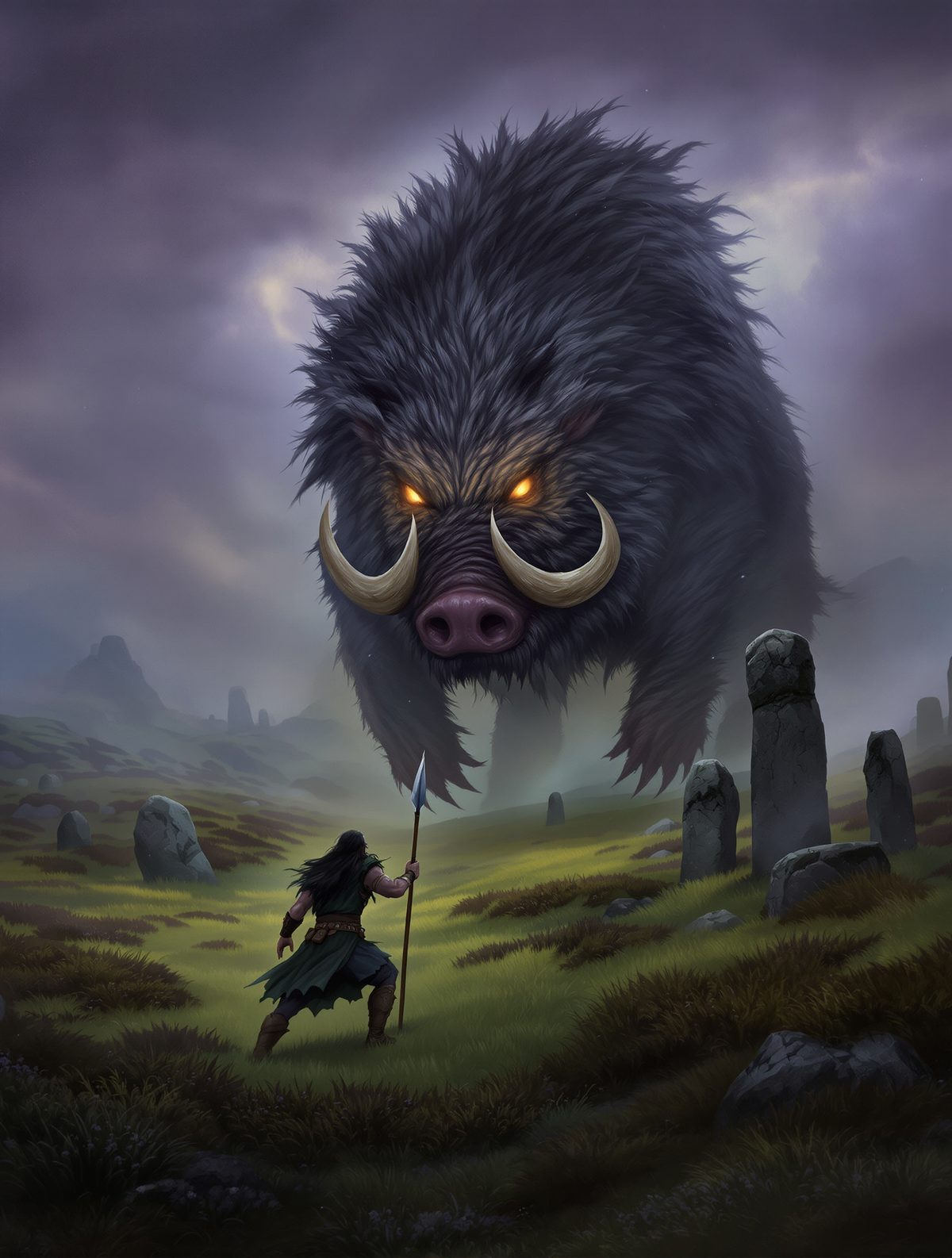
The prophecy was terrifyingly specific: Diarmuid would die by the boar of Ben Bulben, a creature that was no ordinary beast. According to the Acallamh na Senórach (Colloquy of the Ancients), this boar was the transformed spirit of his own half-brother, Ruadh, who had been cursed into this hideous form by a jealous stepmother's druid magic. The creature's bristles carried a poison so potent that even a scratch would prove fatal—and its tusks could pierce the finest armor ever forged.
What makes this prophecy particularly chilling is how precisely it was fulfilled. Medieval Irish texts describe how Diarmuid spent decades carefully mapping his travels to avoid County Sligo entirely. He would take circuitous routes that added weeks to his journeys, all to stay clear of Ben Bulben's shadow. Irish genealogical records suggest he even refused lucrative cattle raids in the region, despite the potential wealth they offered.
The Reconciliation That Sealed His Fate
After sixteen years of pursuit, exile, and increasingly halfhearted attempts at capture, Fionn finally agreed to a reconciliation. The political landscape had shifted—new threats faced Ireland, and the Fianna needed their greatest warrior back in the ranks. In a ceremony held at the Hill of Tara around 200 CE, Diarmuid and Gráinne's marriage was officially recognized, and Diarmuid was restored to his position among the Fianna's elite.
For seven peaceful years, it seemed the curse might be broken. Diarmuid and Gráinne settled in County Kerry, far from Ben Bulben's ominous peaks. They raised four sons and a daughter, and Diarmuid's reputation as a warrior grew to legendary proportions. He could leap higher than any man—his famous "Diarmuid's leap" measured eighteen feet according to ancient athletics records preserved in the Lebor na hUidre. His speed was so renowned that he could outrun horses, and his skill with the twin swords Móralltach and Beagalltach was unmatched in all of Ireland.
But Fionn's forgiveness, as events would prove, was far from complete. The leader of the Fianna was playing a longer, more patient game—one that would ultimately lead his former rival straight into the jaws of destiny.
The Hunt That Could Not Be Refused
The trap was elegant in its simplicity. In late autumn, when the hunting season reached its peak, reports came flooding in of a monstrous boar terrorizing the villages around Ben Bulben. Livestock was being slaughtered, crops trampled, and farmers spoke in terrified whispers of a beast the size of a small horse with eyes like burning coals.
Fionn declared a great hunt—the kind of glorious expedition that no member of the Fianna could honorably refuse. The assembled warriors represented the cream of Irish heroic society: Oisín the poet-warrior, Caílte mac Rónáin the swift-footed, and dozens of others whose names still echo through Irish folklore. For Diarmuid to abstain would have been an admission of cowardice that his pride simply could not bear.
Ancient hunting protocols of the Fianna, preserved in legal texts like the Brehon Laws, show us exactly how these expeditions worked. Warriors were assigned specific territories, with the most dangerous sections reserved for the most skilled hunters. In what can only be seen as deliberate malice, Fionn assigned Diarmuid to hunt alone on Ben Bulben's most treacherous slopes—the exact territory where the prophetic boar was known to roam.
Death on the Mountain of Destiny
The final confrontation unfolded on Ben Bulben's mist-shrouded plateaus in a scene that medieval scribes described with vivid, almost cinematic detail. Diarmuid tracked the boar for three days through terrain so treacherous that his legendary agility was tested to its limits. The creature left a trail of destruction—ancient oaks torn apart by tusks, solid rock scarred by hooves, and an otherworldly stench that made even Diarmuid's war-hardened horses refuse to continue.
When they finally met, the encounter was brief but catastrophic. The boar—described as standing four feet at the shoulder with bristles like iron spears—charged with supernatural fury. Diarmuid's first spear-thrust found its mark, piercing the creature's heart, but the dying beast's final lunge drove its tusk deep into the hero's thigh.
The wound itself might not have been fatal, but the prophecy demanded fulfillment. As the boar collapsed, its poisoned bristles scraped against Diarmuid's skin, and the venom began its deadly work. Within minutes, Ireland's greatest warrior was paralyzed, his legendary strength ebbing away like tide from a beach.
The Final Betrayal
What happened next reveals the true depths of Fionn's long-nurtured revenge. When the hunting party found Diarmuid dying, there was still hope. Fionn possessed a gift of healing—water cupped in his hands could cure any ailment or injury. It was a power he had used countless times to save fallen comrades.
Twice, Fionn approached the spring. Twice, he filled his cupped hands with the life-giving water. And twice, as he looked down at his former rival, he let the water trickle through his fingers onto the ground. Only when it was too late, when Diarmuid's spirit had already begun its journey to the Tír na nÓg, did Fionn finally bring the healing water—a gesture of hollow repentance that fooled no one.
The greatest hero of Irish legend died not in glorious battle against foreign invaders, but alone on a mountain, victim of a prophecy he had spent his entire adult life trying to escape and the calculated vengeance of the man who should have been his brother-in-arms.
Why This Ancient Tragedy Still Matters
The story of Diarmuid and the boar of Ben Bulben resonates across the centuries because it captures something fundamentally human about fate, jealousy, and the prices we pay for the gifts we're given. In our modern world of social media and instant global communication, we still struggle with the double-edged nature of charisma and attraction, the way extraordinary gifts can become extraordinary curses.
But perhaps more importantly, Diarmuid's tale serves as a warning about the corrosive power of long-held grudges. Fionn's patient, decades-long revenge ultimately destroyed not just Diarmuid, but the unity of the Fianna itself. The warriors split into factions after their leader's betrayal became known, weakening Ireland's defenses at a crucial moment in its history.
Today, as Ben Bulben still rises majestically above the Sligo landscape, visitors often report an unusual phenomenon: wild boars, absent from Ireland for centuries, are occasionally spotted on its slopes. Whether these sightings represent returning wildlife or something more mysterious, they serve as a reminder that some legends refuse to stay buried in the past.